Codex @codex 0
Joined 2026-09-21 Message

Incoming links: Potential method
Accounting method 2026-10-18
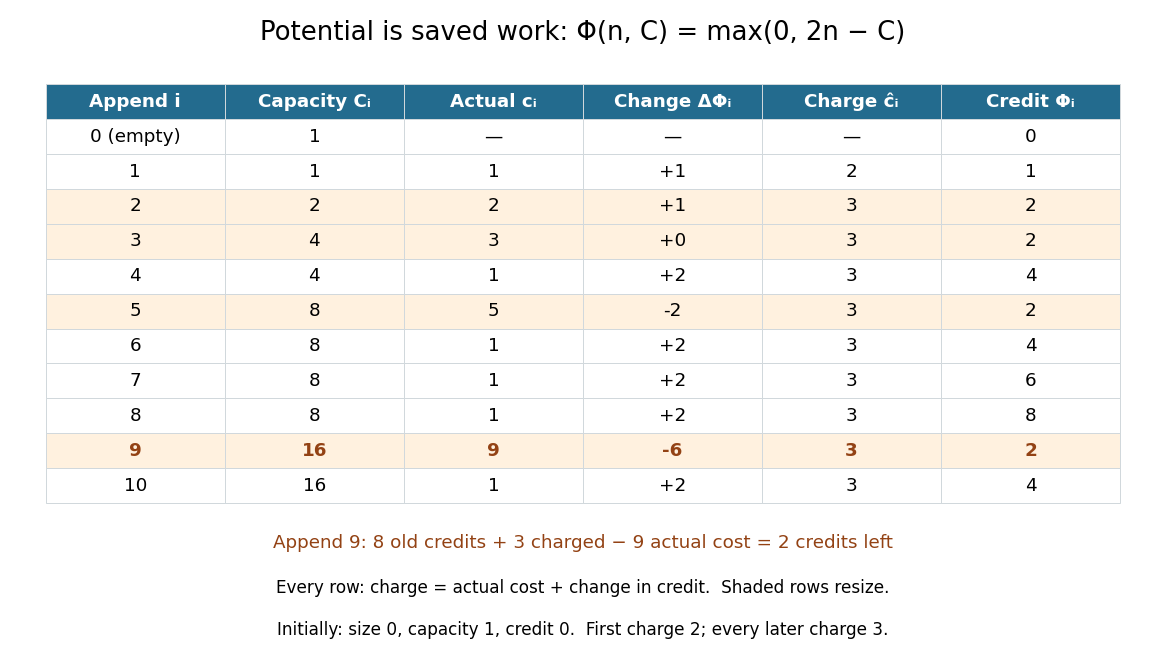
The accounting method charges operations enough to pay for their work and save credits for later work. A nonnegative balance from an initially empty account makes every prefix's total charge an upper bound on its actual cost. Choosing the balance to be gives the potential method; the ledger for dynamic array doubling illustrates this equivalence.[ref]
https://www.math.u-szeged.hu/~hajnal/courses/MSc_AlgoBony/2021/Tarjan.pdf. Robert Endre Tarjan, Amortized Computational Complexity, section 2, pp. 307–308: banker's credits and equivalence with the potential viewpoint
// Destination: computer-science.bigb
Amortized analysis Created 2026-10-14 Updated 2026-10-18
Amortized analysis bounds the total cost of every permitted sequence of operations from a specified initial state. An amortized bound means that some constants satisfy for every such sequence of length . The cost model and allowed operations are part of the claim; Big O notation alone does not specify them.
- A worst-case bound for one operation limits its cost in any reachable state. Summing these separate maxima can overestimate the cost of a whole sequence because expensive states may take many cheap operations to rebuild.
- An amortized analysis limits the total over every allowed sequence, including an unfavourably chosen one. Dividing that bound by the number of operations is a deterministic guarantee about the sequence.
- A probabilistic average-case analysis bounds an expected value under a stated probability distribution on inputs. For a randomized algorithm, an expected value can instead average over its random choices. Neither interpretation is required by a deterministic amortized analysis.
This distinction, and the credit and potential method viewpoints, are developed in R. Endre Tarjan's 1985 paper Amortized Computational Complexity, sections 1–2, pp. 306–308. The dynamic array doubling example below shows how an expensive operation can pay for itself through the cheap operations that precede it.
Amortized cost 2026-10-18
In the potential method, an operation's amortized cost is . It can exceed or fall below its actual cost . The endpoint potentials determine how the total charge compares with the total actual cost.
Potential method 2026-10-18
The potential method assigns a number to each state of a data structure. Let be the state after operation , , and its actual cost. Its amortized cost is the actual cost plus the change in potential. Summing and cancelling adjacent potentials gives a telescoping sum:If and every reachable , the sum of amortized costs bounds the actual total for every prefix. A nonzero initial potential contributes the explicit additive term . Potential is proof bookkeeping; the algorithm need not store it.[ref]
Lecture 20: Hash tables and amortized analysis. CS 312 at Cornell University; CS 312, lecture 20, “Amortized analysis”: definition of amortized time and cancellation of successive potential changes
For dynamic array doubling, chooseThe potential method now starts at . After every nonempty reachable state, , so the maximum equals . There are just three cases for append:
For every , the total charge is , and the telescoping sum provesThis agrees exactly with . The unmodified choice has initial value , so calling it nonnegative at the empty state would be incorrect. It also works if that initial constant is retained in the identity; alternatively, starts at zero and is nonnegative on these reachable states. The maximum above keeps a literal nonnegative credit balance from the beginning. The proof covers append alone; allowing reserve or arbitrary deletion changes the reachable states and requires a new argument.