For a three-light-flavor example, take up quarks, down quarks and strange quarks with the following additive quantum numbers. Here denotes electric charge in units of the positive elementary charge , is baryon number, is strangeness, is the third component of isospin, and is flavor hypercharge. An antiquark reverses all five displayed values. These are flavor coordinates, not spatial coordinates or electroweak hypercharge.
Adding these columns immediately explains familiar hadrons. A proton with valence quarks has and ; a neutron with has and . A positive kaon with has , and . Thus the same constituent rules describe both baryons and mesons.
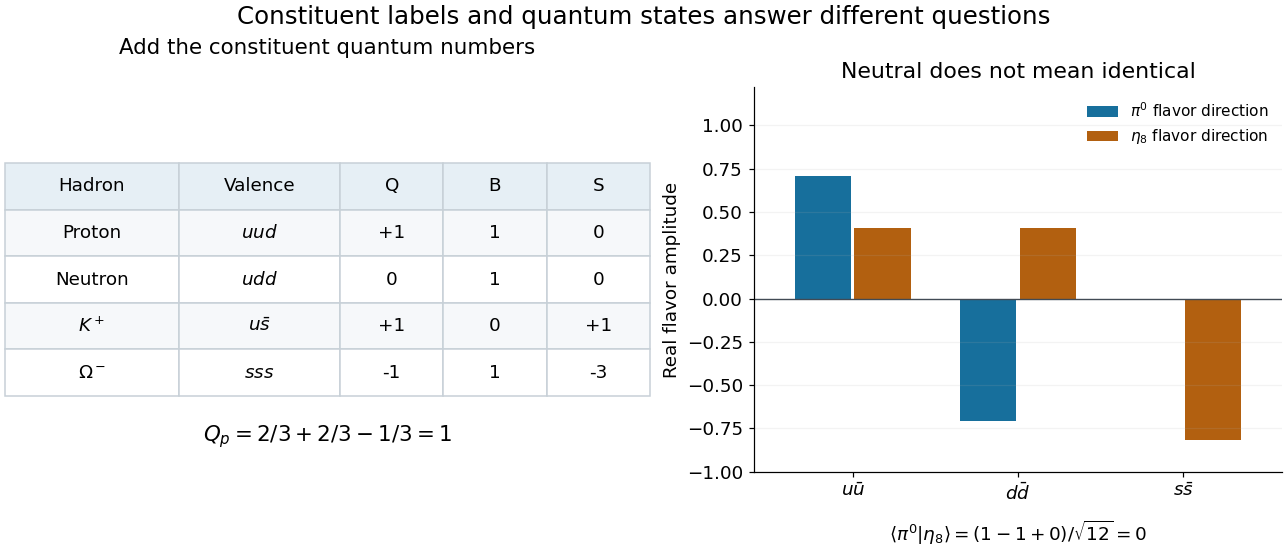
Adding constituent quantum numbers distinguishes charged and neutral hadrons
. Original arithmetic examples for the three-light-flavor quark model. The lower panel contrasts two orthogonal neutral flavor combinations: identical total electric charge does not make two states identical. These are ideal flavor basis states, not a mass fit or a reconstruction of an experimental event. Details.
Two hadrons can have identical additive labels while differing in their internal state. The Lambda baryon and neutral Sigma baryon both have valence content , yet their total isospin differs. Likewise, the neutral pion flavor direction and the Eta octet state both have , but their inner product vanishes. Expanding that inner product gives . Constituent counting must therefore be supplemented by quantum superposition and the symmetry of the state.
A particularly economical example is the baryon decuplet. Restrict to fully symmetric three-quark flavor states. The nonnegative occupation numbers satisfy , giving possibilities by stars and bars. Their additive labels areThese formulas follow directly from the constituent table. With fixed , there are possible values of , so the weight diagram has rows of four, three, two and one states. Its outer triangle is therefore a consequence of the constituent construction, rather than an arbitrary drawing convention.
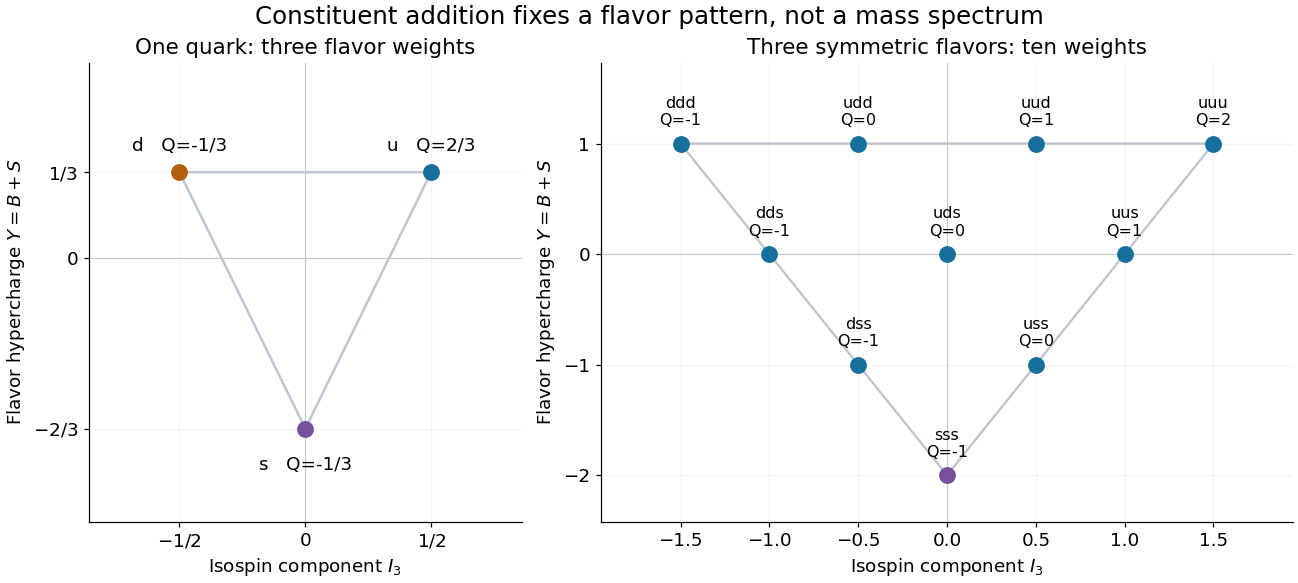

The bottom corner has , hence , and : the Omega baryon position. The top-right corner has and , corresponding to the doubly charged Delta baryon. Every point satisfies the Gell-Mann--Nishijima formula .
The flavor construction is only part of the state. The Pauli constraint on three-quark flavour multiplets also involves spin angular momentum, the spatial wavefunction and color charge. In particular, three identical fermions cannot be assigned a completely symmetric total state merely because the flavor diagram is symmetric. Nor does the same flavor diagram determine the hadron masses: an approximate flavor symmetry can organize a spectrum without making all its members degenerate.
Articles by others on the same topic
There are currently no matching articles.