The infinite form of Ramsey's theorem says that if the -element subsets of an infinite set are finitely colored, then some infinite subset has all its -element subsets in one color.
Take increasing even for which every ordered four-index expression has one colour. The Ramsey theorem for r-sets supplies them. Set and . Then both and use the same ordered coefficient pattern , so their union is monochromatic. The shared half-prefix makes the unweighted pair family possible without asking the two families to use the same generating sequence.
For finitely coloured -element subsets, choose successive least points and use the inductive -set theorem to thin the remaining reservoir after each choice. Every tuple with that least point then has one assigned colour. The infinite pigeonhole principle retains infinitely many least points with the same assigned colour, giving an infinite homogeneous set. The base case is the same pigeonhole principle. This proves the Ramsey theorem for r-sets for all finite .
Fix positive integers with . There is an integer , depending only on , such that every finite coloringhas a subset of size for which the restriction of a function to is a constant function. Here , and denotes the collection of all -element subsets of , rather than its binomial coefficient cardinality. The notation abbreviates this property. Thus is a homogeneous set for a colouring; when , the monochromatic set consists of its -element subsets, not its individual elements. This is the finite assertion in Ramsey's original Theorem B, p. 267.
For , this is the pigeonhole principle, with sharp threshold . For instance, every red-blue coloring of five objects has three of one color; four objects can split two and two. For , and , the sharp threshold is six, as shown by the Ramsey number for triangles. Coloring pairs makes this a problem about edges of a complete graph. For larger , the analogous viewpoint uses a hypergraph.
The finite Ramsey theorem lets an existence argument discard most of a large finite set while retaining a prescribed amount of uniform structure. Its threshold applies to every coloring; one does not need an assumption that colors were assigned randomly. A diagonal compactness argument deduces finite existence from Ramsey's theorem, but does not by itself identify the smallest threshold. For pairs, a Ramsey number makes that optimization explicit.
For positive integers , the Ramsey number is the least integer such that every red-blue edge coloring of the complete graph contains either a red clique on vertices or a blue clique on vertices. The complete graph has all unordered pairs as edges; every edge gets exactly one color, with no requirement that incident edges have different colors. The definition and its graph interpretation appear in D. Yogeshwaran's Discrete Mathematics notes, section 5.3.
For example, asks how many vertices force a monochromatic triangle in a graph. Swapping colors gives . Also : either a red edge exists, or all edges are blue. On vertices, an all-blue coloring avoids both a red edge and a blue -clique. Under the convention that a one-vertex clique qualifies in either color, .
For , splitting the neighbors of one vertex by the colors of their incident edges givesIndeed, in a complete graph of the order on the right, at least neighbors are joined to that vertex by red edges, or at least are joined by blue edges. In the red case, the defining property of the smaller Ramsey number supplies either a blue -clique among the neighbors or a red -clique that extends by the chosen vertex; the blue case is symmetric. Starting from the one-vertex base cases, this recursively proves finite existence. The binomial upper bound for a Ramsey number packages the resulting estimate. [ref]
https://www.its.caltech.edu/~dconlon/RamseyLecture1.pdf. David Conlon's Graph Ramsey Theory notes, Lecture 1
present the neighbor argument and the sharp Ramsey number for triangles.Equivalently, every graph on at least vertices has an -clique or a -element independent set: color its edges red and the edges of its complement graph blue. This is the Ramsey theorem in graph theory. Larger monochromatic patterns have their own thresholds, such as a graph Ramsey number, matching Ramsey number or triangle-packing Ramsey number; these ask different questions from finding one clique.
Every red-blue edge coloring of the complete graph contains a monochromatic triangle in a graph, and some coloring of contains none. Together the five-cycle Ramsey coloring and six-vertex monochromatic triangle argument giveThe threshold is exact: one carefully chosen coloring establishes the lower bound, while the upper bound must handle every coloring.
A familiar interpretation uses six people and colors each pair red if they know one another and blue if they do not. Assuming the relation is symmetric and every pair falls into exactly one case, there are either three mutual acquaintances or three mutual strangers. The conclusion concerns all three pairs within the group, not merely two relationships through a common person. There is no prediction about which color wins or which three people form the group.
The small size makes exhaustive verification practical. The complete graph has edges, giving red-blue colorings of labeled vertices; exactly 12 have no monochromatic triangle in a graph. They are the choices of a red cycle graph of length five, whose blue complement graph is another five-cycle. The complete graph has edges, giving colorings. Checking all triples in every coloring finds none without a monochromatic triangle in a graph; in fact the minimum number is two. These counts can be reproduced by assigning one bit to each unordered pair and testing whether the three bits of each triple agree. The monochromatic-triangle counting formula gives a separate explanation of the stronger minimum-two conclusion.
Place five labeled vertices around a pentagon. In the complete graph , color the five perimeter edges red and the five diagonals blue. Writing for the unordered pair , the red pairs are , and the blue pairs are . This assigns a color to every pair, including every diagonal.
The red subgraph is the cycle graph ; the blue subgraph is the cycle graph . Neither contains a triangle in a graph. Consequently, none of the ten triples has all three edges red or all three blue, proving the lower bound for the Ramsey number for triangles. Crossings in the drawing are not additional vertices.
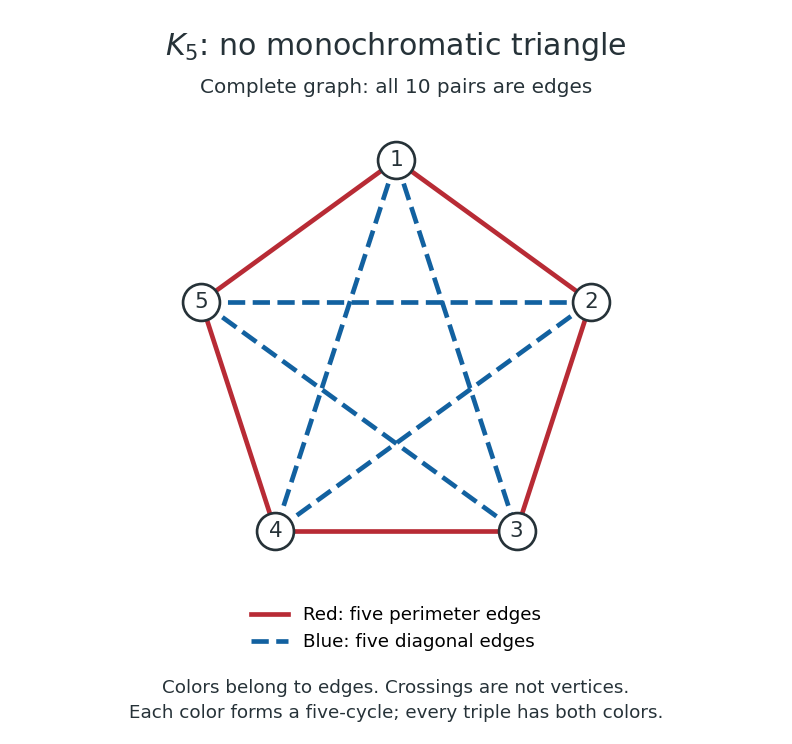
All ten edges of a complete graph on five vertices: red perimeter and blue diagonals avoid monochromatic triangles
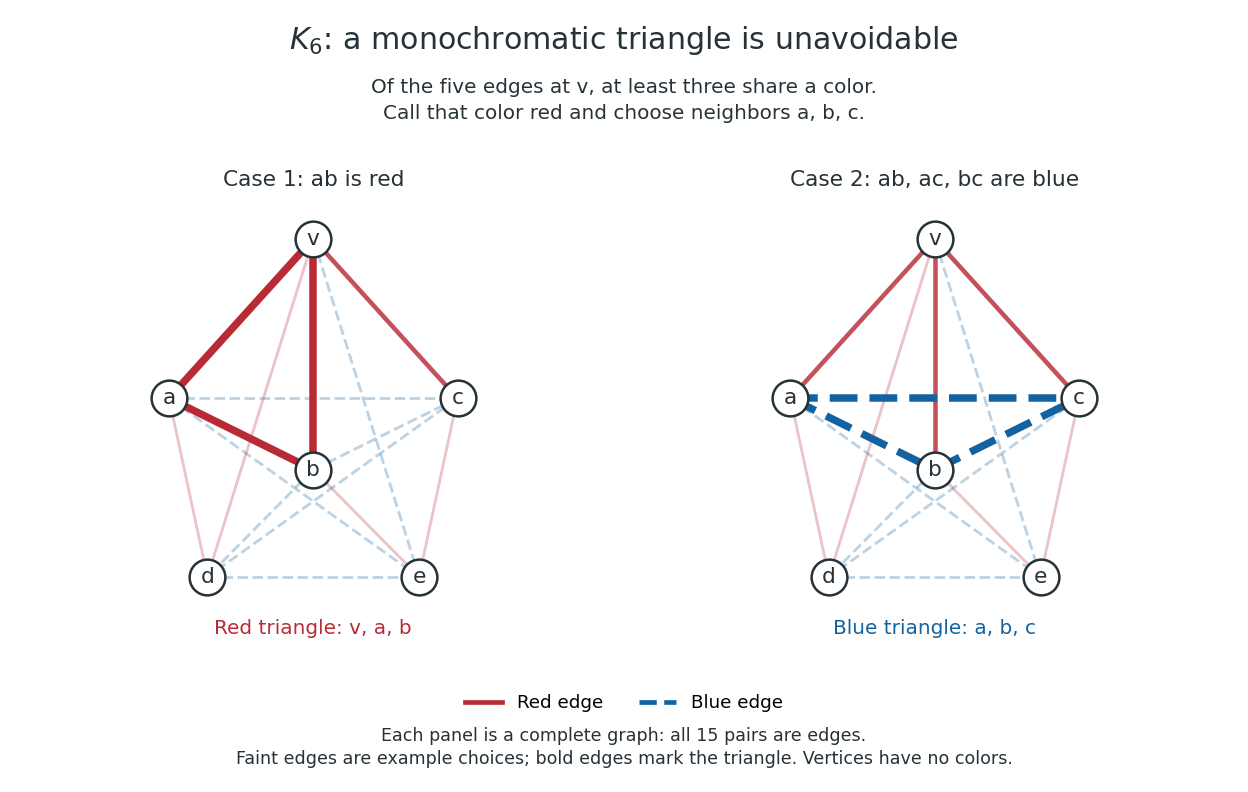
. Details. Choose any vertex of a red-blue colored complete graph . Its five incident edges go to the other five vertices. By the pigeonhole principle, at least three have the same color. Call their other endpoints and, after swapping color names if needed, suppose are red.
If any of is red, it completes a red triangle in a graph with . If none is red, all three are blue, so themselves form a blue triangle in a graph. Both possibilities force a monochromatic triangle in a graph. This proves the upper bound for the Ramsey number for triangles using only five incident edges and the three pairs among the selected neighbors; the colors of the other edges cannot defeat the argument.
Articles by others on the same topic



Ramsey's theorem is a fundamental result in combinatorial mathematics and graph theory that addresses the conditions under which order must appear in a large enough structure. The theorem essentially states that in any sufficiently large graph, one can find certain types of complete subgraphs.