In his 1895 lecture, Lord Rayleigh compared gas masses in a globe under matched pressure and temperature. Removing oxygen from air left gas about half a percent heavier than nitrogen prepared entirely from chemical sources. Several preparation routes reproduced the difference; hydrogen contamination was a concern. An eight-month storage test re-established the filling conditions: simply reweighing a sealed globe could not test a change in molar mass. William Ramsay concentrated the residual gas by circulating the mixture over hot magnesium, which consumed nitrogen. A spectral test checked remaining nitrogen. Agreement of spectra from this route and the alternative spark-and-alkali separation supported a common residual gas.[ref]
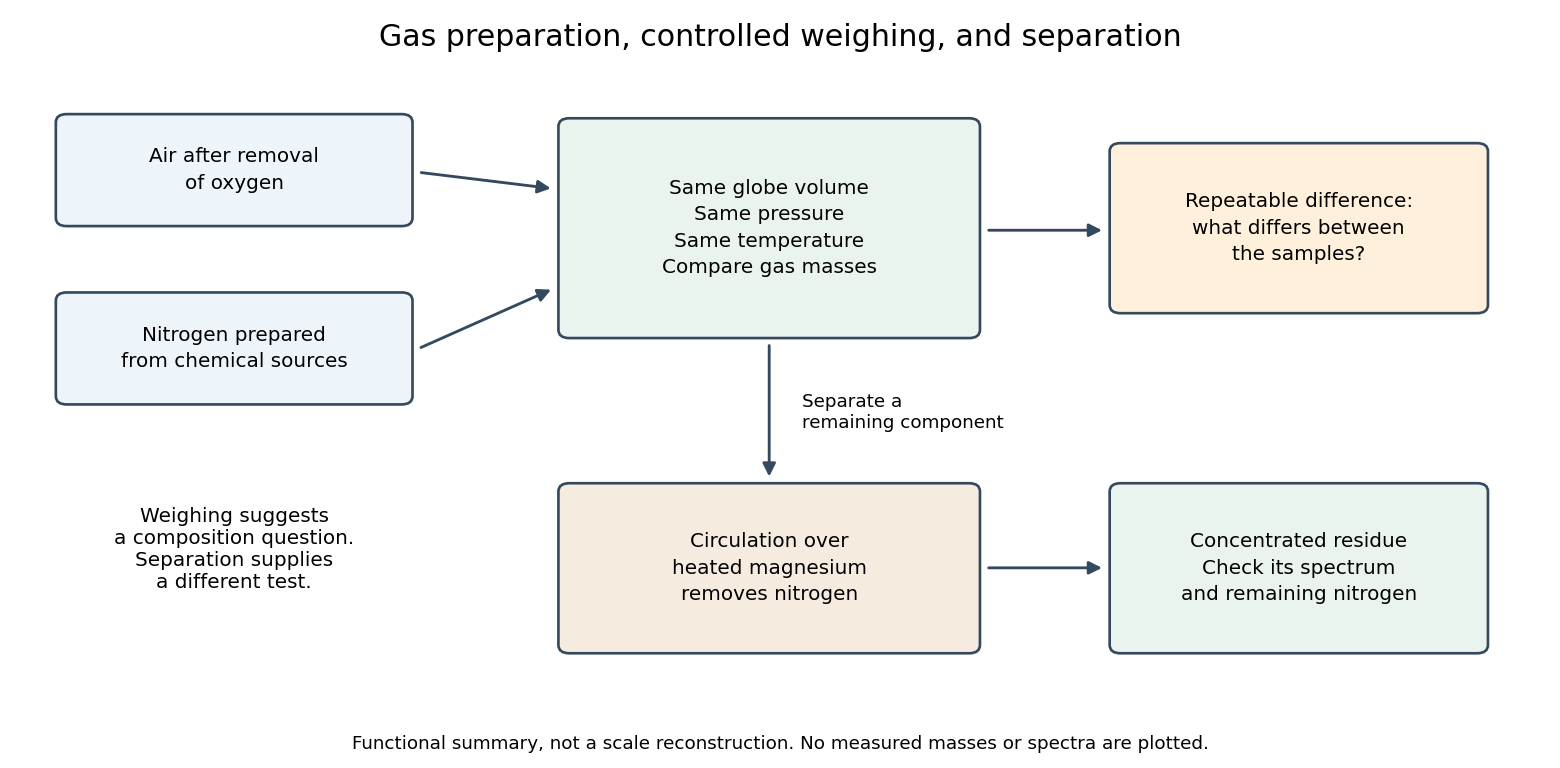

The density difference alone identifies neither a unique chemical element nor its concentration. A heavier contaminant, a lighter reference contaminant, or unmatched filling conditions can all shift a weighing. A separation process and an optical spectrum provide additional observations. This combination makes the experiment powerful: the anomaly motivates another operation whose result can be checked independently.
Articles by others on the same topic
There are currently no matching articles.