A chemical element in group 18 of the periodic table. Argon is a familiar example: its chemical inertness under many ordinary conditions makes it useful when a process needs a gas that does not readily react with the material being processed. Chemical inertness is a statement about conditions, rather than an assertion that no compound can exist.
The chemical element with atomic number eighteen. Argon is a colourless noble gas. It can provide a protective atmosphere around hot, reactive materials, for example in welding, where excluding oxygen limits oxidation. Commercial production separates it by distillation of liquid air.[ref]
Argon — Element information, properties and uses. Periodic Table by Royal Society of Chemistry; Fact box, Uses and Natural abundance: atomic number, group, protective atmosphere and liquid-air distillation
Its discovery shows why a small disagreement can matter more than a reassuringly repeatable result. Two preparations can each give consistent measurements while producing different mixtures. The Rayleigh-Ramsay argon density experiment investigated just such a discrepancy. Gas density links the weighing to a mean molar mass; a separate separation process tests which component accounts for it.
Argon-40 is a stable isotope with 18 protons and 22 neutrons. Radiogenic argon-40 accumulated from potassium-40 is a daughter product used in potassium-argon dating.
In his 1895 lecture, Lord Rayleigh compared gas masses in a globe under matched pressure and temperature. Removing oxygen from air left gas about half a percent heavier than nitrogen prepared entirely from chemical sources. Several preparation routes reproduced the difference; hydrogen contamination was a concern. An eight-month storage test re-established the filling conditions: simply reweighing a sealed globe could not test a change in molar mass. William Ramsay concentrated the residual gas by circulating the mixture over hot magnesium, which consumed nitrogen. A spectral test checked remaining nitrogen. Agreement of spectra from this route and the alternative spark-and-alkali separation supported a common residual gas.[ref]
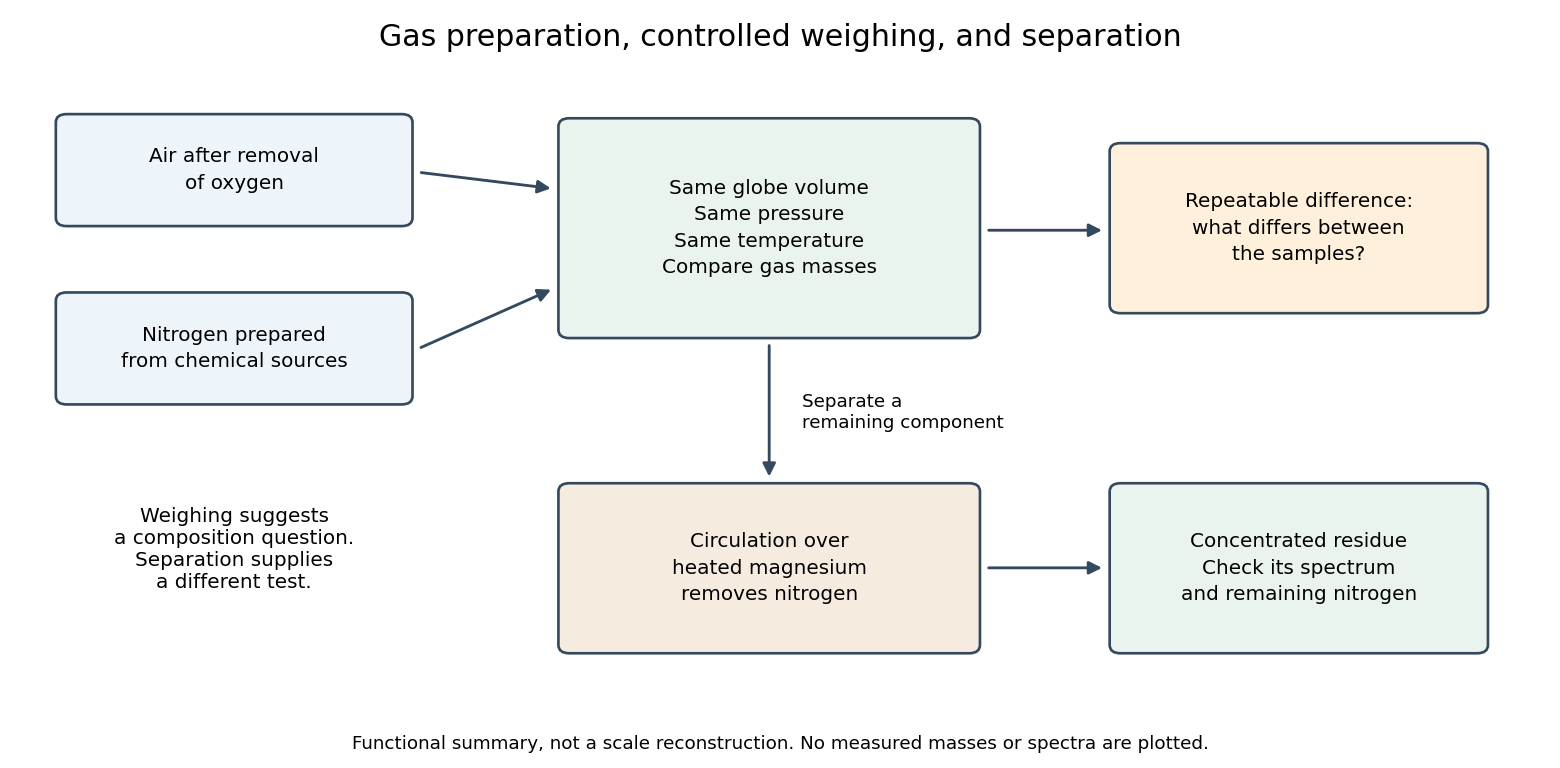
The density difference alone identifies neither a unique chemical element nor its concentration. A heavier contaminant, a lighter reference contaminant, or unmatched filling conditions can all shift a weighing. A separation process and an optical spectrum provide additional observations. This combination makes the experiment powerful: the anomaly motivates another operation whose result can be checked independently.
Consider an original simplified model containing only nitrogen and argon, with argon mole fraction . Let their molar masses be and . Adding the component masses gives the mixture's mean molar massFor an ideal gas mixture at the same pressure and temperature as a pure-nitrogen reference, the gas density ratio isThe inversion requires known identities, the binary-mixture assumption and . A density ratio cannot uniquely recover an arbitrary multicomponent mixture. Nor should be interpreted as the argon fraction of untreated air: the model sample has only the two specified components.
Choose round model values and . For , the calculated relative density excess isThus a one-percent mole fraction does not mean a one-percent gas density change. In a chosen globe at and , the ideal gas law gives approximately for pure nitrogen and for this mixture: only separates the weighings. These are model calculations with rounded molar masses, not historical measurements.
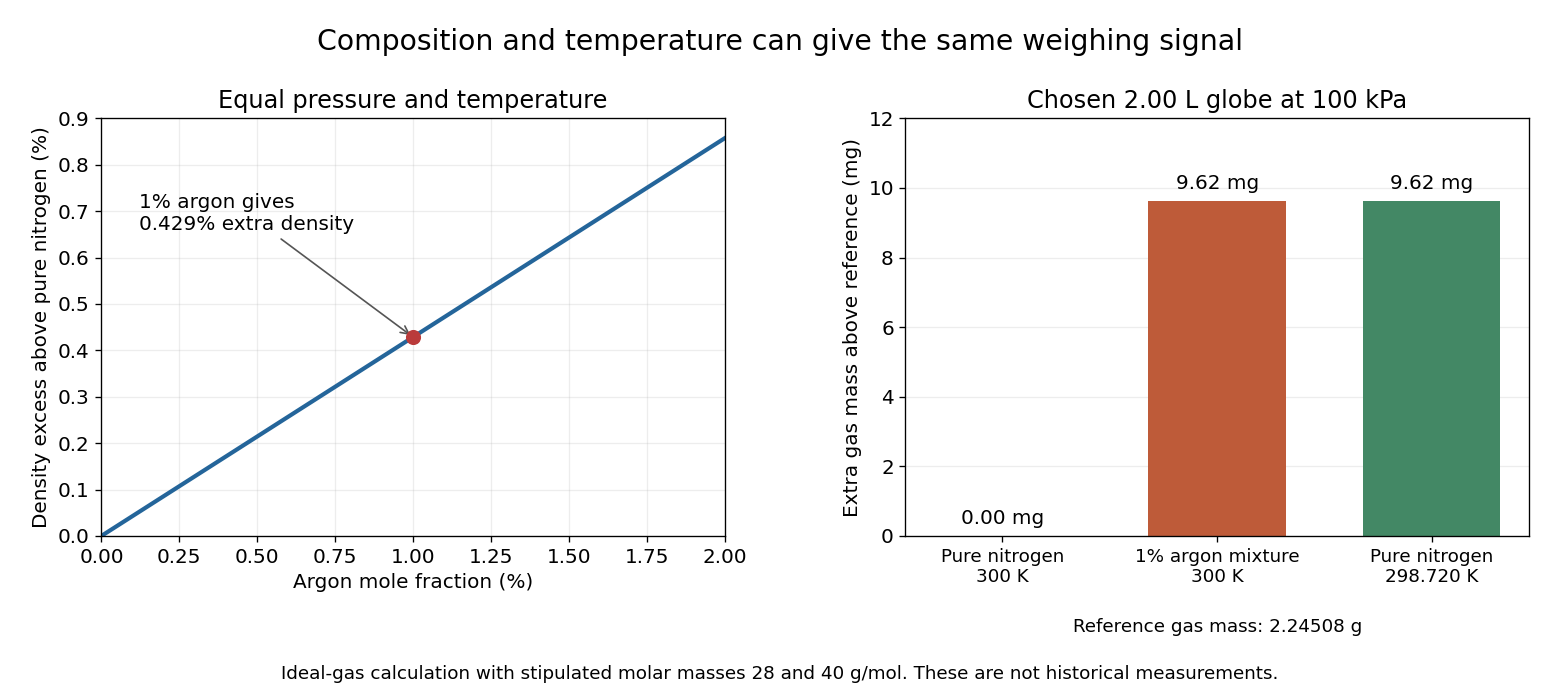
A direct control calculation explains why the filling conditions matter. At fixed pressure, pure nitrogen athas the same gas density as that mixture at . A roughly mismatch can therefore imitate the entire stipulated composition signal. For small changes, the ideal gas law givesAn independently measured pressure and temperature, matched weighing procedure, and checks for residual vapour distinguish composition from these alternative causes. The model explains the need for controls; it does not supply the complete corrections for a real gas-weighing instrument.


