The real affine group used here is the orientation-preserving subgroup of the affine group on the real line. It acts by and has multiplication . The positive dilation distinguishes this connected component from the full group, which also contains negative dilations.
Here is a small Lie group where order matters. Write a point as , and letThe one-parameter subgroups and give dilations and translations. With matrix multiplication acting rightmost first, sends to , whereas sends to . At and , translate then double gives , while double then translate gives . Starting at gives endpoints and .
The same order dependence survives infinitesimally: the matrix commutator is . Indeed, the group commutator satisfiesAt , the residual translation is , close to the leading product . It measures a second-order failure of the four moves to cancel. This connects finite composition directly to the Lie bracket on the Lie algebra; see Meinrenken, Section 4, Proposition 4.7.
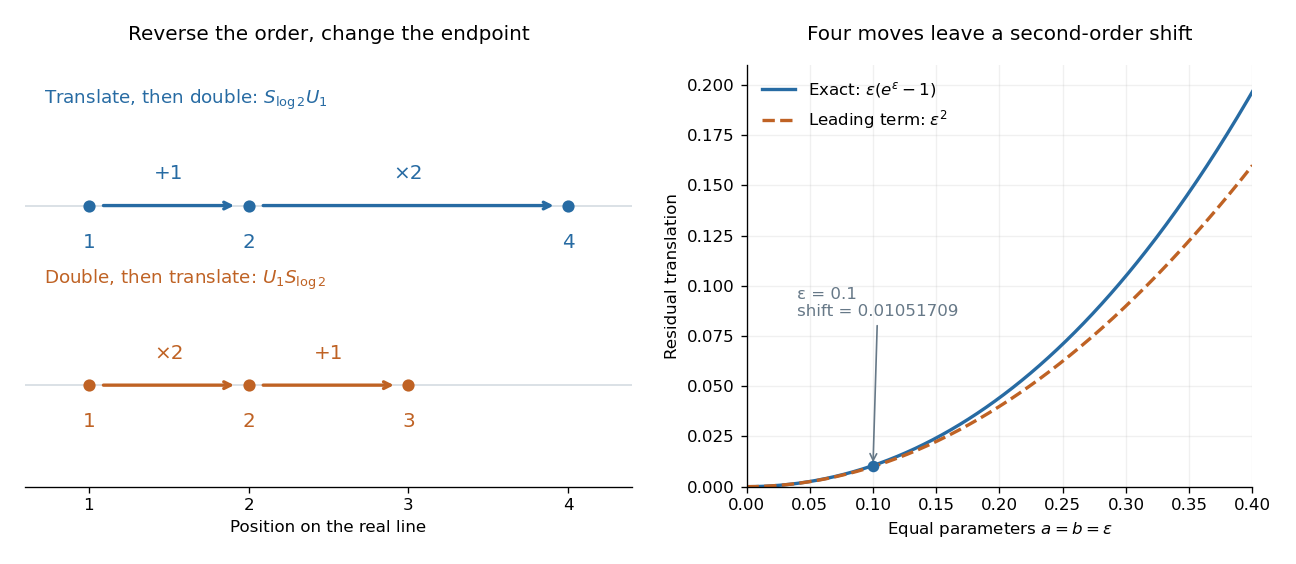
Scaling and translation have different endpoints when their order is reversed
. Details. 
In exponential scale coordinates, the real affine group has matrices . The left and right Maurer-Cartan forms are respectively and . Their dual vector fields obey and , displaying the opposite bracket sign for right-invariant vector fields.
In the faithful matrices with , the Maurer-Cartan form has entries and . Thus the left-invariant differential forms , obey and . The Lie algebra generators satisfy .
Articles by others on the same topic
There are currently no matching articles.