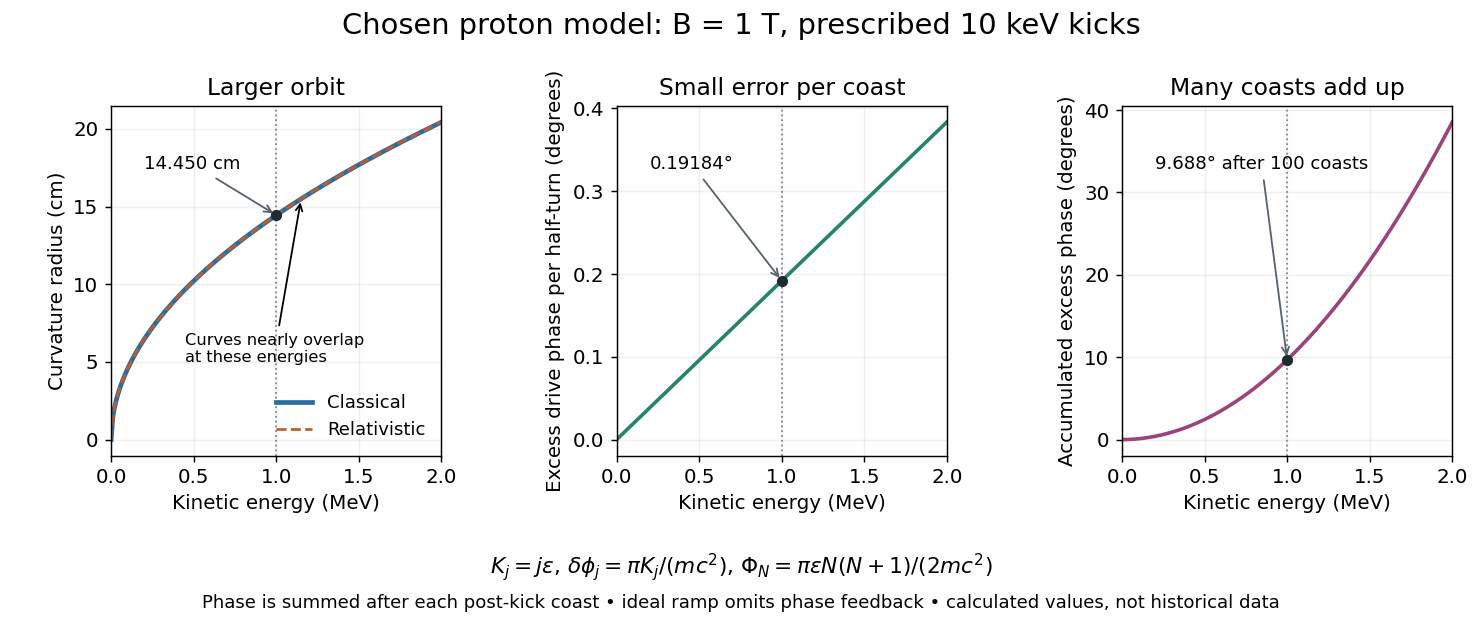
At larger kinetic energy, special relativity changes the relation between momentum and velocity. With the invariant mass, the Lorentz factor is , and a relativistic cyclotron orbit in a fixed uniform magnetic field satisfiesThe cyclotron frequency decreases as the kinetic energy increases. If the drive stays at the classical value , the half-turn time is . During it the drive advances through rather than radians. Its excess phase per half-turn is thereforeEven a small fractional frequency mismatch accumulates across many turns. A particle eventually reaches a weak or decelerating gap phase, so the classical fixed-field, fixed-frequency design has a practical kinetic energy limit. The limit depends on the kick size and acceptable accumulated phase error, rather than one universal cutoff energy. Changing drive frequency or shaping the magnetic field can restore synchronism; the argument does not forbid relativistic circular accelerators.
For the illustrative proton at , : the frequency is lower by about , and the next half-turn adds about of drive phase excess. To see cumulative sensitivity, prescribe an ideal ramp with and sum the errors of the first coasts after kicks:This gives after the coast following kick ; the arrival at kick instead has . The prescribed ramp diagnoses detuning but does not feed the resulting phase error back into the kicks. A self-consistent thin-gap model uses the cyclotron gap energy gain with , then advances the phase with the new kinetic energy during the following coast.

Articles by others on the same topic
There are currently no matching articles.