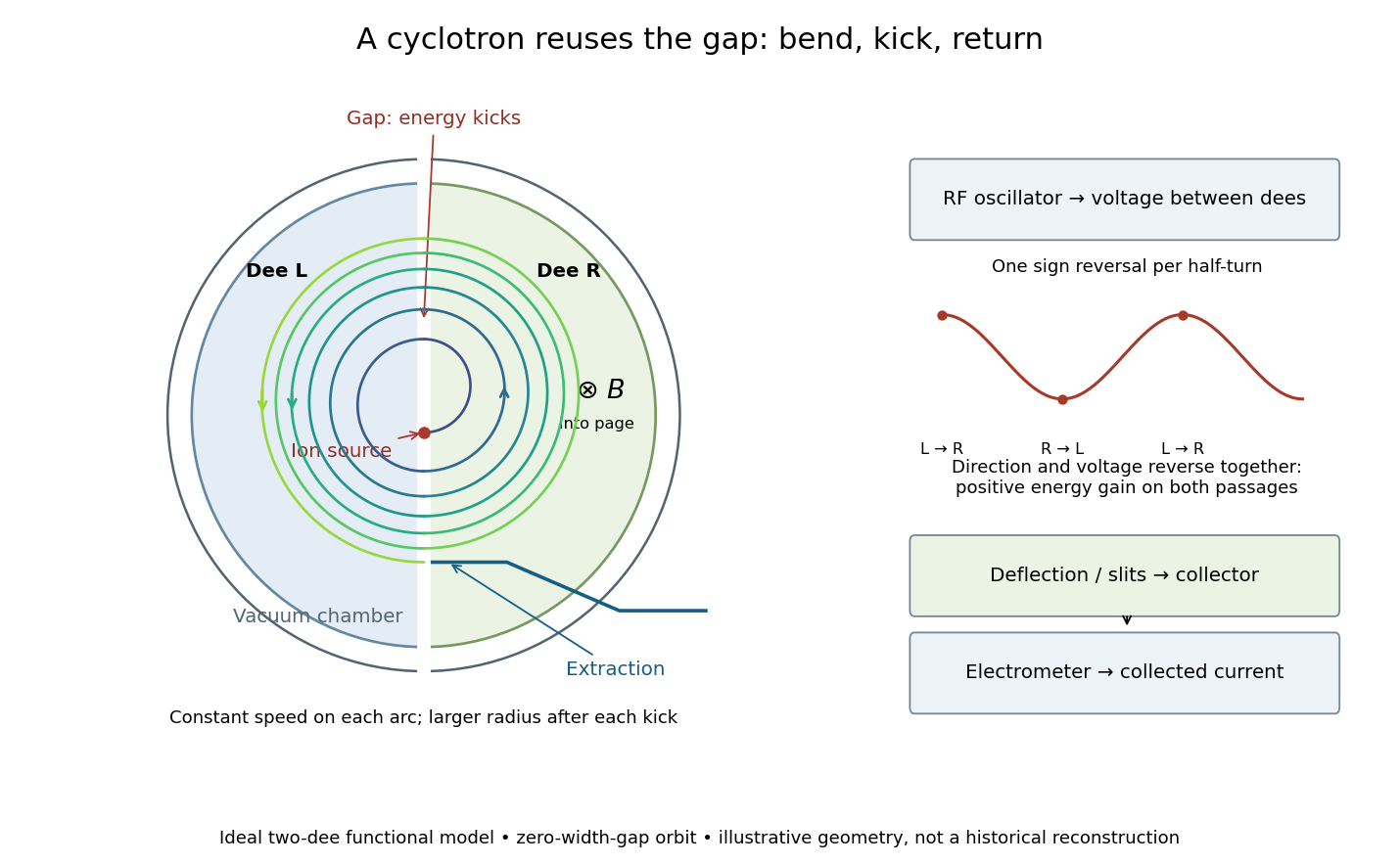
A cyclotron repeatedly passes ions through an alternating electric field between two hollow electrodes called cyclotron dees. A nearly uniform magnetic field perpendicular to their plane bends the charged particles back toward the gap. Inside each cyclotron dee, ideal shielding suppresses the accelerating electric field, so each segment is a constant-speed circular motion. The next gap crossing increases the speed and the radius of curvature. The complete path consists of connected, progressively larger arcs, rather than one circle or a smooth spiral with continuous acceleration everywhere.
The striking feature is a timing cancellation: the longer arc traveled by a faster particle takes the same time. This cyclotron resonance condition lets one fixed radio frequency accelerate many successive gap crossings. The following construction and cyclotron energy and orbit radius example describe an ideal model; the Lawrence-Livingston cyclotron experiment explains what the builders actually measured.
Articles by others on the same topic

A cyclotron is a type of particle accelerator that is used to accelerate charged particles, such as electrons or ions, to high energies. It works on the principle of combining a magnetic field and an electric field to accelerate particles in a spiral trajectory. The basic components of a cyclotron include: 1. **Dees**: These are two hollow, semi-circular, metal electrodes placed in a vacuum chamber that creates an electric field. The name "dee" comes from their D-shape.


Predecessor to the synchrotron.