A respirometer measures gas changes associated with cellular respiration. In the absorber-based pea seed respirometry apparatus, the changing gas inventory is inferred from a liquid boundary's displacement. A respirometer is therefore a physical measurement coupled to a biological process, not a direct ATP counter.
The ratio of outward carbon dioxide transfer to inward oxygen transfer measured at the mouth. It can differ from the cellular respiratory quotient during transient changes in body gas stores.
The University of Oklahoma K20 Center's handout describes three sealed vial-and-pipette respirometers in each temperature bath: soaked, germinating peas; nongerminating peas plus inert plastic beads; and beads alone. Displaced water establishes equal occupied volumes. Absorbent cotton holds potassium hydroxide, which removes carbon dioxide; nonabsorbent cotton separates it from the peas. The source equilibrates the vials before submersion and again before the initial reading. Colored water makes the boundary visible in each calibrated pipette. Readers then record positions every five minutes for twenty minutes.[ref]
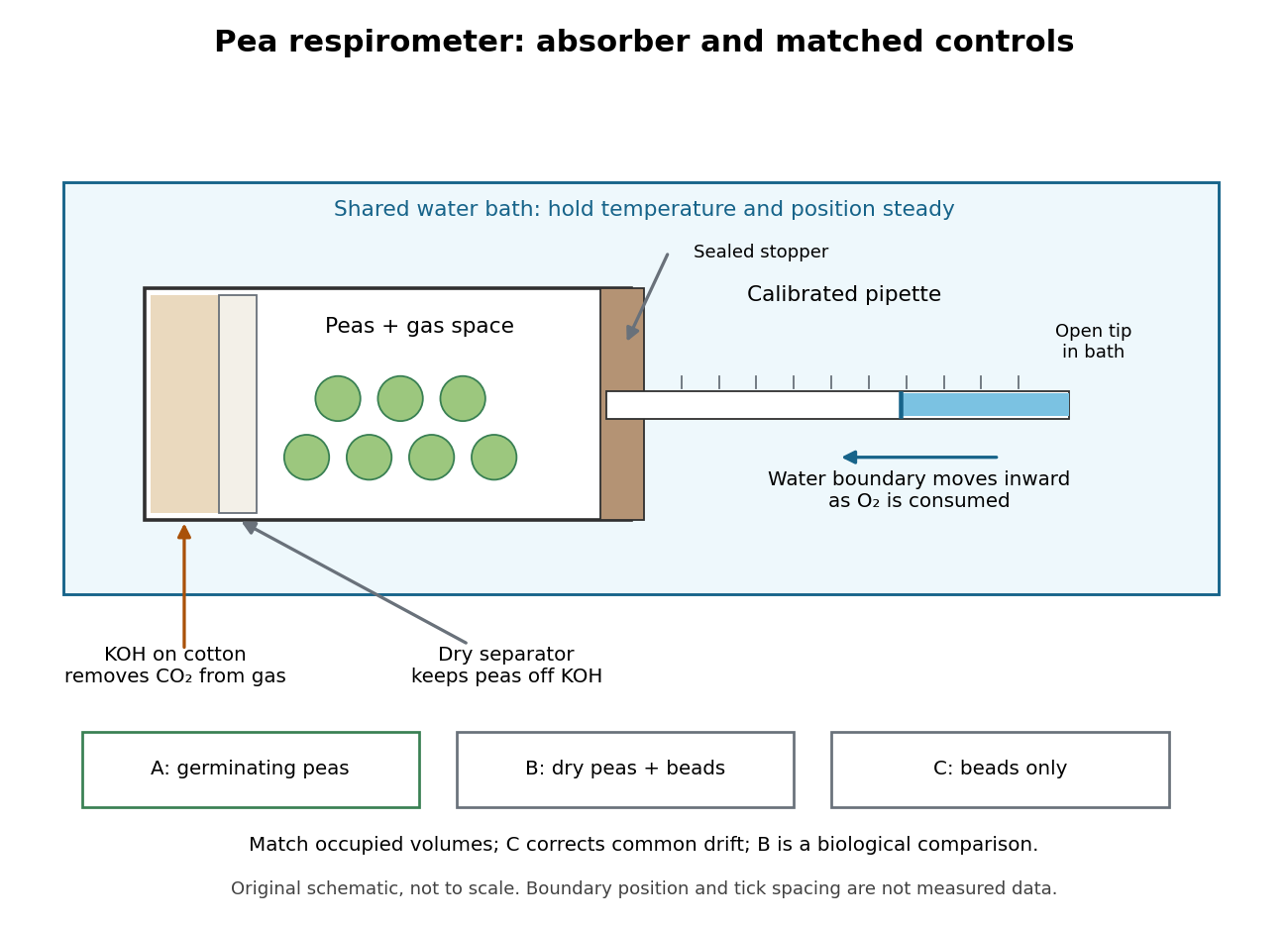

Bath temperature, vial position and seal integrity matter. The beads-only respirometer detects common temperature or atmospheric pressure drift; its change is subtracted from each pea reading. Nongerminating peas provide a biological comparison, not an assumption of zero cellular respiration. A larger corrected uptake slope for germinating peas would support greater molecular oxygen consumption by that sample under the tested conditions.[ref]
Cell Respiration by the K20 Center. Cell Respiration, pp. 1, 3–4 and 6: living dormant seeds, position/leaks, corrected differences and slope
Equal displaced volumes help match the gas spaces; they do not establish equal living mass or equal developmental state. Comparing uptake per seed and uptake per dry mass asks different questions. Leaks, incomplete carbon dioxide absorption, gas dissolution and changing water-vapour contributions can distort the respirometer inference. A blank correction cannot repair a sample-specific leak. These are consequences of the respirometer gas balance, rather than measurements reported in the handout.
For an original idealized mathematical model, let be the amount of substance of molecular oxygen consumed since the initial reading and the carbon dioxide produced. Suppose a fraction of that carbon dioxide is removed from the gas, all other gas inventories remain fixed, and temperature and gas pressure stay constant. The ideal gas law gives the positive gas contractionwhere is the molar gas constant and the gas volume. With complete absorption, , the contraction reflects molecular oxygen uptake regardless of the amount of carbon dioxide made. For a uniform pipette bore of area , an inward boundary displacement gives . A graduated pipette can instead supply the displaced volume directly.
Let denote sample contraction and the matched blank contraction. Define with both taken relative to their own initial readings. Under the preceding assumptions,The slope of corrected volume against time estimates uptake over the chosen interval. The approximate sign acknowledges that a liquid boundary also responds to hydrostatic and capillary pressure, while the gas can exchange water vapour. A fixed-volume apparatus would instead show a pressure decrease; its ideal conversion is after complete absorption and appropriate blank correction.
The ideal gas law also exposes drift without any biology: for fixed gas inventory, . A one-percent rise in absolute temperature at fixed pressure produces a one-percent expansion. Matching the initial gas spaces makes such common changes easier to subtract. Subtracting unmatched blanks can leave a physical signal that looks biological.
The respiratory quotient compares carbon dioxide production with molecular oxygen consumption over the same interval. Complete glucose oxidation in the net equation above gives . In the ideal respirometer gas balance with no absorber, , that conversion gives : substantial cellular respiration can occur without any net gas contraction. A zero contraction therefore does not by itself demonstrate zero metabolism.
Other fuels, incomplete conversion and concurrent synthesis can alter the ratio. Absorber-based respirometry isolates molecular oxygen uptake by deliberately removing the other gas signal; it cannot independently determine the respiratory quotient or identify glucose as the consumed fuel. Separate carbon dioxide measurement would supply the missing account.
Articles by others on the same topic
There are currently no matching articles.