Energy storage 2026-10-24
Storing recoverable energy for later use. Energy capacity, maximum power, duration, round-trip efficiency and degradation are independent dimensions of performance; a high specific energy need not imply high power or efficiency.
Hydrogen storage 2026-10-25
Storage of hydrogen as a chemical-energy carrier. Comparing electricity-storage systems requires including production, containment and reconversion; the fuel heating value alone does not specify electrical round-trip efficiency.
Storage has multiple performance measures: energy and power density, efficiency, cycle/calendar life, duration, cost, materials, safety and siting. Lithium-ion batteries offer high round-trip efficiency, fast response and compactness, making them useful for vehicles and short-duration grid services. That does not make them optimal for every duty. Pumped hydro can suit large stationary energy stores where geography permits; thermal stores can serve heat directly; chemical fuels or other long-duration systems can trade efficiency for cheap energy capacity. A technology that is excellent per kilogram may be poor for seasonal storage. “Best” requires a specified service and life-cycle comparison.
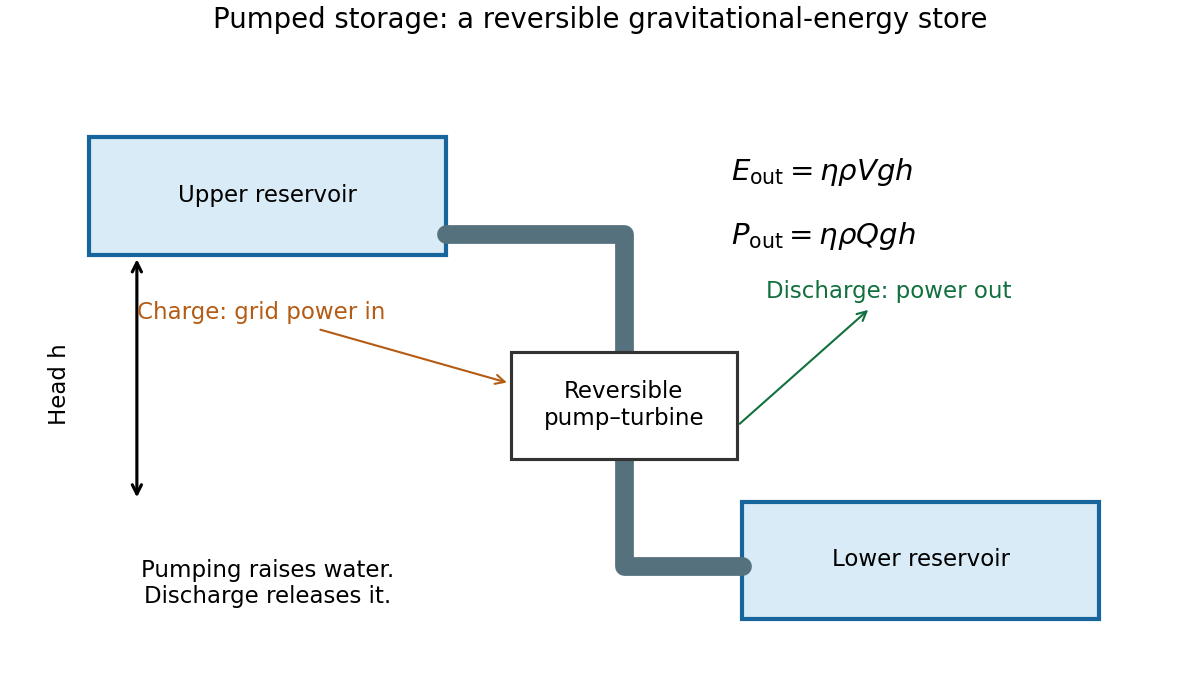
A pumped-storage plant moves water uphill using electrical power, then returns it through a turbine and generator when electricity is needed. The upper and lower reservoirs set the usable volume and head; pumps, penstocks, valves and reversible pump-turbines set the power and flow. The plant stores energy rather than generating net energy over a cycle.
Figure 1.
Gravitational storage separates reservoir energy capacity from pump and turbine power
. An original functional diagram shows an upper and a lower reservoir connected through a penstock and reversible pump-turbine. Charging uses grid electricity to lift water; discharge returns gravitational potential energy through the generator. Details.
For constant head, the gravitational energy is . With the stated generation efficiency,
At GW, gives
Head variation, dead volume and hydraulic losses beyond the stipulated efficiency have been neglected.
To deliver kWh with the same head and efficiency needs of water, roughly a m cube, together with a m elevation difference and a lower reservoir. At a m head it would need about . This contrasts with the small fuel volume: the useful energy density of lifted water depends on its external head, not its chemical composition.
Pumped storage offers long service life, fast dispatch, substantial power, and separate choices of storage volume and turbine rating. Its drawbacks include geographic constraints, construction cost and time, ecological impacts, evaporation and water requirements, plus round-trip losses. The quoted generation efficiency alone is not the round-trip efficiency because pumping also consumes more than the stored potential energy.
The rock cylinder has mass and rises through . Equating its useful energy to the reservoir result cancels the common efficiency and gravity:
Its height is about m and its lift about m, ignoring buoyancy as instructed. Stored energy scales as , excavated volume roughly as , and lined area as . If excavation dominates cost, cost per unit stored energy decreases approximately as . Seals, increasing pressure, geology, leakage, supporting structure and power equipment can change that scaling; a volume law is not a complete cost model.
A battery stores electrochemical free energy. Representative pack specific energy is of order - kWh/kg, with electrical round-trip efficiency roughly -. It responds rapidly and can be modular, but energy capacity requires more active material, and ageing depends on time, temperature and cycling.
Pumped storage stores gravitational potential energy. At a m head with generation efficiency, useful energy is Wh/kg of water. Its low mass-specific energy is acceptable when inexpensive water and large reservoirs are available. Storage volume and generator rating can be chosen substantially independently, making multi-hour service practical, but suitable sites and civil works are major constraints.
Hydrogen stores chemical energy, with a lower heating value around kWh/kg of hydrogen before allowing for tank mass. Electrolysis, compression or other storage processing, and conversion back to electricity can reduce electrical round-trip efficiency to roughly -, depending on the route. Separate tanks or caverns can make long-duration energy capacity less expensive than adding electrochemical cells, but containment, infrastructure, leakage and conversion equipment matter.
The appropriate comparison includes power rating, energy duration, cycle count, system mass or area, and whether heat or electricity is the final useful product. A large fuel heating value does not imply a high electricity-storage efficiency.
