Fix a failure probability and assume an independent and identically distributed statistical sample. A finite-sample confidence band for its population cumulative distribution function isHere is the natural logarithm. The DKW inequality impliesThis is simultaneous coverage over the whole real line, valid at each fixed sample size.[ref]
To obtain the band, solve for the positive . Outside a failure event of probability at most , for every . Since a cumulative distribution function already lies in , clipping the endpoints to this interval preserves the coverage event. The guarantee is at least , and need not equal it.
Choose , giving at least simultaneous coverage under the stated model. For , respectively, the half-widths before clipping areFor the chosen five observations, the band at is , while at it is approximately . At the unclipped band would be , so clipping gives . The broad uncertainty is informative: five observations give a precise description of themselves, but a coarse bound for an unknown population cumulative distribution function.
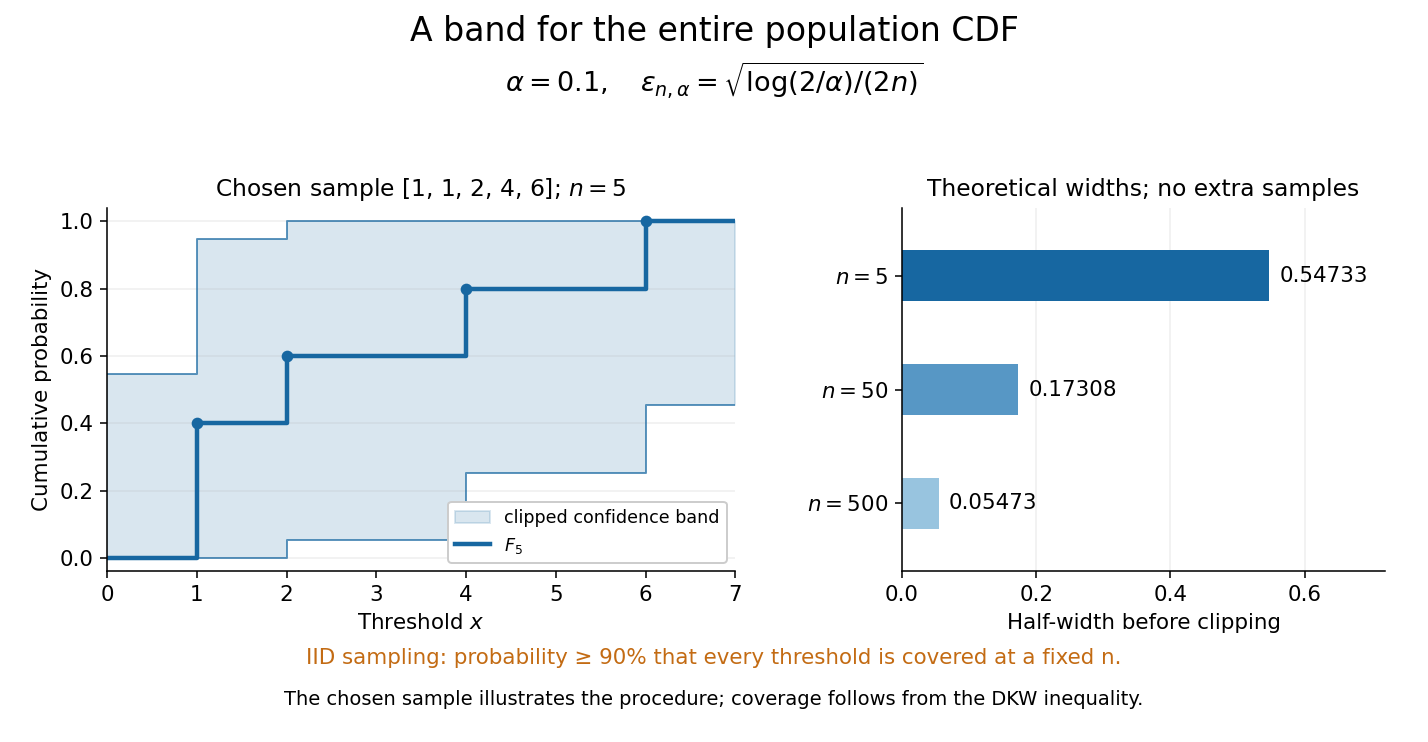
Finite-sample simultaneous uncertainty around an empirical distribution function
. Left: the chosen five observations give and its band clipped to , using . Right: theoretical half-widths for , with no additional samples constructed. The confidence band has coverage at least under independent and identically distributed sampling; the drawing illustrates the procedure and does not establish its coverage. Details.
A collection of pointwise confidence intervals only promises coverage separately at each preselected threshold; it does not promise coverage of an entire cumulative distribution function. Here the one simultaneous event permits inspecting any threshold after seeing the data. The probability refers to repeated sampling of the entire statistical sample, with fixed. It does not assign probability to a fixed after observing this particular band, and it is not a prediction interval for a future observation. The displayed comparison gives a guarantee for each fixed separately, not simultaneous validity over all sample sizes or an optional stopping rule. The chosen observations are an illustration; the coverage claim follows from the DKW inequality, not from their appearance or a simulation. Dependence or observations with different sampling laws require another argument.
At fixed , multiplying by divides the half-width by . Conversely, a desired half-width is ensured by , rounded up to an integer. For and , this sufficient sample size is . This makes the confidence band useful for planning how many observations are needed before estimating threshold probabilities to a chosen simultaneous accuracy.
Articles by others on the same topic
There are currently no matching articles.