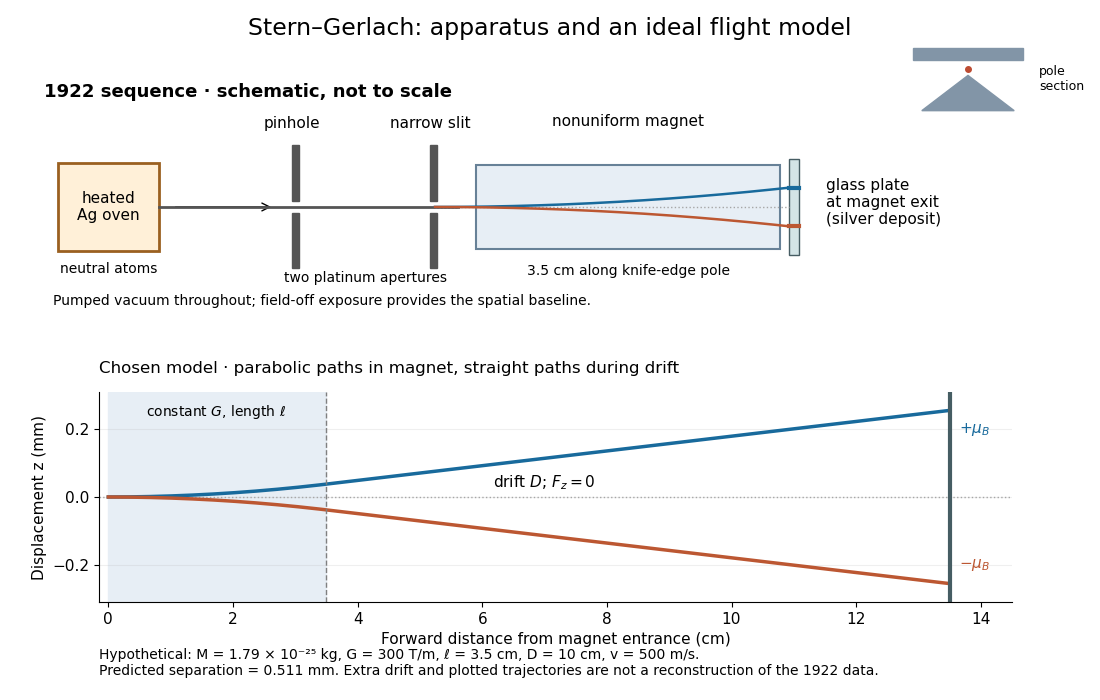
In 1922, Otto Stern and Walther Gerlach used an electrically heated oven to emit neutral silver chemical atoms. Two platinum apertures, a pinhole and a slit – wide, supplied collimation. The beam passed along a knife-edge pole in a nonuniform magnetic field. At its end, a glass plate collected the condensed silver. Continuous pumping maintained vacuum; the thin deposit required development even after eight hours.[ref]
Der experimentelle Nachweis der Richtungsquantelung im Magnetfeld by Walther Gerlach and Otto Stern. Experimental setup, paragraphs 1–5; original 1922 paper in Martin Bauer's translation, PDF pp. 2–3
The field-off image established the undeflected slit width. A comparison put field-on and field-off deposits on the same plate. Microscopy revealed two deflected bands, no detectable central component, and broadening attributed to the velocity distribution. Alignment and distance from the knife-edge affected the pattern; precise magnetic field gradient measurements were still pending.[ref]
Der experimentelle Nachweis der Richtungsquantelung im Magnetfeld by Walther Gerlach and Otto Stern. Results, Figs. 2–5 and observations b–e; closing paragraph, PDF pp. 3–5
The apertures act as a collimator: they constrain the initial transverse positions and velocities, so a magnetic displacement can be distinguished from an initially broad beam. Vacuum reduces collisions that would destroy this preparation. Deposition integrates arrivals over the exposure; a darkened band is not a time-resolved record of individual chemical atoms. The field-off comparison tests whether the magnet changes the spatial distribution, while alignment checks address a geometric source of apparent asymmetry. Finite sensitivity qualifies the absence of a central deposit: it is an experimental upper limit, not a proof that exactly zero atoms landed there.

Articles by others on the same topic
There are currently no matching articles.