An ideal Bjorken scaling model has : varying at fixed Bjorken x leaves this dimensionless deep-inelastic structure function unchanged. The comparison requires extracting a deep-inelastic structure function, rather than plotting raw event counts. Quantum chromodynamics predicts departures from exact Bjorken scaling; finite hadron masses also limit the idealization.
For an original shape comparison, choose and define with . The ideal model has . To display a contrasting size-dependent suppression, define an illustrative elastic-form-factor shape with the freely chosen . Its normalized squared magnitude isThus , whereas . The elastic-form-factor shape is a comparison of suppression mechanisms, not an elastic differential scattering cross-section assigned to : actual elastic scattering from a proton has and . Neither curve is measured data or a fit to the SLAC-MIT experiment.
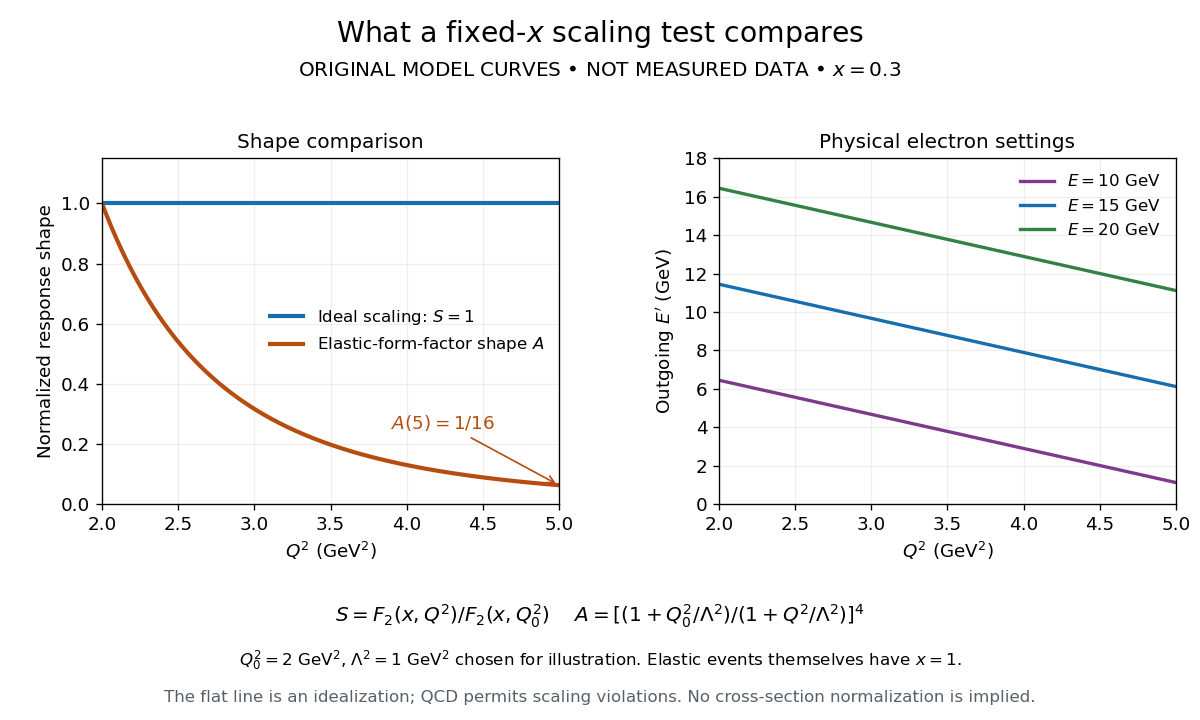

The experimental interpretation required more than a flat curve. The angular dependence and small longitudinal response supported spin one-half partons, expressed at leading order by the Callan-Gross relation . Identification with fractionally charged quarks also drew on later Electron, muon and neutrino comparisons. A scaling plot alone does not determine the individual electric charges of constituents.[ref]
Deep Inelastic Scattering: Comparisons with the Quark Model by Jerome Isaac Friedman. 1990 Nobel lecture, identification of the constituents and early neutrino results; 1991 reprint p. 623
The leading parton model formula already shows the ambiguity: combines squared electric charges with unknown parton distribution functions. One measured function cannot independently fix all these quantities. Confinement also explains why an inclusive final hadron state need not contain an isolated outgoing quark.
Articles by others on the same topic
There are currently no matching articles.