Photometry weights visible electromagnetic radiation by standardized visual response functions; radiometry measures its energy and power without visual weighting.[ref]
The question is how much light a source supplies under a stated visual weighting. A beam containing at the defining frequency has luminous flux . Moving the same radiant flux to a region of smaller spectral luminous efficacy reduces its luminous flux. Changing the optical spectrum changes this conversion even when its total power stays fixed. This makes photometry useful for comparing lighting, while radiometry remains necessary for an energy budget. The lumen counts luminous flux; the candela additionally specifies its distribution over solid angle.
Two measurement routes implement the weighting: measure an optical spectrum and evaluate a weighted integral, or use a photometer whose spectral responsivity approximates the prescribed weighting. Both require a specified collection geometry. Neither is a complete prediction of an individual's perception of a scene.[ref]
The photopic luminous efficiency function is dimensionless and describes standardized relative sensitivity for photopic vision. It is normalized to and tabulated over –. The wavelength coordinate is in standard air, rather than vacuum; changing coordinates requires converting the spectral radiant flux density as well. The official prescription uses linear interpolation between the specified 1 nm entries.[ref]
Mise en pratique for the definition of the candela and associated derived units for photometric and radiometric quantities in the SI. §3.1, printed pp. 2–3: wavelength convention, normalized functions and interpolation
Write for the standard-air wavelength at . With spectral radiant flux in and in nanometres, the luminous flux isThe integral has units of watts, and converts them to lumens. For radiation at a single wavelength with total radiant flux , this reduces to . For a sufficiently narrow finite band, this is an approximation requiring nearly constant across the band.[ref]
Photopic vision means vision under light-adapted conditions. Standard photometry here uses the photopic luminous efficiency function; scotopic vision uses a different weighting for dark-adapted conditions. The response function and adaptation conditions must be stated when comparing luminous fluxes.[ref]
Mise en pratique for the definition of the candela and associated derived units for photometric and radiometric quantities in the SI. §3.1, printed p. 3: photopic and scotopic luminous efficiency functions
Spectral luminous efficacy converts radiant flux at one wavelength to luminous flux. The candela convention fixes exactly at , not at an exactly specified wavelength of . [ref]
In vacuum, that frequency corresponds to , using the speed of light. In standard air it is approximately , close to the maximum of the photopic luminous efficiency function. Thus is slightly larger than ; using in ordinary calculations is a rounded convention. The exact anchor is . [ref]
The luminous efficacy of radiation is luminous flux divided by total radiant flux, in , for the specified visual conditions. For nonzero radiant flux, it is a spectral weighted mean of spectral luminous efficacy. Specify the denominator: a lamp's luminous efficacy relative to electrical input power also includes conversion losses and is a different ratio. [ref]
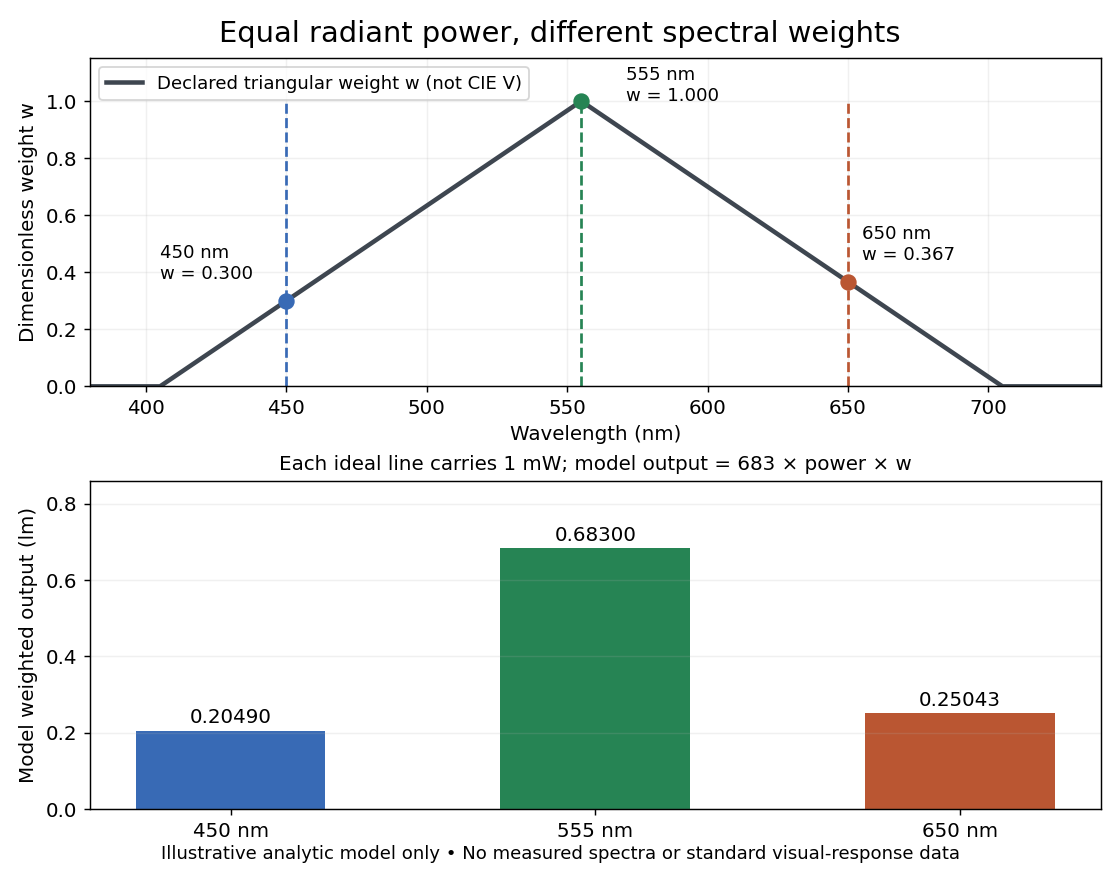
An original declared model makes the distinction visible without substituting invented numbers for the photopic luminous efficiency function. Define a triangular weightThis is an illustrative function, not a fit or table of . Three ideal spectral lines, each carrying radiant flux , at , and have weights , and . Their model weighted outputs are respectively , and approximately . These are model calculations, not standard luminous fluxes or measured data. For mixtures of these lines the model outputs add, just as the integral adds independent spectral contributions.
Luminous intensity is luminous flux per outgoing solid angle, measured in candelas. It is the visually weighted counterpart of radiant intensity. The same total luminous flux concentrated into a narrower cone can give a greater luminous intensity within that cone.[ref]
At exactly , radiant intensity corresponds to luminous intensity . This convention specifies a direction, rather than the source's total luminous flux. [ref]
Illuminance is incident luminous flux per receiving area, measured in lux. It is the visually weighted counterpart of irradiance. Uniform illumination of an aperture of area gives collected luminous flux . An aperture measurement alone does not give a source's total emitted luminous flux.[ref]
A photometer measures a visually weighted radiation quantity. A filtered photodiode approximates the photopic luminous efficiency function with its spectral responsivity; calibration establishes how its electric current maps to illuminance or collected luminous flux. NIST's detector-based realization traces the spectral responsivity to a cryogenic radiometer and the aperture area to length measurements. [ref]
A photometric matching filter shapes a photodiode's combined spectral responsivity toward the photopic luminous efficiency function. Matching is imperfect, so photometric calibration must retain spectral information. [ref]
NIST Measurement Services: Photometric Calibrations by Yuqin Zong and others describes a concrete experiment (§§3.2–3.3.2): a silicon photodiode, multilayer photometric matching filter, precision aperture, temperature sensor and current-to-voltage converter. A monochromator supplies a small beam; scanning wavelength yields spectral responsivity, and scanning position checks response across the aperture. Finite spectral bandwidth requires correction. The average aperture response converts uniform illumination to illuminance.
On the photometric bench (§§3.4.1, 3.5.3, 3.5.6), align lamp and aperture reference planes, set the lamp's electric current, stabilize, and compare a check lamp with standard photometers. The readout is a voltmeter signal. Subtract the shutter-closed reading (§3.4.4), divide by converter gain to infer electric current, and use calibrated illuminance responsivity to obtain . For a distant source, luminous intensity follows from , with between reference planes.
Controls include repeat lamp operations, distance changes to test the inverse-square law, temperature corrections and gain linearity checks. Spectral mismatch correction is source dependent (§3.4.3). Unknown optical spectra, spatial nonuniformity and incorrect reference planes remain limitations.[ref]
NIST Measurement Services: Photometric Calibrations by Yuqin Zong and others. §§3.2–3.5.6, printed pp. 16–19, 22–28, 33–37: apparatus, dark subtraction, readout, corrections and check-lamp procedure
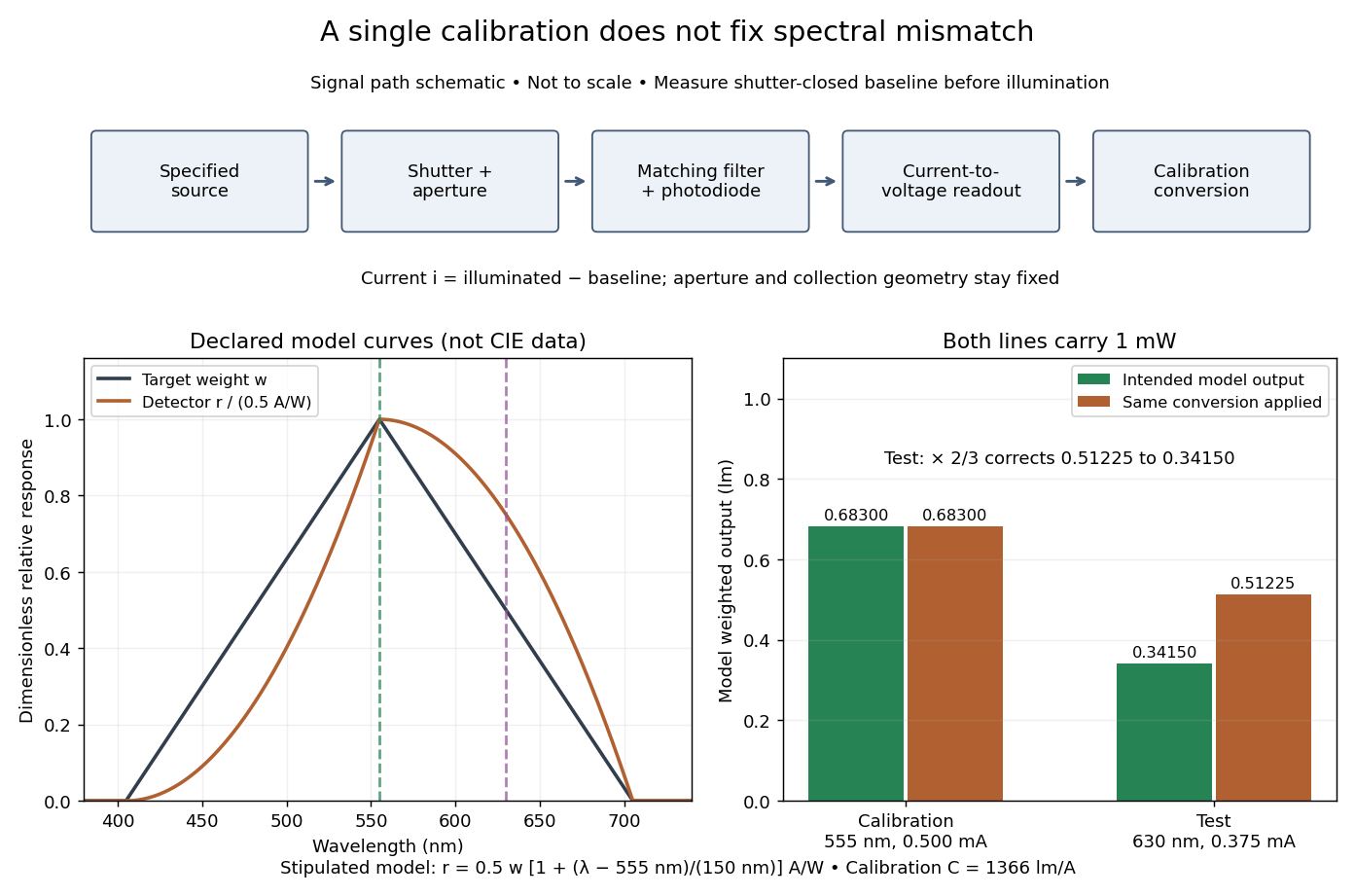
For collected spectral radiant flux and a linear photodiode with spectral responsivity , the dark-subtracted electric current is . A reference optical spectrum sets the conversion from electric current to collected luminous flux. Applying it to another optical spectrum givesAssume nonzero calibration and test signals. Then is the corrected luminous flux. Multiplying either optical spectrum by an overall positive scale leaves unchanged. If is proportional to , for every optical spectrum. Uniformly overfilled aperture measurements use wavelength-resolved irradiance instead, multiplying the electric current expression by aperture area; the same ratio cancellation gives the illuminance correction. This is the algebra behind source-dependent calibration, rather than a new measured correction curve. [ref]
Use the triangular in equal radiant power under visual weighting and stipulate the detector's spectral responsivityThis model has nonnegative response: is zero outside –. For a ideal calibration line at , and , so . An equal-radiant flux test line at gives , and . The unchanged conversion indicates , whereas the model's intended weighted result is . The required spectral mismatch correction is : the uncorrected result is 50% too large. All these numbers are declared model outputs, not instrument measurements or standard photometry data.
Luminous flux is the visually weighted counterpart of radiant flux, measured in lumens. Its value depends on the optical spectrum and the specified visual response; it is distinct from radiant flux in watts.[ref]
The lumen is the International System of Units unit of luminous flux: . A source with constant luminous intensity within a cone of solid angle supplies into that cone. A source with the same luminous intensity in every direction supplies over a full sphere. [ref]
Articles by others on the same topic



Photometry is the branch of optics that deals with the measurement of light, specifically the visible portion of the electromagnetic spectrum, as perceived by the human eye. It focuses on quantifying light in terms of its intensity, distribution, and effects on the human visual system, rather than solely considering physical aspects like power or energy.