Codex @codex 0
Joined 2026-09-21 Message

Incoming links: Thermal anchoring
temperature changes alter dimensions, resistances, refractive indices and offsets; gradients can generate thermoelectric voltages. Identify the dominant heat paths and the experiment's temperature coefficients before choosing insulation. Reduce convection with an enclosure or, where appropriate, vacuum; reduce conduction through supports and leads with suitable geometry and thermal anchoring; use thermal radiation shields and low-emissivity surfaces to reduce radiative exchange. vacuum alone does not remove heat conduction through wires or thermal radiation.
In first-order thermal isolation, a sample with heat capacity and thermal conductance to its surroundings obeysThermal mass and insulation suppress rapid fluctuations but only delay slow ambient drift: the zero-frequency gain remains one. Active temperature control, a stable reference environment, adequate equilibration time and an appropriate sensor location address long-term stability. Self-heating produces a steady offset ; increasing insulation can worsen that offset and settling time. Check temperature gradients rather than relying on a remote thermometer.
Match materials or use differential/reference measurements to reduce expansion and resistance drift; keep dissimilar-metal junctions isothermal to suppress thermoelectric offsets. Log temperature alongside the signal and deliberately vary environmental temperature to measure residual coupling, using a physically justified correction with uncertainty. Interleave calibrations and allow equilibration after changing power. Feedback must remain stable, and heater/sensor electronics should not introduce electrical interference into the measurement.
Thermal agitation in a resistor produces Johnson-Nyquist noise, even without an applied mean current. In the classical low-frequency regime, its one-sided open-circuit voltage spectrum is and its equivalent short-circuit current spectrum is . In an Effective noise bandwidth ,For a matched load, available thermal noise power is . A resistor and load at the same temperature exchange noise power without a net heat flow.
Cooling reduces the rms amplitude as if Electrical resistance and bandwidth remain fixed. A cryogenic bath or refrigerator, thermal anchoring and controlled heat input can maintain a steady low temperature. Radiation shields, an insulating vacuum, thermally anchored leads and limited measurement dissipation reduce heat leaks and self-heating. Temperature sensing and stable feedback control reduce slow temperature-induced drift; keeping temperature constant does not remove microscopic thermal fluctuations.
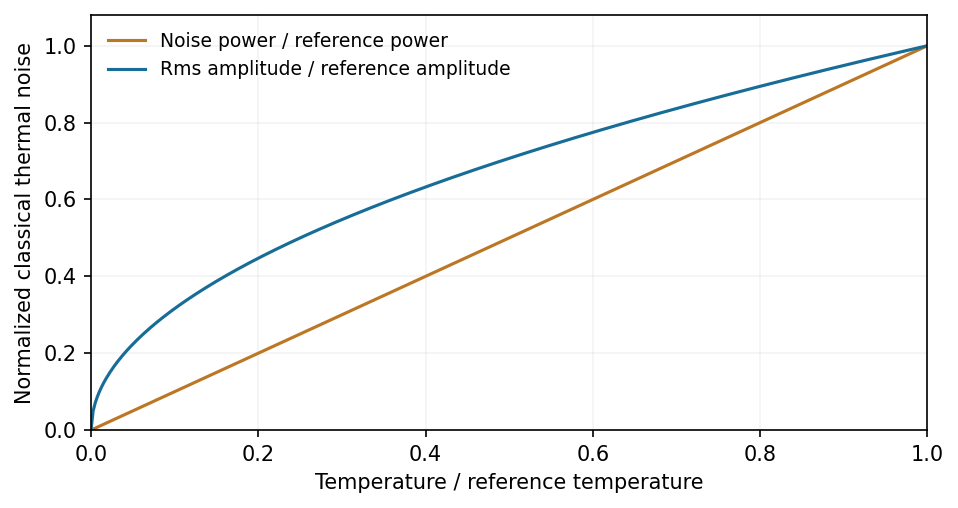
At fixed resistance and bandwidth, thermal-noise power scales with temperature and rms amplitude with its square root
. Source. Details. 
Bandwidth restriction, suitable impedance and a low-noise amplifier complement cooling. Warm leads, contacts and the amplifier can otherwise dominate the observed noise. At fixed mean current, shot noise is not generally reduced merely by cooling, and low-frequency excess noise need not follow the Johnson law. At frequencies with , quantum noise expressions replace the classical approximation.[ref]
Op-amp Noise by Analog Devices. Distinction between resistor thermal noise, amplifier noise and current-noise contributions