A trypsin colorimetric assay follows enzyme activity through absorbance at . Trypsin cleaves an amide bond in the synthetic arginine derivative BAPNA, releasing p-Nitroaniline.[ref]
Enzymatic Assay of APROTININ - Sigma Quality Control Test Procedure. Enzymatic Assay of APROTININ, Sigma quality-control procedure, p. 1: Principle and Conditions
The inspected Sigma procedure prepares fresh trypsin in cold hydrochloric acid and fully dissolves BAPNA. Its buffer solution stock contains triethanolamine and calcium chloride, at pH . Three cuvettes compare trypsin, trypsin plus the enzyme inhibitor aprotinin, and a blank replacing trypsin with its acid solvent. Sodium chloride solution replaces aprotinin in the uninhibited control. A thermostatted instrument for spectrophotometry holds and a light path. After equilibration, adding BAPNA starts approximately five minutes of absorbance recording. The uninhibited sample checks activity; the blank checks background; the inhibited sample tests suppression.[ref]
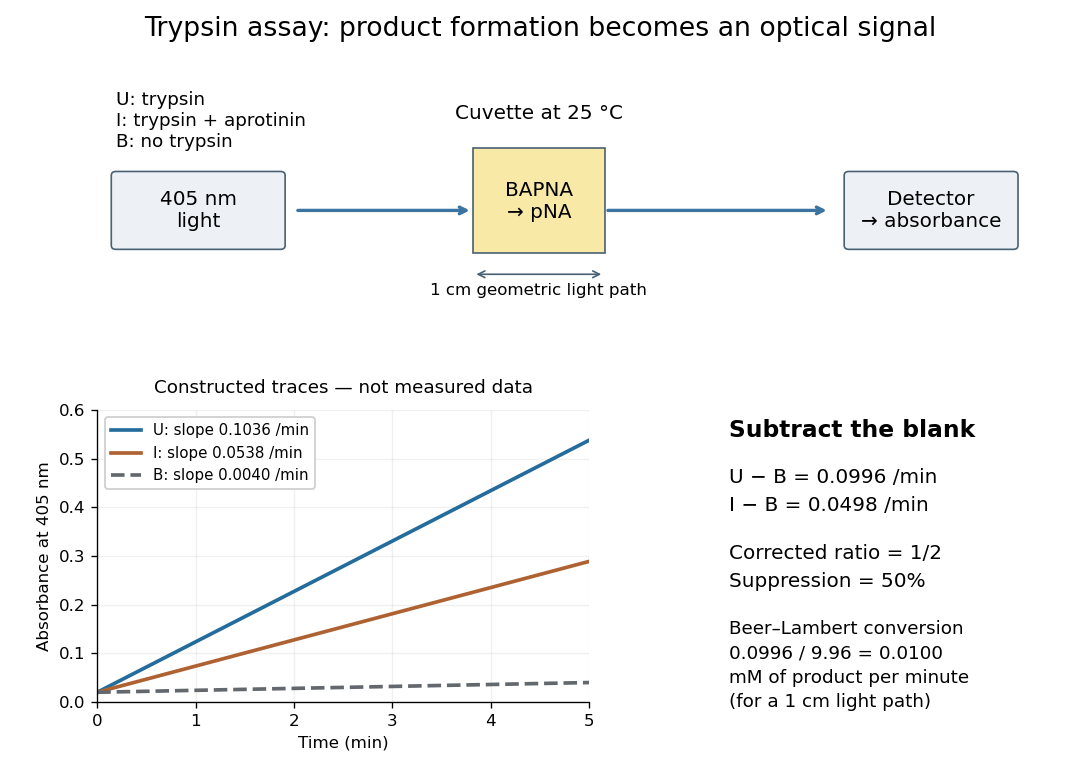

Let , and denote the measured absorbance slopes per minute over the same linear time interval. Blank subtraction gives and . If p-Nitroaniline accounts for the changing absorbance, the Beer-Lambert law givesHere is product molar concentration and is the geometric light path through the chemical solution. Sigma uses .[ref]
Enzymatic Assay of APROTININ - Sigma Quality Control Test Procedure. Enzymatic Assay of APROTININ, p. 2: Calculations, millimolar extinction coefficient at 405 nm
Choose original illustrative slopes , and . The corrected uninhibited slope is , giving at . In , the product amount of substance increases at . The corrected inhibited slope is , half as large. The relative suppression is thereforeThe background cancels in the numerator, but remains essential in the denominator. Using uncorrected slopes would instead give about . Differentiating with fixed and explains the rate conversion; dimensional analysis checks it independently, since .
The inference is a reaction rate on BAPNA under the stated conditions, rather than a direct count of trypsin molecules or proof of every cut in a protein. Cloudiness, other absorbing solutes, or different product protonation can compromise the Beer-Lambert law interpretation. A matched blank and a linear interval are therefore part of the measurement's meaning. A coloured enzyme inhibitor may require its own matched blank; a changed substrate or pH requires a fresh calibration. The constructed constant slopes above describe only that interval, not indefinite product accumulation.
Articles by others on the same topic
There are currently no matching articles.