Let each drive region have length and the drive-free gap have length , measured edge to edge. A particle of constant speed experiences and . For a normalized detected-beam speed probability density function , sum the transition probabilities, not the probability amplitudes of different particles:The displayed is an ideal effusion flux distribution, with speed scale , uniform transmission and speed-independent detection efficiency. It is not a claim about any particular clock's selected beam. The substitution gives , proving normalization. Actual apertures, state selection and readout can change the effective weights.
For an original example choose , , and . The reference particle has , and resonant pulses. The instantaneous-pulse width would be . The exact finite-pulse width for that single speed is about ; the chosen distribution also reduces the on-resonance average to approximately because not every particle receives a pulse.
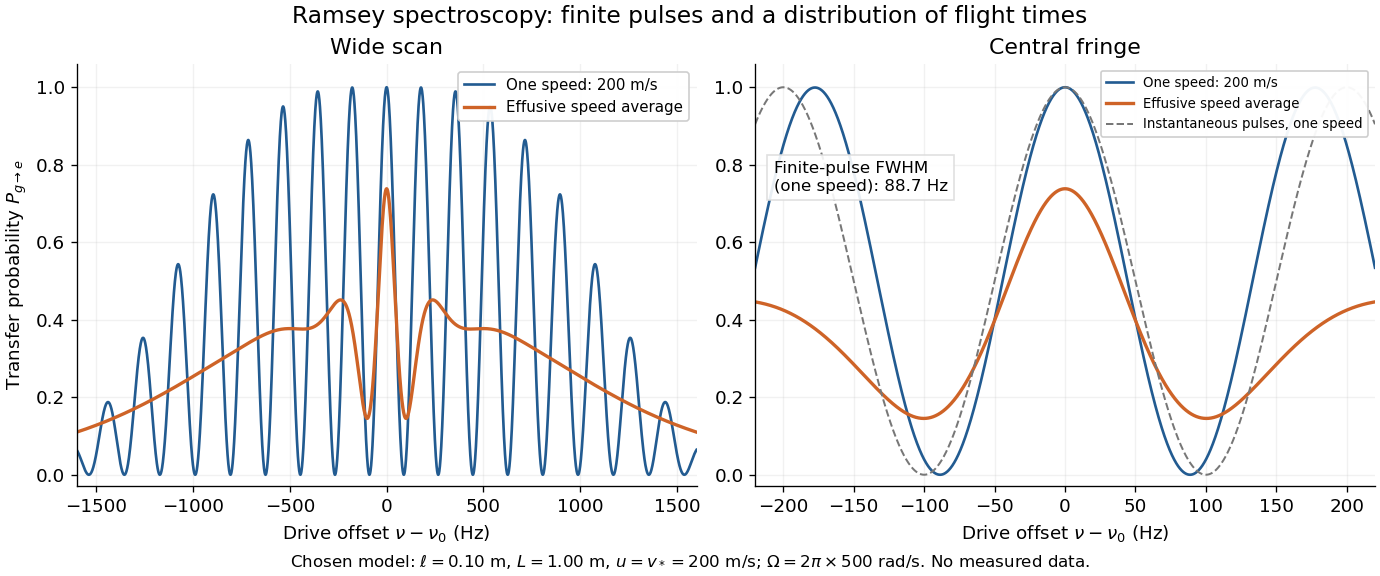

Different velocities smear side fringes because varies across the beam. Nevertheless every term is even in , so this symmetric ideal-model average has no odd line asymmetry that could displace the central lock point. Reduced contrast or altered width alone is not evidence of a shifted line center. A speed-dependent transition shift or unequal drive quantum phases changes that conclusion; atomic clock frequency shifts explains why these distinctions matter experimentally.
Articles by others on the same topic
There are currently no matching articles.