The Wu experiment was performed by Chien-Shiung Wu, Ernest Ambler, Raymond Webster Hayward, Dale D. Hoppes, and Ralph Percy Hudson; its 1957 report was Experimental Test of Parity Conservation in Beta Decay. Their experiment supplied the evidence that the Lee-Yang proposal for a parity test had called for.[ref]
The Fall of Parity Photo Gallery with Short Biographies by National Institute of Standards and Technology. Experimentalists: the five named biographies; theorists: Lee and Yang
A cobalt-60 surface layer on a cerium magnesium nitrate crystal was cooled by adiabatic demagnetization; a solenoid's magnetic field polarized its atomic nuclei. An internal anthracene counter detected Electrons by particle scintillation; a light pipe carried flashes to a photomultiplier. Polar and equatorial gamma ray counters monitored nuclear polarization and effective temperature; bulk thermometry could miss surface heating.[ref]
Experimental Test of Parity Conservation in Beta Decay by Chien-Shiung Wu and others. p. 1413, Fig. 1 and apparatus paragraphs; p. 1414, demagnetization followed by vertical solenoid
Reversing nuclear polarization reversed the Electron excess; warming erased it with gamma ray anisotropy. Warm rates were field-independent. Cooling-field reversal checked remanence; poorly polarized sources checked magnetic deflection. Electrons favored the direction opposite spin.[ref]
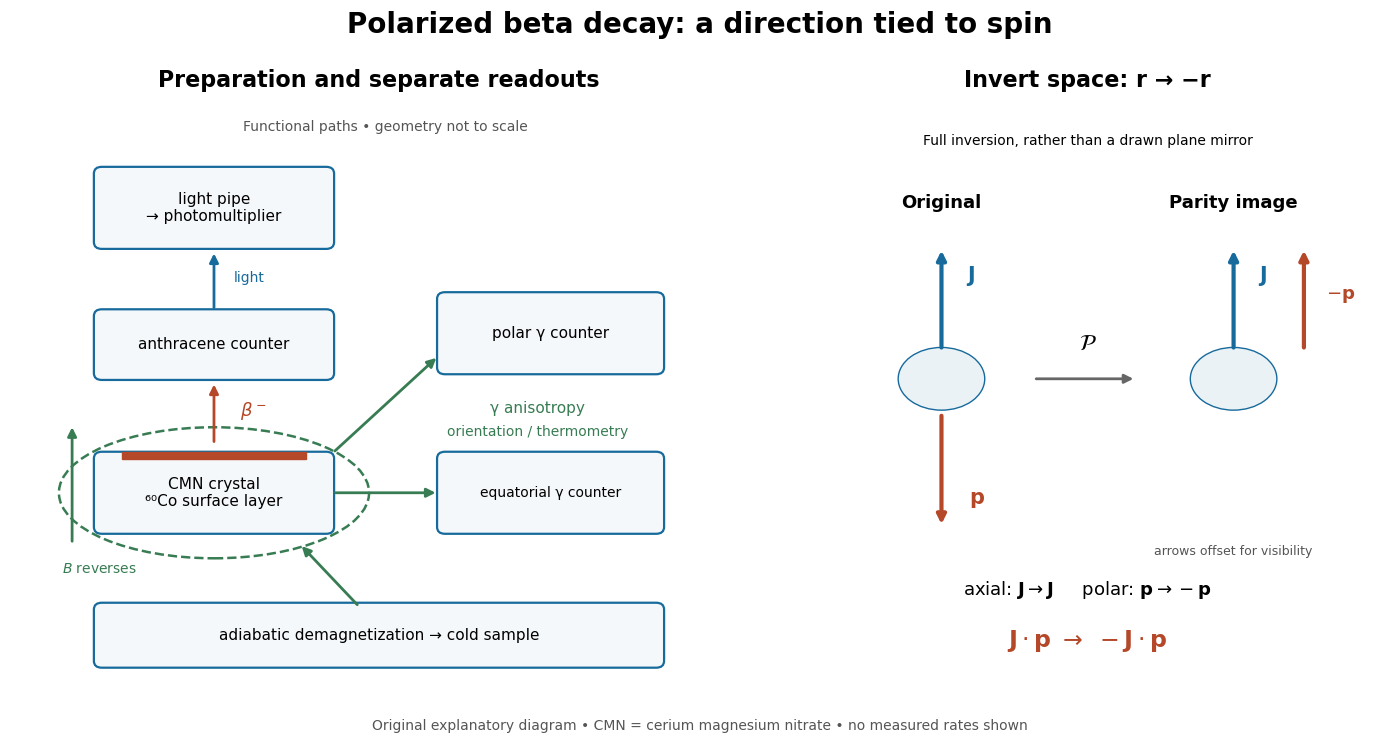
What the apparatus measures, and what spatial inversion changes
. Functional layout, with paths separated for readability. The right-hand construction inverts every spatial coordinate: a polar momentum reverses while an axial spin remains fixed. It is a geometric argument, not a second historical apparatus. Details.The gamma ray anisotropy diagnoses the preparation; the Electron asymmetry diagnoses parity violation. These are different jobs. A directionally uneven gamma ray signal alone need not violate parity conservation: a distribution even in the cosine of the angle can distinguish an axis from its perpendicular without distinguishing its two ends. The spin-momentum correlation instead distinguishes those ends.
The inference requires control of changes in detection efficiency, Electron transport and nuclear polarization. A fixed detector under spin reversal avoids physically exchanging detector positions, but still requires checks for magnetic field effects. The result establishes parity violation in this weak interaction process. A precise microscopic coupling requires more information than the existence or sign of a counting asymmetry; the following model makes that distinction explicit.
Articles by others on the same topic

The Wu experiment refers to a key scientific experiment conducted by physicist Chien-Shiung Wu in the 1950s that provided crucial evidence for the theory of parity violation in weak interactions. In the Wu experiment, which took place in 1956, Wu and her colleagues studied the beta decay of cobalt-60 (\(^{60}\)Co).

