Consider a parent atomic nucleus at rest. Write its signed nuclear polarization along a fixed axis as , where is its maximal spin component. Let be the angle of the emitted Electron momentum to that axis and let . Use for the parity operator, so it is not confused with .
For an axially symmetric leading-dipole model, retain a constant and the term linear in the polarization vector . Rotational symmetry makes the directional term proportional to . Define its dimensionless coefficient as . At fixed Electron energy the relative intensity and normalized probability density function per solid angle are thereforeThe factor is the conventional separation of the speed dependence; rotational symmetry alone does not determine that dependence or . The coefficient contains the decay dynamics. This leading model omits higher angular terms and detailed recoil and radiative effects. A partially oriented higher-spin ensemble can also have alignment that is not specified by its vector nuclear polarization alone.
The unit-integral condition follows without any model of a detector:Thus has unit angular average, while the probability density function in the polar angle alone contains the Jacobian determinant factor:In particular, itself is neither a normalized probability density function in nor a detector count. Positivity on gives .
Under full spatial reflection, but . The latter follows already for orbital angular momentum from ; spin has the same axial vector transformation. Hence is a pseudoscalar, and . If parity conservation held for this model, equal probabilities for the inverted process would force . Conversely, in an unpolarized sample proves nothing about .
Integrating over the two hemispheres gives a useful original check:Choose , , and , so . Then the forward and backward hemisphere probabilities are and , and their counting asymmetry is . These are chosen teaching values, not measured values from the Wu experiment. At a single energy, the angular shape determines the product ; it cannot separately determine without a polarization calibration.
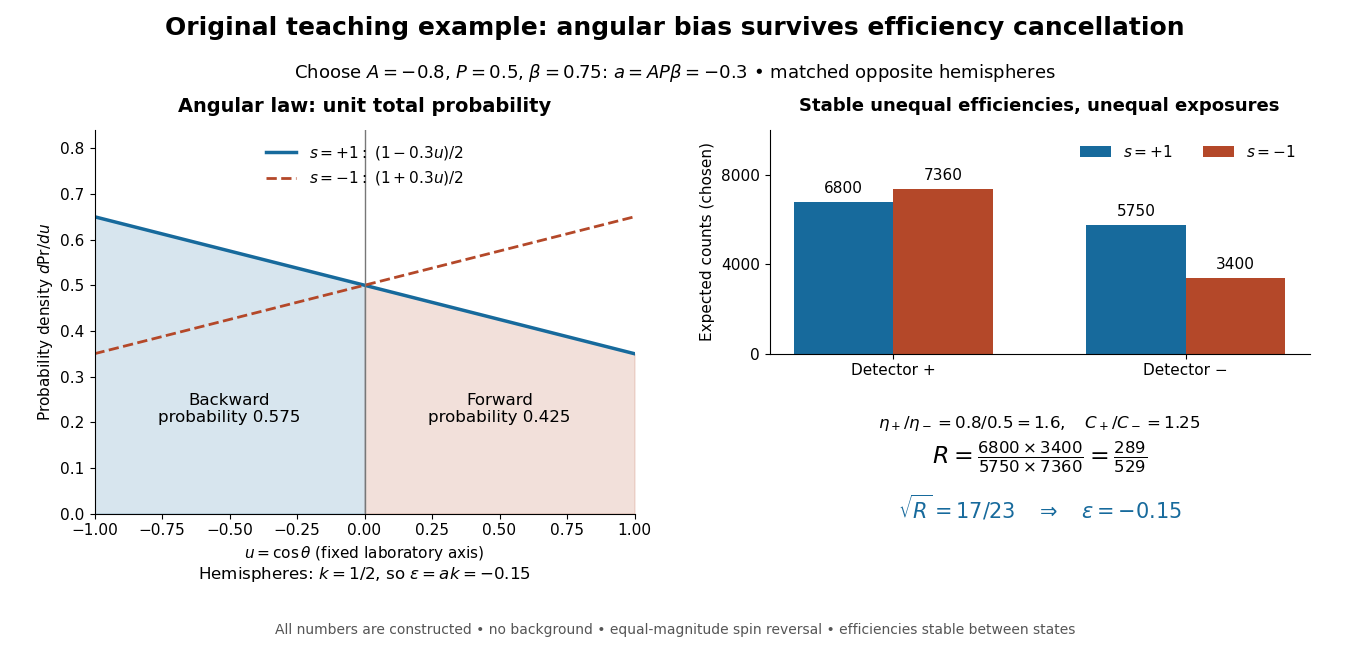
Chosen angular probabilities and detector-efficiency cancellation
. Original model with . The angular probability is distinct from a detector count; opposite hemispheres average the cosine to . Unequal efficiencies and exposures distort individual detector ratios, while a reversal cross-ratio recovers the chosen hemispheric asymmetry. All counts are constructed. Details.
Consider a teaching extension with two opposite detectors, labelled and by fixed laboratory directions, and two preparation states with equal and opposite nuclear polarization. This is an original two-detector model; the historical Wu experiment used a fixed internal Electron counter with reversal.[ref]
The Reversal of Parity Law in Nuclear Physics by National Institute of Standards and Technology. Apparatus explanation and December 27 notebook: fixed beta counter, reversed solenoid current, and warming
Let describe the exposure in each state and the stable detection efficiency of detector .For matched opposite acceptances, write their common mean absolute cosine as . The four expected positive counts areThe same-state ratios each retain the unequal detection efficiencies:Dividing these ratios gives the spin-reversal cross-ratio for beta decay:Both the exposure ratio and the detection efficiency ratio cancel. The positive square root is essential: positive expected counts and make positive.
For the chosen , opposite hemispheres give , hence . Choose , , , and , with their common acceptance factor absorbed into . The four expected counts in the displayed order are , , , and . ThusThe first raw detector ratio exceeds one despite negative : detector imbalance can overwhelm the physical directional preference. Reversal separates the stable imbalance from the term that changes sign.
A detector collects a range of solid angles, not a single direction. If its nonnegative angular response is , defineIntegrating the polarized beta-decay angular distribution gives a count proportional to . For a uniform forward cone with half-angle , put . Direct integration givesThe opposite cone has mean cosine . A hemisphere gives ; a narrow cone tends to . Hence a spin-reversal cross-ratio for beta decay measures , and an acceptance correction is needed to obtain .
With unequal angular responses, let the two laboratory mean cosines be and , including their signs. Then the actual expectation iswhich reduces to the simple square only when . The cancellation of stable multiplicative detection efficiencies survives, but their angular shapes still matter. An energy-integrated response likewise averages with the accepted spectrum; a mean speed cannot in general be substituted independently of acceptance.
Additive backgrounds, unequal polarization magnitudes or detection efficiencies that change on reversal do not have the assumed factorization. For example, a reversal-dependent efficiency cross-ratio multiplies by . Background subtraction also creates statistical complications: positive expected signal counts are assumed in this derivation, whereas finite samples with Poisson distributions can contain zero counts. Taking square roots of negative background-subtracted counts is not a valid estimator. These limits explain why reversal and independent preparation checks belong together.
Articles by others on the same topic
There are currently no matching articles.