
Fatty acids are carboxylic acids with long hydrocarbon chains, which can vary in length and degree of saturation. They are essential components of lipids (fats and oils) and play crucial roles in biological processes. ### Key Features of Fatty Acids: 1. **Structure**: - **Carboxyl Group**: Each fatty acid has a carboxyl (-COOH) group at one end, which gives it acidic properties.
Applejack can refer to a few different things, depending on the context: 1. **Cider**: Traditionally, applejack is a type of alcoholic beverage made from apples, similar to apple cider but with a higher alcohol content. It is produced through the process of freezing cider and removing the ice, which concentrates the alcohol. 2. **Character**: In the realm of popular culture, Applejack is also a character from the animated television series "My Little Pony: Friendship Is Magic.
It is understandable that you might not be able to reproduce a paper that does a natural science experiment, given that physics is brutal.
But for papers that have either source code or data sets, academic journals must require that those be made available, or refuse to publish.
Any document without such obvious reproducibility elements is a white paper, not a proper peer reviewed paper.
The small one in comparison to the ribosome large subunit.
Prime factor exponent notation is a way to express a number as a product of its prime factors, where each prime factor is raised to an exponent that indicates how many times that factor is used in the product. This notation is particularly useful in number theory for simplifying calculations, finding factors, and understanding the properties of numbers.
This is an extremely widely used technique as of 2020 and much earlier.
If allows you to amplify "any" sequence of choice (TODO length limitations) between a start and end sequences of interest which you synthesize.
If the sequence of interest is present, it gets amplified exponentially, and you end up with a bunch of DNA at the end.
You can then measure the DNA concentration based on simple light refraction methods to see if there is a lot of DNA or not in the post-processed sample.
Even Ciro Santilli had some contact with it at: Section "How to use an Oxford Nanopore MinION to extract DNA from river water and determine which bacteria live in it", see: PCR!
One common problem that happens with PCR if you don't design your primers right is: en.wikipedia.org/wiki/Primer_dimer
Sometime it fails: www.reddit.com/r/molecularbiology/comments/1kouomw/when_your_pcr_fails_again_and_you_start/and a comment:
Nothing humbles you faster than a bandless gel. One minute you’re a scientist, the next you’re just a pipette-wielding wizard casting spells that don’t work. Meanwhile, physicists are out there acting like gravity always behaves. Smash that upvote if your reagents have ever gaslit you.
PCR = Pray, Cry, Repeat
In 2020 physics, best explained by general relativity.
How to use an Oxford Nanopore MinION to extract DNA from river water and determine which bacteria live in it Sample collection by  Ciro Santilli 37 Updated 2025-07-16
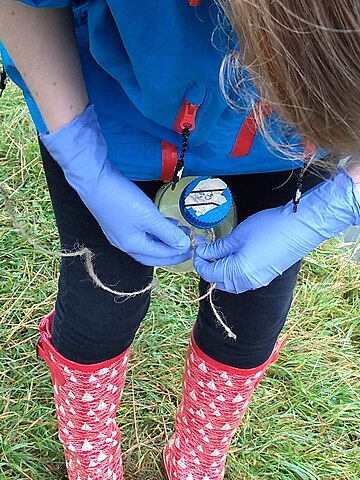
Ciro Santilli 37 Updated 2025-07-16As you would expect, not much secret here, we just dumped a 1 liter glass bottle with a rope attached around the neck in a few different locations of the river, and pulled it out with the rope.



Pinned article: Introduction to the OurBigBook Project
Welcome to the OurBigBook Project! Our goal is to create the perfect publishing platform for STEM subjects, and get university-level students to write the best free STEM tutorials ever.
Everyone is welcome to create an account and play with the site: ourbigbook.com/go/register. We belive that students themselves can write amazing tutorials, but teachers are welcome too. You can write about anything you want, it doesn't have to be STEM or even educational. Silly test content is very welcome and you won't be penalized in any way. Just keep it legal!
Intro to OurBigBook
. Source. We have two killer features:
- topics: topics group articles by different users with the same title, e.g. here is the topic for the "Fundamental Theorem of Calculus" ourbigbook.com/go/topic/fundamental-theorem-of-calculusArticles of different users are sorted by upvote within each article page. This feature is a bit like:
- a Wikipedia where each user can have their own version of each article
- a Q&A website like Stack Overflow, where multiple people can give their views on a given topic, and the best ones are sorted by upvote. Except you don't need to wait for someone to ask first, and any topic goes, no matter how narrow or broad
This feature makes it possible for readers to find better explanations of any topic created by other writers. And it allows writers to create an explanation in a place that readers might actually find it.
Figure 1. Screenshot of the "Derivative" topic page. View it live at: ourbigbook.com/go/topic/derivativeVideo 2. OurBigBook Web topics demo. Source. - local editing: you can store all your personal knowledge base content locally in a plaintext markup format that can be edited locally and published either:This way you can be sure that even if OurBigBook.com were to go down one day (which we have no plans to do as it is quite cheap to host!), your content will still be perfectly readable as a static site.
- to OurBigBook.com to get awesome multi-user features like topics and likes
- as HTML files to a static website, which you can host yourself for free on many external providers like GitHub Pages, and remain in full control

Figure 3. Visual Studio Code extension installation.
Figure 4. Visual Studio Code extension tree navigation.
Figure 5. Web editor. You can also edit articles on the Web editor without installing anything locally.Video 3. Edit locally and publish demo. Source. This shows editing OurBigBook Markup and publishing it using the Visual Studio Code extension.Video 4. OurBigBook Visual Studio Code extension editing and navigation demo. Source. 
- Infinitely deep tables of contents:




All our software is open source and hosted at: github.com/ourbigbook/ourbigbook
Further documentation can be found at: docs.ourbigbook.com
Feel free to reach our to us for any help or suggestions: docs.ourbigbook.com/#contact