In mathematics, particularly in the fields of probability theory and statistics, a characteristic function is a tool used to uniquely identify the probability distribution of a random variable. The characteristic function of a random variable is defined as the expected value of the exponential function of the random variable, typically involving a complex variable.
Articles by others on the same topic

The characteristic function of a real random variable isIt determines the probability distribution of .
Here and . By Euler's formula, its real part and imaginary part are and . The complex exponential has absolute value one, so this expected value exists for every real random variable, even without finite absolute moments. Moreover,The bound uses the triangle inequality for a vector-valued integral; the last identity is complex conjugate symmetry.[ref]
Probability: Theory and Examples (fifth edition) by Rick Durrett. §3.3.1 definition, printed p. 125; Theorem 3.3.1(a)–(c), printed p. 126
Consequently the real part is an even function and the imaginary part is an odd function.For a discrete probability distribution with values and probabilities , the characteristic function is : a weighted average of points on the unit circle in the complex plane. For example, if has the Bernoulli distribution with and , thenEach point being averaged has absolute value one, but their directions partially cancel. At , the same average is ; at , it returns to one. The characteristic function is thus neither a probability density function nor a probability mass function: its argument is a frequency parameter, and its values can be complex numbers. This Bernoulli distribution has no probability density function with respect to Lebesgue measure, yet its characteristic function is defined at every frequency.
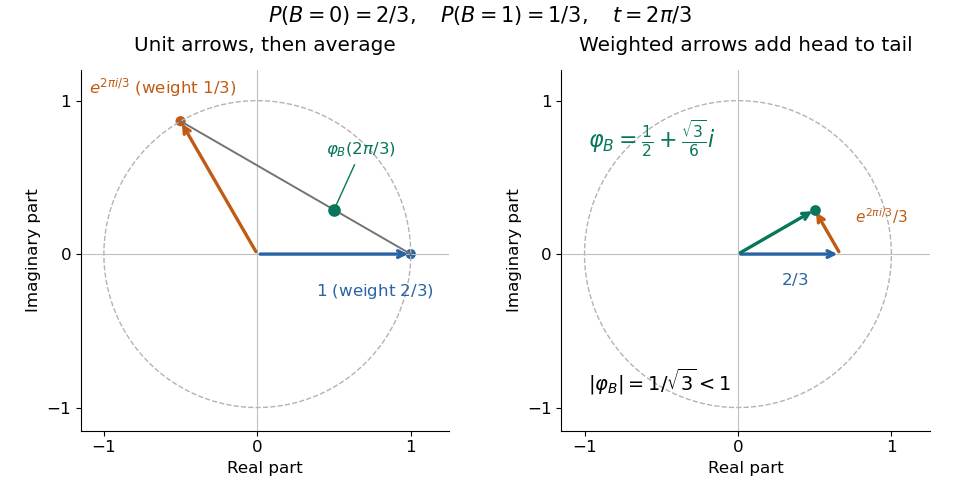

For a probability density function , the same definition becomes , the Fourier transform with the displayed sign convention. The Laplace transform of a nonnegative random variable instead uses for , a real decaying weight. For the Bernoulli distribution above, it is ; neither transform is the probability density function. The uniqueness theorem for characteristic functions explains why the oscillating averages still retain the entire probability law, while the characteristic function of a sum of independent variables turns combining laws into multiplication. These two properties make the representation useful even when directly computing a sum's probability distribution is cumbersome.