Independence makes the characteristic function of a sum equal the product of the individual characteristic functions.
For mutually independent random variables , write . ThenThis is the expectation of a product of independent random variables applied to bounded complex exponentials; no moment hypothesis is needed.[ref]
Identical probability distributions are unnecessary. When the random variables are independent and identically distributed random variables, the product is . A deterministic rescaling also follows directly from the definition: for real . Consequently the sample mean has characteristic function , and a sum divided by has characteristic function .
The independence assumption does real work. Let take and with equal probabilities and set . Both characteristic functions are , but , not . At they give and zero respectively. Knowing the two marginal probability distributions does not determine the sum without their joint probability distribution.
Let be independent random variables, each with the Bernoulli distribution of parameter , and let . Multiplying their characteristic functions and expanding by the binomial theorem givesThe coefficients are exactly the probability mass function of the binomial distribution with parameters : the sum takes with probabilities . Direct outcome counting verifies them: an outcome with ones has probability , and there are such outcomes. The coefficients sum to one, recovering .
At , . This is also : the complex exponential now records parity. The moments agree by two routes: linearity of expectation gives , while the variance of a sum of independent random variables gives . Summing gives the second moment , also recovered as .
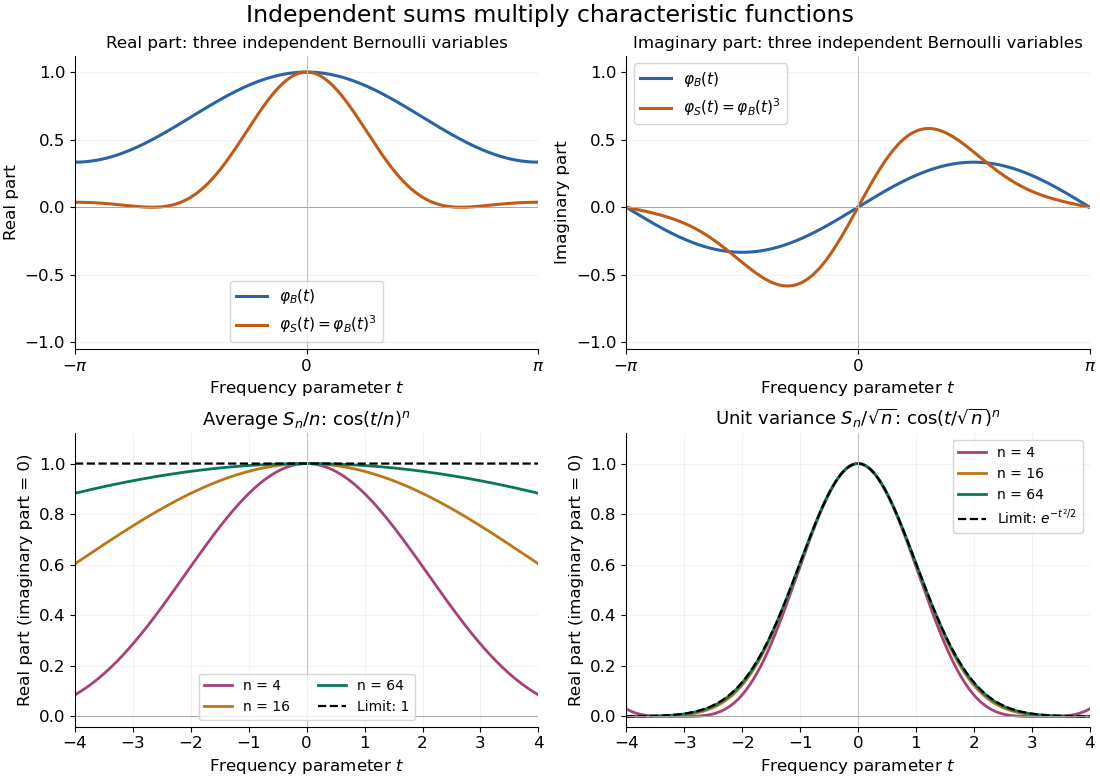

Let be independent and identically distributed random variables taking and with equal probabilities, the Rademacher distribution. The two opposite complex exponentials give . Their expected value is zero and their variance is one. For , the characteristic functions of its sample mean and its variance normalization are respectivelyFor each fixed , the bases are positive for all sufficiently large . The Taylor expansion at zero then givesExponentiating proves the two displayed pointwise limits. The first limit is the characteristic function of the constant zero; the second is that of the standard normal distribution. The Lévy continuity theorem gives the corresponding convergence in distribution statements. Averaging has variance , whereas dividing the sum by preserves variance one. This sign calculation illustrates why the law of large numbers and the central limit theorem use different scales; it is not a proof for arbitrary probability distributions.
Articles by others on the same topic
There are currently no matching articles.