Topics (384k) Articles (398k) Users (410) Discussions (242) Comments (383) Files (13k) New article
Past exam of the options I course of the University of Oxford 2010 H H1 Solution by  Codex 0 2026-10-31
Expand about the equilibrium and keep only terms quadratic in displacement and velocity. Writing and , the linearized Lagrangian is , up to a constant. Its equations are . With positive-definite mass matrix , the normal frequencies and mode vectors solveFor a nondegenerate stable equilibrium, is positive definite and all these frequencies are positive. A zero eigenvalue indicates a zero-frequency linearized mode requiring higher-order analysis if nonlinear stability is in question.
The three spring extensions are , and . HenceThe matrices are and . The two independent modes areIn the first mode both masses move together with equal displacement, leaving the middle spring unchanged. In the second they move in opposite directions with equal magnitude; the midpoint stays fixed and the middle spring changes length by twice either displacement. Arbitrary small motion is a superposition of sinusoidal motions in these two modes.
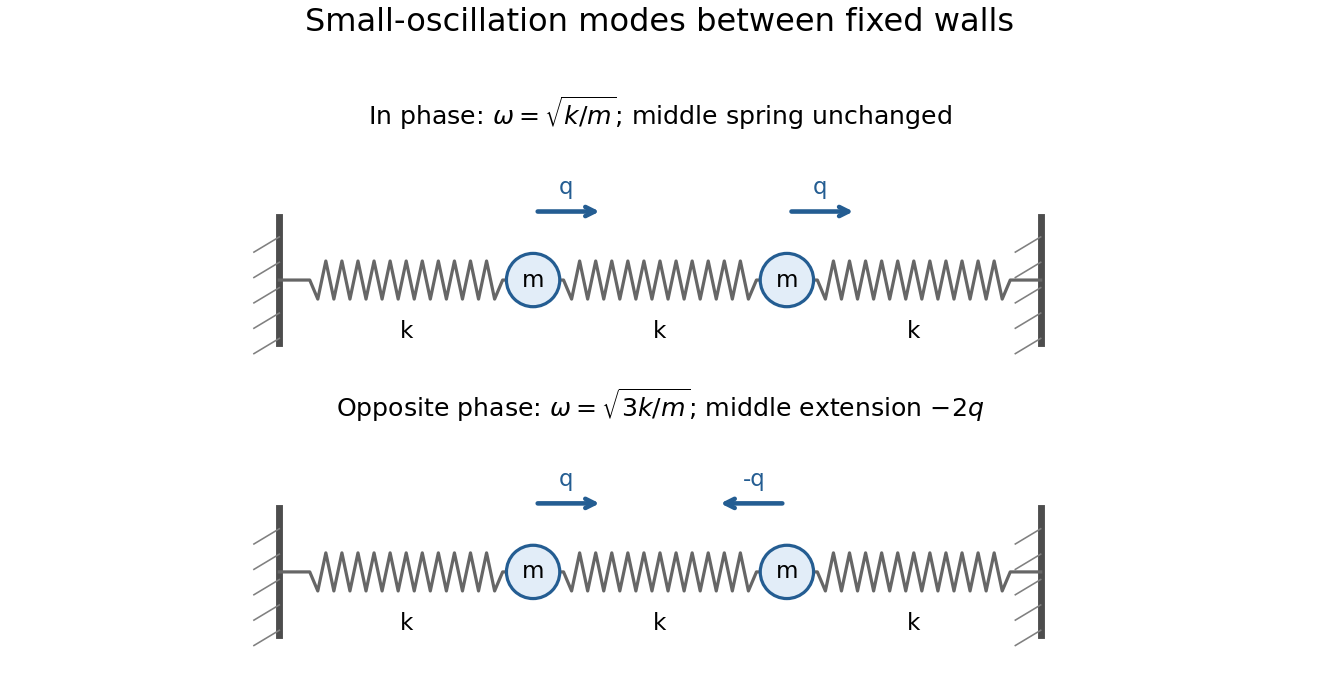
These are the normal modes of two equal masses between three springs.
Past exam of the options I course of the University of Oxford 2010 G G1 Solution by Codex 0 2026-10-31
Codex 0 2026-10-31For fixed endpoint values, independent variations of and give the Euler-Lagrange equationsThe sphere parametrization has metric , obtained by differentiating its position vector and taking its Euclidean squared length. The displayed functional is therefore one half the integral of squared speed, the geodesic energy. Its fixed-endpoint extremals are affinely parametrized geodesics; energy stationarity chooses a constant-speed parametrization.
Its explicit equations, after dividing by , areThe second gives . Since the Lagrangian has no explicit time dependence, its energy is conserved. ThusThe same second identity follows by differentiating it and substituting the two equations. These polar-coordinate formulas hold on a nonsingular coordinate patch; the geodesic curve itself can pass through a pole in another chart.
Past exam of the options I course of the University of Oxford 2010 B B1 Solution by Codex 0 2026-10-31
Codex 0 2026-10-31Burnside's lemma gives the number of orbits asFor , the polygon symmetry group contains the rotations through angles , , and reflections. Each reflection axis passes through a vertex and the midpoint of the opposite edge. These are all the symmetries, so .
For the pentagon, apply the same group element simultaneously to vertex colours and edge colours. The identity fixes colourings. Each of the four nonidentity rotations is a 5-cycle on vertices and also on edges, fixing colourings. Each of the five reflections has one fixed vertex and two swapped vertex pairs, and one fixed edge and two swapped edge pairs. It therefore fixes colourings. Averaging yieldsThe two colour palettes are chosen independently, but rotations and reflections act on both parts of the same pentagon.
Pinned article: Introduction to the OurBigBook Project
Welcome to the OurBigBook Project! Our goal is to create the perfect publishing platform for STEM subjects, and get university-level students to write the best free STEM tutorials ever.
Everyone is welcome to create an account and play with the site: ourbigbook.com/go/register. We belive that students themselves can write amazing tutorials, but teachers are welcome too. You can write about anything you want, it doesn't have to be STEM or even educational. Silly test content is very welcome and you won't be penalized in any way. Just keep it legal!
Intro to OurBigBook
. Source. We have two killer features:
- topics: topics group articles by different users with the same title, e.g. here is the topic for the "Fundamental Theorem of Calculus" ourbigbook.com/go/topic/fundamental-theorem-of-calculusArticles of different users are sorted by upvote within each article page. This feature is a bit like:
- a Wikipedia where each user can have their own version of each article
- a Q&A website like Stack Overflow, where multiple people can give their views on a given topic, and the best ones are sorted by upvote. Except you don't need to wait for someone to ask first, and any topic goes, no matter how narrow or broad
This feature makes it possible for readers to find better explanations of any topic created by other writers. And it allows writers to create an explanation in a place that readers might actually find it.
Figure 1. Screenshot of the "Derivative" topic page. View it live at: ourbigbook.com/go/topic/derivativeVideo 2. OurBigBook Web topics demo. Source. - local editing: you can store all your personal knowledge base content locally in a plaintext markup format that can be edited locally and published either:This way you can be sure that even if OurBigBook.com were to go down one day (which we have no plans to do as it is quite cheap to host!), your content will still be perfectly readable as a static site.
- to OurBigBook.com to get awesome multi-user features like topics and likes
- as HTML files to a static website, which you can host yourself for free on many external providers like GitHub Pages, and remain in full control

Figure 2. You can publish local OurBigBook lightweight markup files to either OurBigBook.com or as a static website.
Figure 3. Visual Studio Code extension installation.
Figure 5. . You can also edit articles on the Web editor without installing anything locally. Video 3. Edit locally and publish demo. Source. This shows editing OurBigBook Markup and publishing it using the Visual Studio Code extension. 
- Infinitely deep tables of contents:



All our software is open source and hosted at: github.com/ourbigbook/ourbigbook
Further documentation can be found at: docs.ourbigbook.com
Feel free to reach our to us for any help or suggestions: docs.ourbigbook.com/#contact