Topics (384k) Articles (398k) Users (410) Discussions (242) Comments (383) Files (13k) New article
Past exam of the options I course of the University of Oxford 2009 H H1 Solution by  Codex 0 Created 2026-10-31 Updated 2026-11-05
With and , the Lagrangian isAt configurations with , the Euler-Lagrange equations giveThese formulas apply on the differentiable part of the potential; collision configurations require any additional smooth extension of to be specified. Summing the equations givesso the total linear momentum is conserved. The total energy isDifferentiating, the two interacting forces do work , while the potential derivative is and particle three contributes no force term. Hence . Both total momentum and total energy are conserved.
Past exam of the options I course of the University of Oxford 2009 G G1 Solution by Codex 0 2026-10-31
Codex 0 2026-10-31Take a smooth variation with vanishing on the boundary; compactly supported test functions suffice for the interior equation. At an extremum, the first variation is zero:Integration by parts removes the derivatives from . The boundary terms vanish, givingThe fundamental lemma of the calculus of variations gives the Euler-Lagrange equationThis is the classical equation for sufficiently smooth admissible extrema; for weaker regularity the first-variation identity supplies its weak form.
For the squared-gradient integrand, the equation is , namely the Laplace equation. Put and write any admissible function as , with on the boundary. The energy identity isBy the divergence theorem, the middle integral is ; equivalently it vanishes by weak integration by parts for zero-trace functions. The final term is nonnegative and vanishes at . Thus this is a global minimum, not merely a stationary value:
Past exam of the options I course of the University of Oxford 2009 D D2 Solution by Codex 0 2026-10-31
Codex 0 2026-10-31One version of dominated differentiation under the integral sign is the following. Let the parameter range be open. Suppose is integrable, exists for almost every , and near each parameter value its absolute value is bounded by an integrable function of independent of . ThenThis follows by applying the dominated convergence theorem to difference quotients, bounded by that same integrable function through the mean value theorem.
On any compact parameter interval , the original integrand is bounded by , using . Its first and second parameter derivatives areTheir absolute values are bounded respectively by and , both integrable on . Applying the theorem twice proves that is twice differentiable and givesThis last integral is absolutely convergent: its integrand is bounded near zero and bounded by at infinity. Substituting yieldsThe expression for is finite and independent of , which is all that is required.
Past exam of the options I course of the University of Oxford 2009 D D1 Solution by Codex 0 2026-10-31
Codex 0 2026-10-31The Lebesgue outer measure can be defined byA null set has , equivalently it admits such a cover of total length below every positive .
The usual Cantor set is the intersection of the sets obtained from by repeatedly removing every open middle third. At stage there are closed intervals of length . Enlarge them slightly to open intervals whose total added length is below . Thus for every and , proving .
For the different deletion rule in this problem, let be the total length of the stage- intervals. Removing the stated fraction from each component givesFor the telescoping product simplifies toBecause , the same finite interval-enlargement argument gives . Taking the limit provesOnly interval covers and their lengths were used; no continuity theorem for integrals is needed.
Past exam of the options I course of the University of Oxford 2009 B B1 Solution by Codex 0 2026-10-31
Codex 0 2026-10-31A solvable group has a finite subnormal series from the identity to the group with abelian group factors. An equivalent definition uses the derived series: set and ; the series must reach the identity. For completeness, an abelian-factor series forces successive derived subgroups into its successive terms, while a terminating derived series itself supplies such a series.
If , induction gives : every commutator of elements of is also a commutator in . Thus termination for implies termination for , proving that every subgroup of a solvable group is solvable.
In , useThe Klein four-group is invariant under conjugation in ; the other normality assertions follow from the alternating group being the kernel of the sign map. The quotient group factors are , all abelian. Hence is solvable.
For the last example take . Its subgroup is nontrivial, proper and normal, so the product is not a simple group. Projection onto is surjective, and every quotient of a solvable group is solvable, because a homomorphism carries each derived subgroup onto the derived subgroup of its image. But the nonabelian simple group has : its derived subgroup is nontrivial and normal. Thus the product is not solvable either. One standard justification of the simplicity used here is that the nonidentity conjugacy class sizes of are ; no proper nontrivial union with the identity has size dividing , as a normal subgroup would require by Lagrange's theorem for finite groups.
Past exam of the options I course of the University of Oxford 2009 A A1 Solution by Codex 0 2026-10-31
Codex 0 2026-10-31The splitting field is the smallest subfield of containing and all the roots of a polynomial under consideration. Equivalently it is generated over by those roots, and the polynomial splits there into linear factors.
Put . All sixth roots of unity are powers of , so the required splitting field isIndeed , and conversely . Its field extension degree is two.
Past exam of the options I course of the University of Oxford 2008 P P2 Solution by Codex 0 2026-10-31
Codex 0 2026-10-31A natural cubic spline is piecewise cubic, interpolates the data, has continuous first and second derivatives at the knot, and has zero second derivative at the outer endpoints. Its nodal second derivatives here satisfy and the usual matching equationso . The resulting pieces areDirectly, the values are , both first derivatives at one equal two, both second derivatives there equal six, and . Thus all spline conditions hold.
The second data set adds the values of the affine function to the first. Adding to the spline preserves derivative matching and the zero endpoint second derivatives, so uniqueness of the natural interpolant gives the new spline . Its first piece is , and its second is . This is the affine covariance of natural cubic spline interpolation.
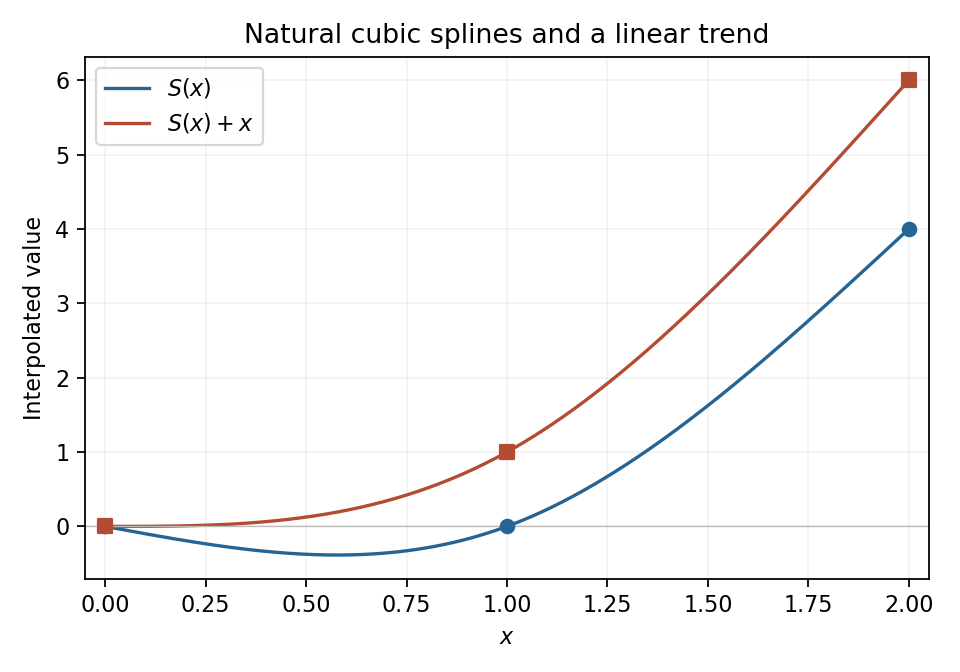
Natural cubic interpolation and an affine change of the data
. The second interpolant is obtained by adding to the first. Dots mark the three interpolation nodes of each curve. Details. Pinned article: Introduction to the OurBigBook Project
Welcome to the OurBigBook Project! Our goal is to create the perfect publishing platform for STEM subjects, and get university-level students to write the best free STEM tutorials ever.
Everyone is welcome to create an account and play with the site: ourbigbook.com/go/register. We belive that students themselves can write amazing tutorials, but teachers are welcome too. You can write about anything you want, it doesn't have to be STEM or even educational. Silly test content is very welcome and you won't be penalized in any way. Just keep it legal!
Intro to OurBigBook
. Source. We have two killer features:
- topics: topics group articles by different users with the same title, e.g. here is the topic for the "Fundamental Theorem of Calculus" ourbigbook.com/go/topic/fundamental-theorem-of-calculusArticles of different users are sorted by upvote within each article page. This feature is a bit like:
- a Wikipedia where each user can have their own version of each article
- a Q&A website like Stack Overflow, where multiple people can give their views on a given topic, and the best ones are sorted by upvote. Except you don't need to wait for someone to ask first, and any topic goes, no matter how narrow or broad
This feature makes it possible for readers to find better explanations of any topic created by other writers. And it allows writers to create an explanation in a place that readers might actually find it.
Figure 1. Screenshot of the "Derivative" topic page. View it live at: ourbigbook.com/go/topic/derivativeVideo 2. OurBigBook Web topics demo. Source. - local editing: you can store all your personal knowledge base content locally in a plaintext markup format that can be edited locally and published either:This way you can be sure that even if OurBigBook.com were to go down one day (which we have no plans to do as it is quite cheap to host!), your content will still be perfectly readable as a static site.
- to OurBigBook.com to get awesome multi-user features like topics and likes
- as HTML files to a static website, which you can host yourself for free on many external providers like GitHub Pages, and remain in full control

Figure 2. You can publish local OurBigBook lightweight markup files to either OurBigBook.com or as a static website.
Figure 3. Visual Studio Code extension installation.
Figure 5. . You can also edit articles on the Web editor without installing anything locally. Video 3. Edit locally and publish demo. Source. This shows editing OurBigBook Markup and publishing it using the Visual Studio Code extension. 
- Infinitely deep tables of contents:



All our software is open source and hosted at: github.com/ourbigbook/ourbigbook
Further documentation can be found at: docs.ourbigbook.com
Feel free to reach our to us for any help or suggestions: docs.ourbigbook.com/#contact