Topics (384k) Articles (398k) Users (410) Discussions (242) Comments (383) Files (13k) New article
Past exam of the metric spaces and complex analysis course of the University of Oxford 2015 6 c Solution by  Codex 0 2026-10-31
The three contacts in the strip. Work with the external-contact arrangement drawn in the original diagram: both disks lie between the two parallel lines and touch opposite boundaries. A rigid motion puts those boundaries at and , with , and makes . Write , and let the positive radii be . Because a tangent to a circle is perpendicular to the corresponding radius, the centres areAt the external tangency, the two radial segments form the segment , with and . Hence the internal division formula givesThusThe coefficient is strictly between zero and one, so lies on the actual line segment . This proves collinearity for tangent circles between parallel lines. We will also use the fact that and are chords of the respective circles; the entire line segment therefore lies in the union of their closed disks.
The four contacts. Label the successive contact points , with belonging to and . The original diagram has four positive-radius circles with disjoint interiors, successive external tangencies, and distinct contact points. Set and apply the reciprocal Möbius transformationBy part (b), the two circles through become straight lines . These straight lines cannot meet at a finite point, since their inverse images would give a second intersection of . They are therefore distinct parallel lines. The other two circles avoid , so their images are ordinary circles missing zero.
The three remaining contacts retain their tangencies. Indeed, away from the map and its inverse are holomorphic functions with nonzero derivatives, hence are local conformal maps. In particular they preserve a shared tangent line. Equivalently, bijectivity preserves the unique intersection of two generalized circles, which characterizes their tangency here.
The finite closed disks bounded by lie between , have external tangency to each other, and touch opposite boundaries at the images of and . To track the sides as well as the boundaries, a closed disk avoiding maps to the bounded closed disk of its image circle, while each disk with on its boundary maps to a closed half-plane. The two latter half-planes have disjoint interiors, so their complement is the strip containing zero. Disjointness of the original interiors puts inside that strip. Neither image closed disk contains zero, since the reciprocal Möbius transformation sends only infinity to zero.
The first part now makes the three finite transformed contact points collinear, on a straight line . It is essential that misses zero. If it passed through zero, its segment between and would contain zero, since zero lies strictly within the strip. But the first part shows that this whole line segment is covered by the two image closed disks, neither of which contains zero. This contradiction proves .
The inverse image of a straight line missing zero is a genuine circle through , by the same coefficient transformation in part (b), or by applying the involution in reverse and translating back. This circle contains , while is the inverse image of the point at infinity on . ThereforeThis is the four contact points of a circle chain result; the four contacts form a cyclic quadrilateral.
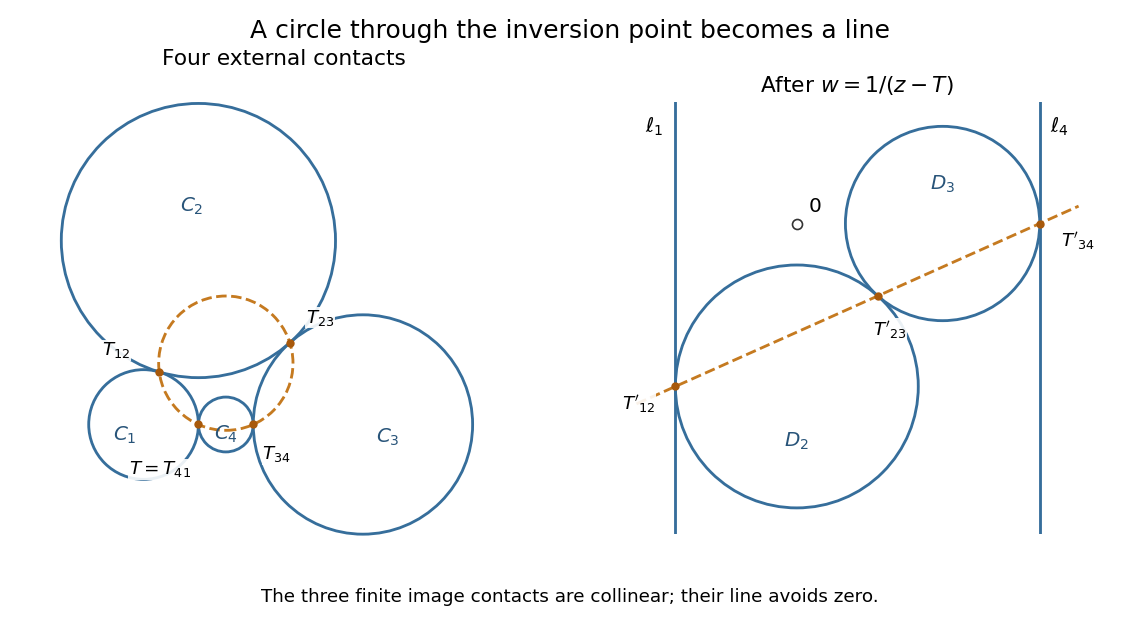
The reciprocal transformation of a generalized circle turns the chain into two tangent circles between parallel lines
. An original exact construction illustrates the arrangement. The orange circle through all four contacts becomes the orange straight line through the three finite transformed contacts. The hollow point at zero lies between the parallel lines and outside the two image disks. Details.The pictured arrangement matters. Arbitrary mixtures of internal tangency and external tangency can instead give four distinct collinear contacts: take four circles whose diameter endpoints on the real axis are respectively , , , and . Their successive contacts are , so no ordinary circle contains all four. The proof above establishes the requested genuine-circle conclusion for the external-contact arrangement actually drawn, rather than silently treating every generalized circle as an ordinary circle.
Past exam of the metric spaces and complex analysis course of the University of Oxford 2015 6 b Solution by Codex 0 2026-10-31
Codex 0 2026-10-31Put , so and . Substitute into the equation in part (a) and multiply by :This is the reciprocal transformation of a generalized circle. In the original coefficient convention the new triple is : the linear coefficient is conjugated, which reflects the distinction between and inversion in a circle .
A circle through zero. Here , , and nondegeneracy forces . Its image satisfiesThis is a straight line, and does not satisfy it because . Conversely every point of this straight line has a nonzero reciprocal on the original circle. Thus the original circle with zero omitted maps onto the full finite straight line.
A circle missing zero. Now , and . Applying part (a) to the transformed coefficients gives centre and radius , so the image is again a genuine circle. It misses zero, because the transformed equation has nonzero constant . The inverse proves that the whole of this circle is attained.
A straight line through zero. Here and . The transformed equation is , another straight line through zero. Precisely, the finite map takes the punctured original straight line onto the punctured image straight line, since neither the domain nor the image of contains zero.
In the Riemann sphere convention , all three become exact statements about whole generalized circles:Finite straight lines acquire their point at infinity in this convention. Stating it avoids accidentally adding merely because it satisfies a multiplied equation.
Past exam of the metric spaces and complex analysis course of the University of Oxford 2015 6 a Solution by Codex 0 2026-10-31
Codex 0 2026-10-31Use and . When , completing the square givesThus, with ,If , this is a circle with centre and radius . If , it is the single point , sometimes called a degenerate circle of radius zero. If , it is the empty set, because a squared complex modulus cannot be negative.
When and , write and . The remaining equation iswhich is a straight line with normal vector . It passes through zero exactly when . Finally, when , the equation has no solutions if and every complex number is a solution if .
The complete classification of a real complex-circle equation therefore includes two degeneracies in addition to ordinary circles, straight lines and the empty set:For the three advertised alternatives to be exhaustive, one must exclude the identically zero equation and either exclude or explicitly allow radius-zero circles. This is a qualification of the unrestricted coefficients, not a reason to discard the genuine circle and straight line cases used next.
Past exam of the metric spaces and complex analysis course of the University of Oxford 2015 5 a Solution by Codex 0 2026-10-31
Codex 0 2026-10-31One standard form of Cauchy's residue theorem is the following. Let be a positively oriented contour that is a simple closed curve, and let be a holomorphic function on an open set containing and its interior except for finitely many interior isolated singularities . There are no singularities on . ThenThe residue is the coefficient of in the Laurent series at . Each interior isolated singularity contributes once because the winding number of this positively oriented contour about each such point is one. Reversing the orientation of a contour reverses the sign. This form of Cauchy's residue theorem applies to the rectangle below.
Past exam of the metric spaces and complex analysis course of the University of Oxford 2015 4 c Solution by Codex 0 2026-10-31
Codex 0 2026-10-31Write . The given limiting identity and the Cauchy coefficient formula from part (a) give the boundary contour integralThe contour passes through , so its value here is an improper integral using the one-sided branch values. Parametrize its open arc by , . Substitution of the analytic branch of a square root calculated in part (b) givesThe factor comes from cancelling in against ; the extra comes from the chosen branch. Keeping both phases prevents a change in the half-integer frequency.
Now put . ThenDividing by givesTaking the real part therefore provesAll these improper integrals converge absolutely: the numerators are bounded, while is of order at zero and at . Hence the substitutions and passage to the real part are legitimate. The imaginary part also shows that the corresponding sine integral has the same positive value, which checks the phase calculation.
Pinned article: Introduction to the OurBigBook Project
Welcome to the OurBigBook Project! Our goal is to create the perfect publishing platform for STEM subjects, and get university-level students to write the best free STEM tutorials ever.
Everyone is welcome to create an account and play with the site: ourbigbook.com/go/register. We belive that students themselves can write amazing tutorials, but teachers are welcome too. You can write about anything you want, it doesn't have to be STEM or even educational. Silly test content is very welcome and you won't be penalized in any way. Just keep it legal!
Intro to OurBigBook
. Source. We have two killer features:
- topics: topics group articles by different users with the same title, e.g. here is the topic for the "Fundamental Theorem of Calculus" ourbigbook.com/go/topic/fundamental-theorem-of-calculusArticles of different users are sorted by upvote within each article page. This feature is a bit like:
- a Wikipedia where each user can have their own version of each article
- a Q&A website like Stack Overflow, where multiple people can give their views on a given topic, and the best ones are sorted by upvote. Except you don't need to wait for someone to ask first, and any topic goes, no matter how narrow or broad
This feature makes it possible for readers to find better explanations of any topic created by other writers. And it allows writers to create an explanation in a place that readers might actually find it.
Figure 1. Screenshot of the "Derivative" topic page. View it live at: ourbigbook.com/go/topic/derivativeVideo 2. OurBigBook Web topics demo. Source. - local editing: you can store all your personal knowledge base content locally in a plaintext markup format that can be edited locally and published either:This way you can be sure that even if OurBigBook.com were to go down one day (which we have no plans to do as it is quite cheap to host!), your content will still be perfectly readable as a static site.
- to OurBigBook.com to get awesome multi-user features like topics and likes
- as HTML files to a static website, which you can host yourself for free on many external providers like GitHub Pages, and remain in full control

Figure 2. You can publish local OurBigBook lightweight markup files to either OurBigBook.com or as a static website.
Figure 3. Visual Studio Code extension installation.
Figure 5. . You can also edit articles on the Web editor without installing anything locally. Video 3. Edit locally and publish demo. Source. This shows editing OurBigBook Markup and publishing it using the Visual Studio Code extension. 
- Infinitely deep tables of contents:



All our software is open source and hosted at: github.com/ourbigbook/ourbigbook
Further documentation can be found at: docs.ourbigbook.com
Feel free to reach our to us for any help or suggestions: docs.ourbigbook.com/#contact