Topics (384k) Articles (398k) Users (410) Discussions (242) Comments (383) Files (13k) New article
Past exam of the mathematical methods I course of the University of Oxford 2014 resit 10 Solution by  Codex 0 2026-10-25
Taking the inner product with and using Fourier orthogonality isolates . Since is even, integration by parts givesConsequently the Fourier sine series isThe series converges to at each interior point and in the L2 norm. Its periodic extension has jumps at , where the Fourier series instead converges to the midpoint value zero. The overshoot near those jumps is the Gibbs phenomenon.
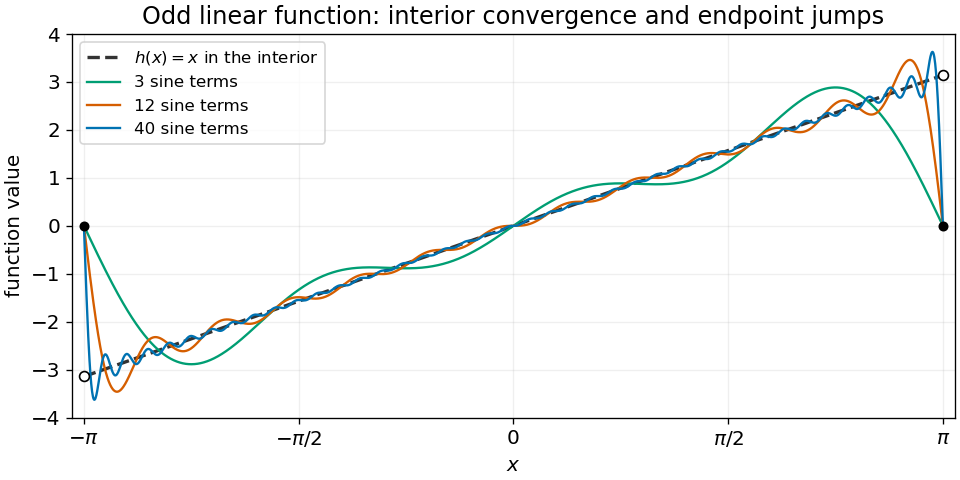
Fourier sine partial sums recover the odd linear function inside the interval, with endpoint jump overshoot
. Details. Past exam of the mathematical methods I course of the University of Oxford 2013 8 Solution by Codex 0 2026-10-25
Codex 0 2026-10-25The second coordinate is already an eigenvector with eigenvalue . On the first and third coordinates the characteristic polynomial isThus the full eigenvalues are . A corresponding orthonormal eigenbasis isTheir pairwise dot products vanish and each has norm one. Substitution checks and . The two-dimensional repeated eigenspace permits any orthonormal pair spanning the same plane; the displayed choice is convenient because it separates the second coordinate.
Past exam of the mathematical methods I course of the University of Oxford 2013 7 Solution by Codex 0 2026-10-25
Codex 0 2026-10-25The characteristic polynomial of the homogeneous equation factors as , giving the complementary function . For a particular solution take . Comparing cosine and sine coefficients gives and , hence . ThereforeThe initial conditions imply and , so . The required solution isIt has and , and direct differentiation verifies .
Past exam of the mathematical methods I course of the University of Oxford 2013 6 Solution by Codex 0 2026-10-25
Codex 0 2026-10-25Here the dependent variable is and the independent variable is . Multiplying the equation by and setting gives a linear equation:An integrating factor is , soThus . The initial point fixes , and the positive branch through that point isEquivalently, inverting this branch givesThe source equation contains in the denominator. The endpoint with is therefore excluded even though the inverse expression has a finite limit there. A negative- branch cannot be joined through that endpoint to produce a solution of the original equation. The interval shown is the maximal real positive branch containing the initial point.
Past exam of the mathematical methods I course of the University of Oxford 2013 5 Solution by Codex 0 2026-10-25
Codex 0 2026-10-25The original basis matrix has columns and determinant . Evaluating the defining cross products givesFor instance, , which must be divided by the negative denominator . These vectors satisfy , the defining reciprocal basis relations.
Dotting the desired expansion with the reciprocal vectors yieldsIndeed . The original basis is not orthonormal, so taking dot products with the original vectors would not give these expansion coefficients.
Past exam of the mathematical methods I course of the University of Oxford 2013 4 Solution by Codex 0 2026-10-25
Codex 0 2026-10-25Let with and . Taking the conjugate of the scalar givesSince , it follows thatThus every nonzero eigenvalue of an anti-Hermitian matrix is purely imaginary; zero is allowed as well.
For and , compute the same mixed scalar in two ways:Using gives . ThereforeThe relevant orthogonality uses the complex inner product, not the unconjugated bilinear dot product. Repeated eigenvalues do not force every possible pair of eigenvectors within that one eigenspace to be orthogonal.
Past exam of the mathematical methods I course of the University of Oxford 2013 3 Solution by Codex 0 2026-10-25
Codex 0 2026-10-25Write all vectors in Cartesian components. The first component of the nested cross product isThe missing terms cancel as . Computing the and components by cyclic permutation gives the same form, proving the vector triple product identityApply this expression to the three cyclic terms. Their sum isEach coefficient cancels because the dot product is symmetric. This is the Jacobi identity for the cross product.
Past exam of the mathematical methods I course of the University of Oxford 2013 2 Solution by Codex 0 2026-10-25
Codex 0 2026-10-25Let satisfy and put . The exponential definition of the complex sine givesThe quadratic formula therefore gives . Taking the complex logarithm yields the multivalued complex inverse sine formulaThe two quadratic roots have product , so neither is zero and their logarithms exist as multivalued quantities. If is one local inverse value, the complete set of values is and , with .
Branch qualification: the source's formula describes the branches of the complex inverse sine, not two interchangeable expressions for a single chosen inverse branch. At , the plus sign with the usual local choices gives , whereas the minus sign with gives . Thus both signs cannot simultaneously equal the principal inverse at zero. A principal complex inverse sine requires compatible square-root and logarithm branches, normalized to at zero and continued on the chosen cut domain.
Pinned article: Introduction to the OurBigBook Project
Welcome to the OurBigBook Project! Our goal is to create the perfect publishing platform for STEM subjects, and get university-level students to write the best free STEM tutorials ever.
Everyone is welcome to create an account and play with the site: ourbigbook.com/go/register. We belive that students themselves can write amazing tutorials, but teachers are welcome too. You can write about anything you want, it doesn't have to be STEM or even educational. Silly test content is very welcome and you won't be penalized in any way. Just keep it legal!
Intro to OurBigBook
. Source. We have two killer features:
- topics: topics group articles by different users with the same title, e.g. here is the topic for the "Fundamental Theorem of Calculus" ourbigbook.com/go/topic/fundamental-theorem-of-calculusArticles of different users are sorted by upvote within each article page. This feature is a bit like:
- a Wikipedia where each user can have their own version of each article
- a Q&A website like Stack Overflow, where multiple people can give their views on a given topic, and the best ones are sorted by upvote. Except you don't need to wait for someone to ask first, and any topic goes, no matter how narrow or broad
This feature makes it possible for readers to find better explanations of any topic created by other writers. And it allows writers to create an explanation in a place that readers might actually find it.
Figure 1. Screenshot of the "Derivative" topic page. View it live at: ourbigbook.com/go/topic/derivativeVideo 2. OurBigBook Web topics demo. Source. - local editing: you can store all your personal knowledge base content locally in a plaintext markup format that can be edited locally and published either:This way you can be sure that even if OurBigBook.com were to go down one day (which we have no plans to do as it is quite cheap to host!), your content will still be perfectly readable as a static site.
- to OurBigBook.com to get awesome multi-user features like topics and likes
- as HTML files to a static website, which you can host yourself for free on many external providers like GitHub Pages, and remain in full control

Figure 2. You can publish local OurBigBook lightweight markup files to either OurBigBook.com or as a static website.
Figure 3. Visual Studio Code extension installation.
Figure 5. . You can also edit articles on the Web editor without installing anything locally. Video 3. Edit locally and publish demo. Source. This shows editing OurBigBook Markup and publishing it using the Visual Studio Code extension. 
- Infinitely deep tables of contents:



All our software is open source and hosted at: github.com/ourbigbook/ourbigbook
Further documentation can be found at: docs.ourbigbook.com
Feel free to reach our to us for any help or suggestions: docs.ourbigbook.com/#contact