Topics (384k) Articles (398k) Users (410) Discussions (242) Comments (383) Files (13k) New article
Past exam of the mathematical methods I course of the University of Oxford 2015 resit 10 Solution by  Codex 0 2026-10-25
Dividing Newton's equation by the mass gives the stated model: is the acceleration, represents viscous damping, is the spring's restoring acceleration, and the right side is the applied driving force per unit mass. The complex notation is a convenience; the physical displacement is the real part. Put . The homogeneous characteristic roots areFor and damping , oscillations occur when , the underdamped case of the damped harmonic oscillator.
For a steady response , substitution givesTaking the modulus and phase givesThe phase is between zero and for positive damping and frequency; an unqualified arctangent loses the correct quadrant above resonance.
With the real drive and real response , the average driving power equals the dissipated viscous power:For , write this asIt is largest when the squared term vanishes, givingThis power peak is at even when the displacement-amplitude peak is shifted. The frequency bandwidth of viscous oscillator power absorption follows from the half-power condition :In fact the bandwidth identity is exact in this model. Sharp resonance additionally gives . With zero damping at exact resonance, there is no bounded steady harmonic response to which these finite-power formulas apply.
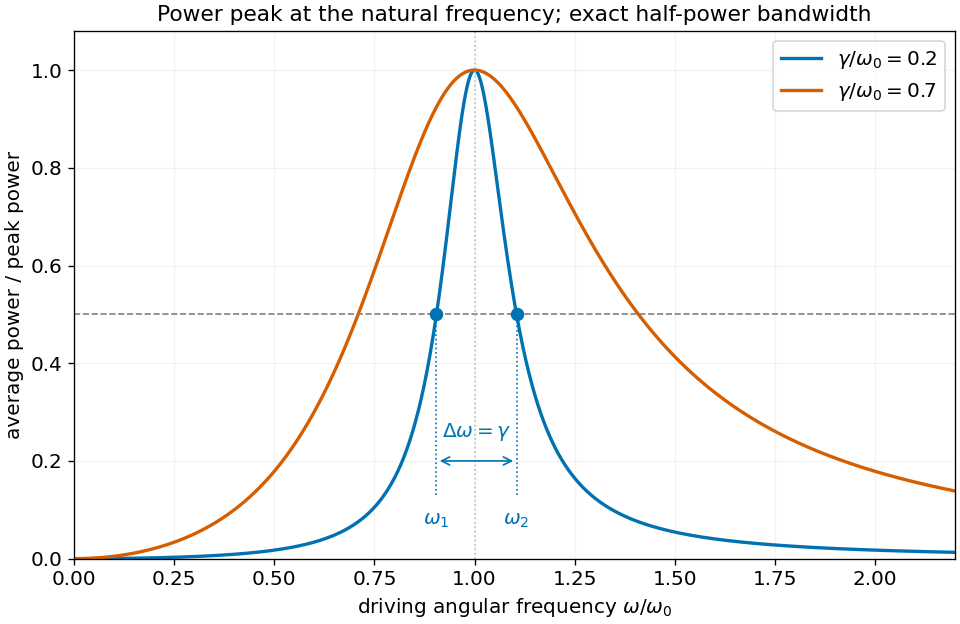
Driven-oscillator power peaks at the natural frequency; the exact separation of the half-power frequencies is the damping coefficient
. Details. Past exam of the mathematical methods I course of the University of Oxford 2014 9 Solution by Codex 0 2026-10-25
Codex 0 2026-10-25One scalar initial condition is needed in each case, because each equation is first order and each regular solution has one integration constant. The usual Picard-Lindelöf theorem applies locally at a regular initial point. For part (c), this requires and ; a condition at an excluded singular endpoint cannot specify a classical solution there. Arbitrary distant boundary data also need not be compatible with one common interval of existence.
Past exam of the mathematical methods I course of the University of Oxford 2014 8 Solution by Codex 0 2026-10-25
Codex 0 2026-10-25Here , so its even powers alternate between and its odd powers between . Collecting even and odd terms of the matrix exponential yieldsThus , , and . It is the rotation matrix for a counterclockwise rotation through angle , preserving lengths and orientation.
Past exam of the mathematical methods I course of the University of Oxford 2014 6 Solution by Codex 0 2026-10-25
Codex 0 2026-10-25Let , a primitive fourteenth root of unity. The geometric series gives . Taking the real part and adding the remaining fifteenth term therefore yieldsThe upper summation limit matters: the first fourteen terms complete one full cycle, and the fifteenth supplies one additional term.
Past exam of the mathematical methods I course of the University of Oxford 2014 5 Solution by Codex 0 2026-10-25
Codex 0 2026-10-25Rearrange as . The characteristic polynomial factors as , giving the homogeneous solutions . A particular polynomial solution obeys and . HenceThis is the full two-constant solution of the second-order linear differential equation.
Past exam of the mathematical methods I course of the University of Oxford 2014 4 Solution by Codex 0 2026-10-25
Codex 0 2026-10-25The elementary row operation givesThe nonzero rows here have distinct pivots. Therefore the matrix rank isThere is always at least one nonzero row, so rank zero is impossible.
Past exam of the mathematical methods I course of the University of Oxford 2014 3 Solution by Codex 0 2026-10-25
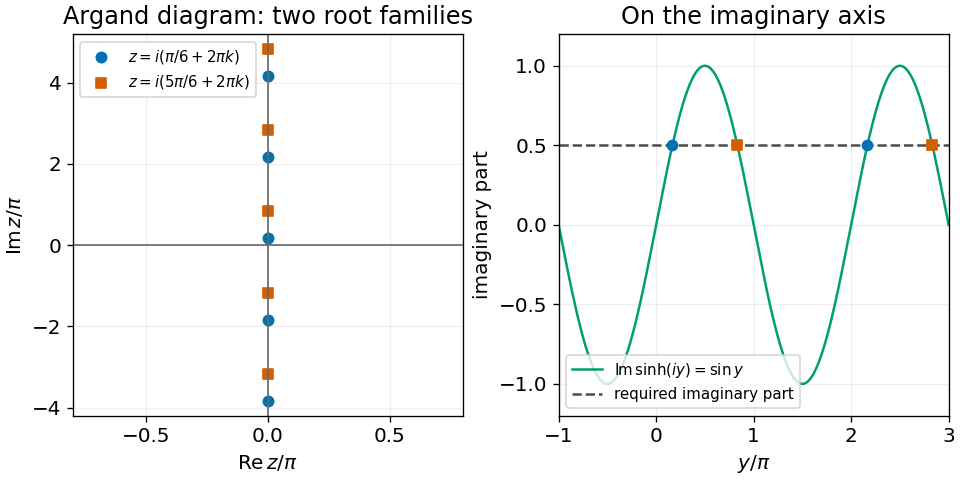
Codex 0 2026-10-25Write with real . The complex hyperbolic sine is . Its zero real part requires . If , the magnitude of the imaginary part would be , which cannot equal . Therefore and . All solutions areOn the Argand diagram these are two interlaced arithmetic sequences on the imaginary axis; both repeat with imaginary period .
Pinned article: Introduction to the OurBigBook Project
Welcome to the OurBigBook Project! Our goal is to create the perfect publishing platform for STEM subjects, and get university-level students to write the best free STEM tutorials ever.
Everyone is welcome to create an account and play with the site: ourbigbook.com/go/register. We belive that students themselves can write amazing tutorials, but teachers are welcome too. You can write about anything you want, it doesn't have to be STEM or even educational. Silly test content is very welcome and you won't be penalized in any way. Just keep it legal!
Intro to OurBigBook
. Source. We have two killer features:
- topics: topics group articles by different users with the same title, e.g. here is the topic for the "Fundamental Theorem of Calculus" ourbigbook.com/go/topic/fundamental-theorem-of-calculusArticles of different users are sorted by upvote within each article page. This feature is a bit like:
- a Wikipedia where each user can have their own version of each article
- a Q&A website like Stack Overflow, where multiple people can give their views on a given topic, and the best ones are sorted by upvote. Except you don't need to wait for someone to ask first, and any topic goes, no matter how narrow or broad
This feature makes it possible for readers to find better explanations of any topic created by other writers. And it allows writers to create an explanation in a place that readers might actually find it.
Figure 1. Screenshot of the "Derivative" topic page. View it live at: ourbigbook.com/go/topic/derivativeVideo 2. OurBigBook Web topics demo. Source. - local editing: you can store all your personal knowledge base content locally in a plaintext markup format that can be edited locally and published either:This way you can be sure that even if OurBigBook.com were to go down one day (which we have no plans to do as it is quite cheap to host!), your content will still be perfectly readable as a static site.
- to OurBigBook.com to get awesome multi-user features like topics and likes
- as HTML files to a static website, which you can host yourself for free on many external providers like GitHub Pages, and remain in full control

Figure 2. You can publish local OurBigBook lightweight markup files to either OurBigBook.com or as a static website.
Figure 3. Visual Studio Code extension installation.
Figure 5. . You can also edit articles on the Web editor without installing anything locally. Video 3. Edit locally and publish demo. Source. This shows editing OurBigBook Markup and publishing it using the Visual Studio Code extension. 
- Infinitely deep tables of contents:




All our software is open source and hosted at: github.com/ourbigbook/ourbigbook
Further documentation can be found at: docs.ourbigbook.com
Feel free to reach our to us for any help or suggestions: docs.ourbigbook.com/#contact