Topics (384k) Articles (398k) Users (410) Discussions (242) Comments (383) Files (13k) New article
Past exam of the developing new and effective psychological treatments for anxiety disorders and psychosis course of the University of Oxford 2022 4 Solution by  Codex 0 2026-10-25
A psychological treatment has a specific effect only relative to a clearly defined alternative explanation. Benefit beyond waiting is different from benefit beyond credible therapeutic contact, and both differ from evidence that a named technique works through its proposed mechanism. No single research design establishes all three. A persuasive programme combines controlled clinical comparisons with component and process experiments, while keeping patient-relevant outcomes central.
An uncontrolled before-and-after study cannot isolate a treatment effect. People may enter care when symptoms are unusually severe, creating regression toward their longer-term level; difficulties can improve naturally; expectations, concurrent care and repeated assessment can also change outcomes. A waiting-list randomised trial controls some time-related explanations but adds unequal expectations and contact. It can establish benefit from being offered the treatment package compared with waiting under those conditions, without identifying which ingredient produced the difference.
For specificity beyond nonspecific therapy effects, use a randomised comparison with a credible active intervention. Match time, attention, therapist competence and assessment opportunities as far as the question permits. Measure credibility and expected benefit rather than assuming equivalence from similar session counts. Keep relevant usual care available in both arms. Allocation concealment prevents recruitment decisions from anticipating the next assignment, while blinded independent outcome assessment reduces a different source of bias after allocation. Therapists and patients usually cannot be fully blinded to psychological procedures.
Daniel Freeman and colleagues' Feeling Safe trial illustrates this stronger package comparison. Patients with persistent persecutory delusions received the programme or befriending delivered by the same therapists, alongside usual care. At six months, the primary continuous conviction measure favoured Feeling Safe. This supports an effect beyond the particular befriending comparator, but does not establish that each module is necessary or that the whole benefit travelled through one nominated mediator.[ref]
Comparison of a theoretically driven cognitive therapy (the Feeling Safe Programme) with befriending for the treatment of persistent persecutory delusions: a parallel, single-blind, randomised controlled trial by Daniel Freeman and others. Lancet Psychiatry 8, 696–707; 130 patients, same-therapist befriending, six-month continuous conviction and categorical recovery distinction
The comparator should be interpreted fairly. A weak or implausible control can exaggerate apparent specificity, while an active comparator may itself change the proposed mechanism. If befriending improves social confidence, it is not a biologically inert placebo. A null result may mean two useful treatments have similar effects, both are ineffective, or the study is too imprecise. Failure of a superiority test does not demonstrate equivalence; an equivalence or noninferiority question requires prespecified clinically justified margins and appropriate precision.
A dismantling trial varies a specified component while keeping the surrounding treatment adequate and similar. For example, compare the same exposure programme with and without a safety behavior intervention. This estimates a conditional contribution: absence of an additional benefit does not imply that the component is useless in every context, because another part may produce similar learning. A factorial design can independently vary an action and its explanatory rationale, estimating their effects and interaction when the study has adequate power.
The early panic safety behavior experiment provides both an example and a caution. Greater change after brief exposure with precautions reduced supports the combined manipulation. Yet behavioral instructions and the explanation of the exercise were not fully separated. The appropriate next test would vary those elements independently and check actual behavior and expectancy change. Simply renaming the conditions 'cognitive' and 'behavioral' would not remove the confounding.[ref]
An experimental investigation of the role of safety-seeking behaviours in the maintenance of panic disorder with agoraphobia by Paul Salkovskis and others. Behaviour Research and Therapy 37, 559–574; brief exposure manipulation and repeated behavioural test
A mechanistic experiment can provide more direct leverage than a full treatment comparison. Colin MacLeod and colleagues trained attentional bias using a modified dot-probe task and tested later responses to stress. This asked whether experimentally changing information processing altered emotional vulnerability. It remains necessary to establish that the manipulation engaged the intended process rather than only a task-specific strategy, and that any effect transfers to the clinical phenomenon of interest. Laboratory emotional vulnerability is not itself diagnostic remission.[ref]
Selective attention and emotional vulnerability: assessing the causal basis of their association through the experimental manipulation of attentional bias by Colin MacLeod and others. Journal of Abnormal Psychology 111, 107–123; modified dot-probe training and responses to a standardised stress task
Likewise, Daniel Freeman and colleagues used virtual social environments to compare exposure against threat testing with safety behavior reduction. Both groups encountered graded situations, making the content of learning more directly investigable than in a therapy-versus-waiting comparison. The combined manipulation and brief follow-up constrain the mechanism claim. A useful manipulation check, an independent behavioral outcome and later transfer assessment strengthen the design more than a treatment label does.[ref]
Virtual reality in the treatment of persecutory delusions: randomised controlled experimental study testing how to reduce delusional conviction by Daniel Freeman and others. British Journal of Psychiatry 209, 62–67; 30 participants, graded social environments, safety reduction versus exposure and real-world assessment
Mediation analysis is informative but insufficient on its own. Randomising treatment identifies the total effect of assignment under the trial's assumptions; it does not automatically randomise the mediator. Symptom improvement could change reported beliefs, or an unmeasured process could influence both the belief score and the outcome. Measure the proposed mediator before the downstream outcome, assess competing pathways and perform sensitivity analyses. Replication using a different way to alter the same process can provide converging evidence; stronger identification may require experimental manipulation of that process itself.
Clinical trials also need suitable sampling, prespecified outcomes, adequate power, intention-to-treat analysis and transparent missing data handling. Outcomes should include functioning and possible deterioration, with follow-up long enough to distinguish transient reassurance from durable benefit. Treatment fidelity and competence must be assessed in both arms. Therapist allegiance, clustering of patients within therapists and differential dropout can affect interpretation. Statistical significance alone does not establish a meaningful improvement, especially when many outcomes or subgroup comparisons are explored.
Pragmatic implementation trials answer a complementary question: does the intervention add benefit in ordinary care, at acceptable cost and burden? Jaime Delgadillo and colleagues' therapist-cluster trial tested an automated feedback system linked to supervisory review within routine services. Its comparison isolates the added feedback arrangement more closely than an observational association between high-performing services and monitoring. It still tests a specified package of information and response, rather than an abstract effect of measurement divorced from clinical action.[ref]
Feedback-informed treatment versus usual psychological treatment for depression and anxiety: a multisite, open-label, cluster randomised controlled trial by Jaime Delgadillo and others. Lancet Psychiatry 5, 564–572; 77 participating therapists, 2233 patients, cluster allocation and not-on-track outcomes
The strongest conclusion consequently states its level of specificity. A well-conducted active control trial can establish an incremental treatment-package effect. A dismantling or factorial trial can identify a component's contribution within a defined context. An experimental process manipulation, supported by temporally ordered measurements and converging clinical evidence, can constrain the mechanism. Keeping these claims separate prevents a successful therapy from being treated as proof of its entire theory, while preserving the practical importance of improvements patients actually experience.
Past exam of the developing new and effective psychological treatments for anxiety disorders and psychosis course of the University of Oxford 2022 3 Solution by Codex 0 2026-10-25
Codex 0 2026-10-25Anxiety disorders centrally involve cognition, but describing them solely as disorders of cognition is too strong unless the term is defined so broadly that it loses explanatory value. Threat appraisal, attention, interpretation and memory can contribute to excessive fear and avoidance. Bodily arousal, learning history, action and the environment also matter. A useful account specifies how these processes interact and asks whether changing a proposed cognitive process changes anxiety, rather than simply observing that anxious people report anxious thoughts.
David M. Clark's cognitive model of panic illustrates the explanatory gain. Ordinary sensations such as a racing heart can be interpreted as evidence of imminent catastrophe. Fear increases arousal, which provides further sensations for threatening interpretation. The account distinguishes the bodily input from its meaning and explains why similar sensations need not produce the same fear in different circumstances. It also predicts that precautions and avoidance can prevent disconfirmation. The 1986 paper supplied a mechanistic model, not by itself proof that every panic episode requires a consciously articulated catastrophic thought.[ref]
A cognitive approach to panic by David M. Clark. Behaviour Research and Therapy 24, 461–470; catastrophic interpretation model, not a new clinical trial
The distinction between cognition and explicit verbal reasoning matters. A person may orient rapidly toward threat, experience an image or respond to a bodily sensation before they can describe a proposition. Absence of a reported sentence does not establish absence of information processing. Equally, a theory should not rescue itself from every negative finding by postulating an inaccessible belief. It must specify observable predictions and measures that can fail, including what would count as successful alteration of the proposed process.
Cross-sectional evidence is insufficient to establish direction. A threat interpretation could increase anxiety, anxiety could bias the interpretation, or a third factor could influence both. Questionnaires can also partly measure the same evaluative content on both sides of the association. Longitudinal prediction improves temporal ordering but leaves confounding possible. Experiments that manipulate interpretation or attention therefore offer a stronger test, especially when changes in the intended process are verified separately from changes in symptoms.
Andrew Mathews and Bundy Mackintosh reported five experiments inducing relatively threatening or benign interpretations of ambiguous material. Interpretative bias could be changed, but parallel effects on state anxiety depended on active processing of personally relevant meanings. This supports a causal contribution under specified conditions and shows that a changed task response need not automatically mean changed emotional experience. These experiments do not establish that an interpretation-training task is a complete treatment for a diagnosed anxiety disorder.[ref]
Induced emotional interpretation bias and anxiety by Andrew Mathews and Bundy Mackintosh. Journal of Abnormal Psychology 109, 602–615; five experiments, ambiguity training, active meaning generation and state anxiety
Colin MacLeod and colleagues manipulated selective attention using a modified dot-probe procedure. The location of a subsequent probe was used to train attention in different directions relative to emotional material, followed by a standardised stress task. Differences in emotional vulnerability support a contribution from attention rather than association alone. Transfer from a laboratory induction to enduring clinical change, however, remains an additional question. Learning a task contingency, altered expectancies and the reliability of the process measure all require consideration.[ref]
Selective attention and emotional vulnerability: assessing the causal basis of their association through the experimental manipulation of attentional bias by Colin MacLeod and others. Journal of Abnormal Psychology 111, 107–123; modified dot-probe training and responses to a standardised stress task
Clinical treatment comparisons provide complementary evidence. David M. Clark and colleagues compared cognitive therapy, applied relaxation and imipramine in panic disorder, with self-exposure homework shared across conditions. The findings supported cognitive therapy as a useful treatment. They do not make the comparison a pure test of thought change against an absence of learning or behavior: treatment packages differ in multiple ways, and a pharmacological treatment can also alter the sensations and experiences from which beliefs are formed.[ref]
A comparison of cognitive therapy, applied relaxation and imipramine in the treatment of panic disorder by David M. Clark and others. British Journal of Psychiatry 164, 759–769; treatment comparison, common self-exposure homework and follow-up
Safety behavior research further shows why a sharp cognition-versus-behavior division can mislead. Paul Salkovskis and colleagues found that changing precautions during exposure altered catastrophic beliefs and anxiety. The behavior may control which evidence is encountered and how success is explained. Conversely, a different explanation may make abandoning the behavior possible. These reciprocal effects favour a specified feedback system over treating observable action and mental representation as competing, self-contained causes.[ref]
An experimental investigation of the role of safety-seeking behaviours in the maintenance of panic disorder with agoraphobia by Paul Salkovskis and others. Behaviour Research and Therapy 37, 559–574; brief exposure manipulation and repeated behavioural test
Learning accounts also need not exclude cognition. An inhibitory learning approach proposes that exposure establishes alternative expectations rather than necessarily erasing the original threat association. Context-dependent retrieval can explain return of fear after apparently successful practice. Michelle G. Craske and colleagues developed a translational framework around this distinction. It offers a way to connect expectation, experience and later retrieval, while its clinical implementation requires direct evaluation rather than assuming that a learning rationale proves a particular protocol optimal.[ref]
Maximizing exposure therapy: An inhibitory learning approach by Michelle G. Craske and others. Behaviour Research and Therapy 58, 10–23; inhibitory-learning framework and illustrative strategies, not a component trial
The broader phrase 'anxiety disorders' also conceals heterogeneity. The feared consequence in social anxiety differs from the interpretation of bodily sensations in panic or persistent worry about many possible outcomes. A common information processing principle can coexist with disorder-relevant mechanisms. Actual danger and social adversity must be assessed: an expectation is not distorted simply because it concerns something distressing. Genetic, developmental and physiological influences can affect sensitivity to threat without fixing the meaning or outcome of every encounter.
Strong evidence for a particular cognitive mechanism would combine an experimental manipulation, a successful process check, subsequent change in fear and transfer to relevant everyday behavior. A factorial design could vary interpretation and a maintaining precaution separately, with matched contact and exposure opportunities. Repeated measurements should establish whether the cognitive change precedes the outcome. Treatment randomisation identifies the package effect, but mediation requires additional assumptions because the mediator itself has not necessarily been randomised.
Evidence against an exclusive account would include effective treatment without the predicted process change, or a precise null effect on anxiety after a successful, sufficiently strong manipulation of that process. Such a result might constrain the population or context in which the mechanism matters rather than rule out all cognitive contributions. Measurement sensitivity and alternative pathways must be considered without making the theory unfalsifiable.
The defensible conclusion is that cognition contributes materially to the persistence and modification of anxiety, with experimental evidence beyond introspective report. It is less defensible to claim that all anxiety disorders are caused only by consciously held false beliefs, or that the success of cognitive therapy establishes that exclusivity. Mechanistic precision and evidence about causal interaction are more informative than choosing between cognition, the body and behavior as if only one could matter.
Past exam of the developing new and effective psychological treatments for anxiety disorders and psychosis course of the University of Oxford 2022 2 Solution by Codex 0 2026-10-25
Codex 0 2026-10-25Routine outcome monitoring has made the results of IAPT services unusually visible and has created opportunities to improve care. Its benefits should be separated into three claims: measurement is more complete, the resulting information supports clinical and organisational decisions, and acting on that information improves patient outcomes. The first two do not automatically prove the third. A service can record a recovery accurately without the act of recording being its cause.
The historical IAPT programme expanded psychological treatment for depression and anxiety, using evidence-based interventions and stepped care where appropriate. Repeated measures allow a trajectory to be examined instead of relying on a clinician's general impression at discharge. Depression, general anxiety and disorder-relevant symptoms can be monitored alongside functioning and the person's own goals. A symptom questionnaire is a useful indicator, but a cutoff-based service definition of recovery is not identical to a blinded diagnostic interview or to complete restoration of everyday life.
David M. Clark and colleagues' evaluation of the Doncaster and Newham demonstration sites showed that session-by-session collection could achieve unusually complete before-and-after information in routine care. Reported recovery was about 55–56% among patients seen at least twice, and a follow-up examined maintenance beyond the last session. These prospective service cohorts demonstrated feasibility and informed implementation, but were not randomised tests of monitoring itself. Their denominator also excluded people who never progressed beyond an initial contact.[ref]
Improving access to psychological therapy: Initial evaluation of two UK demonstration sites by David M. Clark and others. Behaviour Research and Therapy 47, 910–920; Doncaster and Newham prospective service cohorts, sessional monitoring and ten-month follow-up
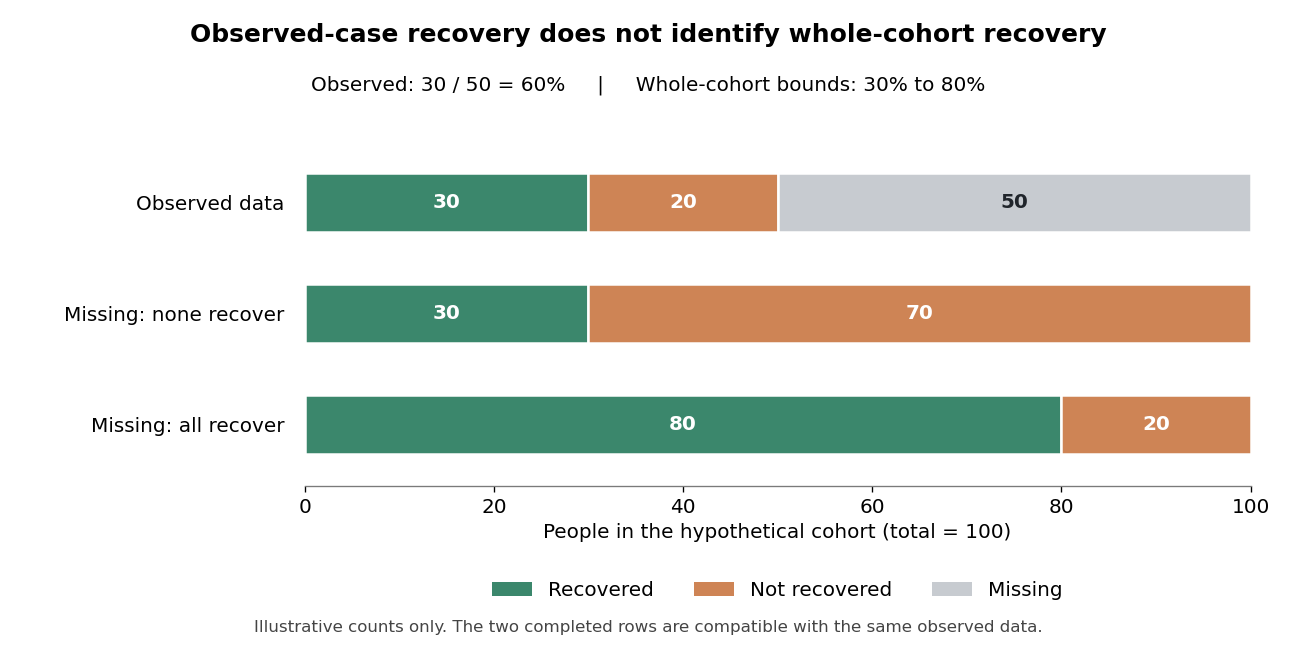
Completeness matters because selective follow-up can substantially distort apparent success. Consider a purely hypothetical cohort of one hundred baseline cases: fifty have an endpoint recorded and thirty of those meet the chosen recovery criterion. The observed-case recovery rate is 60%. If none of the fifty missing cases recovered, the whole-cohort rate is 30%; if all recovered, it is 80%. The missing-outcome bounds for a binary endpoint are sharp: both extremes fit exactly the observed data. Without assumptions or additional measurements, the observations alone cannot identify where within those bounds the cohort lies. This example is not an estimate of any IAPT service.
Sessional collection reduces dependence on a separate final questionnaire: a last available observation often exists even when a planned final appointment is missed. It does not make all missingness harmless. A last attended session can occur earlier for someone who disengages, and is not automatically equivalent to a common long-term endpoint. Outcomes should therefore be reported with clear eligibility, timing, completion and missing data definitions. Monitoring treated patients very thoroughly still does not describe those who were referred but never entered treatment.
David M. Clark and colleagues' 2018 analysis reported approximately 98% before-and-after symptom coverage among treated IAPT patients. It related public service outcomes to organisational characteristics and examined whether those characteristics also predicted changes between years. Waiting, missed appointments and the organisation of treatment were associated with outcomes; deprivation remained relevant. This made variation actionable and generated specific implementation hypotheses. Nevertheless, service-level associations and longitudinal prediction remain vulnerable to case mix, selection and unmeasured organisational differences.[ref]
Transparency about the outcomes of mental health services (IAPT approach): an analysis of public data by David M. Clark and others. Lancet 391, 679–686; 98% outcome coverage among treated patients, organisational predictors and between-year analyses
At the individual level, a visible trajectory can identify deterioration or lack of progress earlier than an end-of-treatment assessment. This provides a reason to review the formulation, barriers, intervention fidelity or level of care. It can make supervision concrete: a supervisor and therapist can examine which patients are not improving and whether the active treatment has actually been delivered. A score should initiate inquiry rather than automatically trigger a uniform decision, since transient distress, measurement error and contextual crises can change a session's result.
There is experimental evidence for an additional feedback system. Jaime Delgadillo and colleagues randomised therapists to automated outcome feedback or usual psychological treatment across eight NHS trusts. Seventy-seven therapists participated and 2233 patients were included. The system flagged people who were not on track and prompted supervisory review. Among those classified as not on track, feedback was associated with modestly better depression and anxiety outcomes, with effect sizes around 0.23 and 0.19 respectively. The trial tested feedback and its linked clinical response within services already collecting measures, not questionnaire collection versus no monitoring.[ref]
Feedback-informed treatment versus usual psychological treatment for depression and anxiety: a multisite, open-label, cluster randomised controlled trial by Jaime Delgadillo and others. Lancet Psychiatry 5, 564–572; 77 participating therapists, 2233 patients, cluster allocation and not-on-track outcomes
This distinction is central to interpreting the benefits. Data make a problem detectable; feedback makes it salient; a feasible clinical action must then address it. An alert that repeatedly identifies nonresponse without available treatment alternatives may add burden without improvement. Cluster allocation appropriately recognises that therapists change their practice across patients, while open-label delivery and quasi-random patient allocation to available therapists still qualify the causal interpretation. The modest subgroup effects should not be presented as proof that monitoring transforms every case.
At service level, routinely available outcomes support accountability, training evaluation and investigation of inequalities. Comparisons can identify where referral pathways, waiting times or treatment delivery need examination. However, unadjusted league tables can penalise services treating more complex or disadvantaged populations. Risk adjustment should be transparent and should not erase the very inequalities that require attention. Process measures, symptom outcomes, functioning and reach together give a fuller picture than one recovery percentage.
Targets can also create incentives to select easier cases, change denominators or emphasise crossing a threshold over a person's priorities. A reliable change index scales change by expected measurement error. Reliable improvement distinguishes such a change from a small numerical movement, while reliable recovery additionally considers caseness; neither removes the need to monitor deterioration and residual disability. Questionnaire accessibility, language and the validity of comparing groups require attention. Patients should understand why information is collected and how it contributes to care.
By May 2022, the clearest benefits were high outcome coverage, a transparent basis for improving implementation and a modest experimentally supported benefit from targeted feedback. Routine data had narrowed the gap between trial evidence and what services actually achieved. Further progress required responding intelligently to trajectories, preserving inclusive denominators and testing organisational changes, rather than treating measurement or a rising aggregate recovery figure as self-validating evidence of effectiveness.
Past exam of the developing new and effective psychological treatments for anxiety disorders and psychosis course of the University of Oxford 2022 1 Solution by Codex 0 2026-10-25
Codex 0 2026-10-25A safety behavior is an action intended to prevent a feared consequence or conceal signs of distress. Its immediate purpose can be understandable even when its longer-term effect maintains a problem. The useful unit of analysis is the action's function in a particular situation: carrying water, seeking reassurance or avoiding eye contact is not inherently pathological. A formulation must distinguish an anxiety-maintaining precaution from protection against genuine danger, ordinary support and a necessary accessibility adjustment.
One maintenance route is failed disconfirmation. A person predicts that ordinary bodily arousal will lead to collapse, completes an activity while gripping a support and then attributes survival to the grip. The feared catastrophe has not happened, but the episode is interpreted as evidence that the precaution was necessary. Immediate relief can negatively reinforce the precaution, increasing its future use. This explains why repeated encounters with a feared situation need not correct the threat belief when the person regards each successful encounter as a narrowly avoided disaster.
Safety behaviors can also change the evidence available. In a conversation, monitoring one's voice and rehearsing every sentence may divert attention from what another person says. Minimal replies can make the interaction less reciprocal; bodily monitoring can make ordinary sensations seem unusually salient. The person then treats this altered experience as confirmation of the original concern. These are testable possibilities, not a claim that every unsuccessful social encounter originates in the patient's cognition. Bullying, exclusion and discrimination can be real.
Paul Salkovskis and colleagues experimentally compared brief situational exposure with safety-seeking behaviors maintained or dropped in patients with panic disorder and agoraphobia. A subsequent behavioral test showed greater reductions in catastrophic beliefs and anxiety after the reduction condition. This supports a maintaining role, beyond the simple association between severe anxiety and frequent precautions. However, the manipulation also involved its therapeutic explanation, so the study does not perfectly isolate motor behavior from changed expectations about the task.[ref]
An experimental investigation of the role of safety-seeking behaviours in the maintenance of panic disorder with agoraphobia by Paul Salkovskis and others. Behaviour Research and Therapy 37, 559–574; brief exposure manipulation and repeated behavioural test
Freda McManus and colleagues obtained complementary social-anxiety evidence. Interviews found greater reported use in highly socially anxious participants, while both high- and low-anxiety groups regarded their strategies as helpful. Their experimental study manipulated safety behaviors together with self-focused attention and found detrimental effects. The combination strengthens the case that perceived helpfulness can differ from observed consequences, but leaves the separate contributions of attention and behavior incompletely identified.[ref]
Why social anxiety persists by Freda McManus and others. Journal of Behavior Therapy and Experimental Psychiatry 39, 147–161; interview and combined safety-behavior/self-focus manipulation
The account extends beyond conventional anxiety diagnoses. Daniel Freeman and colleagues randomised thirty patients with persecutory delusions to virtual-reality exposure or threat testing that included dropping safety behaviors. A head-mounted social environment allowed graded encounters with computer-generated people; the latter condition produced greater reductions in conviction and distress in a real-world assessment. This is a useful causal and translational experiment, but its small sample, brief intervention and combined instructions limit conclusions about durable treatment effects or any single ingredient.[ref]
Virtual reality in the treatment of persecutory delusions: randomised controlled experimental study testing how to reduce delusional conviction by Daniel Freeman and others. British Journal of Psychiatry 209, 62–67; 30 participants, graded social environments, safety reduction versus exposure and real-world assessment
Different clinical presentations can share the functional cycle without sharing an identical disorder. A checking ritual can prevent learning that uncertainty is tolerable; repeated reassurance can make confidence depend on another person's answer; social withdrawal can restrict opportunities to evaluate beliefs about others. These examples identify hypotheses for assessment rather than establish one universal cause of anxiety, obsessive-compulsive problems or psychosis. The onset of a difficulty can involve other processes even when a safety behavior subsequently helps maintain it.
The strongest version of the theory—that any safety behavior necessarily prevents useful learning—is not established. Stanley Rachman and colleagues compared exposure with response prevention against exposure followed by use of a hygienic wipe in eighty undergraduates with contamination fears. Both conditions showed sustained reductions across two sessions separated by two weeks. The analogue sample and short follow-up limit clinical generalisation, but the findings demonstrate why immediate elimination cannot be justified by definition alone.[ref]
Reducing contamination by exposure plus safety behaviour by Stanley Rachman and others. Journal of Behavior Therapy and Experimental Psychiatry 42, 397–404; 80 undergraduates, exposure with or without hygienic wipes, two-session analogue
An inhibitory learning interpretation makes the key question more precise: what does the person learn, and to what do they attribute safety? A precaution could block a decisive test, become a safety signal, or make initial participation feasible while leaving the relevant prediction open to testing. Michelle G. Craske and colleagues' framework emphasises alternative learning and its retrieval across contexts rather than equating exposure success with immediate calm. Its theoretical coherence does not establish the optimal safety behavior policy for every patient or intervention.[ref]
Maximizing exposure therapy: An inhibitory learning approach by Michelle G. Craske and others. Behaviour Research and Therapy 58, 10–23; inhibitory-learning framework and illustrative strategies, not a component trial
Measurement should therefore distinguish the behavior, the feared outcome and the person's explanation. Self-report inventories can indicate frequency but may group together actions with different functions. Observation during an agreed task, ratings of the predicted catastrophe and a review of why it did or did not occur give more specific information. An experiment should verify that the intended behavior actually changed, while monitoring whether a different precaution replaced it. Apparent nonresponse after an unsuccessful manipulation is not a clean falsification of the mechanism.
A stronger research design would randomise the use or reduction of an individually identified precaution while matching exposure opportunities, therapist attention and explanatory credibility. Where feasible, vary the explanation separately from the action, and assess both immediate expectations and later approach without the precaution in a new setting. Record acceptability and dropout as well as fear: an effective learning procedure that few people can engage with may have limited service value. Prespecify the feared mechanism and outcome so improvement is not retrospectively assigned to whichever explanation fits.
Safety behaviors consequently offer a productive transdiagnostic account of persistence and a route to testable treatment innovations. The evidence is strongest for specified actions and maintaining processes under controlled conditions. It supports assessing function and testing predictions collaboratively, while retaining necessary protections and acknowledging that helpful participation, short-term relief and durable threat learning need not move together.
Pinned article: Introduction to the OurBigBook Project
Welcome to the OurBigBook Project! Our goal is to create the perfect publishing platform for STEM subjects, and get university-level students to write the best free STEM tutorials ever.
Everyone is welcome to create an account and play with the site: ourbigbook.com/go/register. We belive that students themselves can write amazing tutorials, but teachers are welcome too. You can write about anything you want, it doesn't have to be STEM or even educational. Silly test content is very welcome and you won't be penalized in any way. Just keep it legal!
Intro to OurBigBook
. Source. We have two killer features:
- topics: topics group articles by different users with the same title, e.g. here is the topic for the "Fundamental Theorem of Calculus" ourbigbook.com/go/topic/fundamental-theorem-of-calculusArticles of different users are sorted by upvote within each article page. This feature is a bit like:
- a Wikipedia where each user can have their own version of each article
- a Q&A website like Stack Overflow, where multiple people can give their views on a given topic, and the best ones are sorted by upvote. Except you don't need to wait for someone to ask first, and any topic goes, no matter how narrow or broad
This feature makes it possible for readers to find better explanations of any topic created by other writers. And it allows writers to create an explanation in a place that readers might actually find it.
Figure 1. Screenshot of the "Derivative" topic page. View it live at: ourbigbook.com/go/topic/derivativeVideo 2. OurBigBook Web topics demo. Source. - local editing: you can store all your personal knowledge base content locally in a plaintext markup format that can be edited locally and published either:This way you can be sure that even if OurBigBook.com were to go down one day (which we have no plans to do as it is quite cheap to host!), your content will still be perfectly readable as a static site.
- to OurBigBook.com to get awesome multi-user features like topics and likes
- as HTML files to a static website, which you can host yourself for free on many external providers like GitHub Pages, and remain in full control

Figure 2. You can publish local OurBigBook lightweight markup files to either OurBigBook.com or as a static website.
Figure 3. Visual Studio Code extension installation.
Figure 5. . You can also edit articles on the Web editor without installing anything locally. Video 3. Edit locally and publish demo. Source. This shows editing OurBigBook Markup and publishing it using the Visual Studio Code extension. 
- Infinitely deep tables of contents:



All our software is open source and hosted at: github.com/ourbigbook/ourbigbook
Further documentation can be found at: docs.ourbigbook.com
Feel free to reach our to us for any help or suggestions: docs.ourbigbook.com/#contact