Topics (384k) Articles (398k) Users (410) Discussions (242) Comments (383) Files (13k) New article
Past exam of the condensed matter physics major option course of the University of Oxford 2016 7 Solution by  Codex 0 2026-10-25
For ion pairs per unit volume, a relative displacement produces ionic polarization . Solving the driven Lorentz oscillator model with the source's convention givesThe constant includes the fast electronic response: infinity here means well above the phonon band but below electronic resonances. Writing makes the numerator . In an undamped longitudinal mode the bulk displacement field vanishes without an external free charge, so a nonzero electric field requires . ThereforeThis is the Lyddane-Sachs-Teller relation for the single polar mode.
At normal incidence from vacuum the Fresnel equations giveBelow the transverse resonance the dielectric response increases, raising reflectivity. Between the transverse and longitudinal frequencies the undamped dielectric function is negative, giving an evanescent transmitted wave and nearly total reflection: the Reststrahlen band. Above the longitudinal edge it becomes small and positive, passing through at the reflectivity minimum and eventually approaching its electronic background.
Reading the original graph to its limited precision gives and , hence and . Extrapolating the low-energy reflectivity to roughly givesValues around – and – are appropriate to this graphical estimate. Neither the dip near nor the finite-energy right endpoint represents the high-frequency asymptote; treating that endpoint as would underestimate .
At , with . Weak damping gives , so for the complex refractive index ,Squaring and substituting provesUse the reflectivity at the estimated transverse resonance, not automatically the plateau maximum. A representative reading , with , gives , andGraphical uncertainty in the transverse edge makes this only a few-picosecond estimate: readings – give approximately –. The displacement amplitude decays as and has lifetime ; phonon occupation/energy decays as and has lifetime . Anharmonic forces allow an optical phonon to decay into two lower-energy phonons when energy and crystal momentum are conserved. Spontaneous decay can persist at low temperature; defects and electron–phonon scattering can add further linewidth.
Past exam of the condensed matter physics major option course of the University of Oxford 2016 6 Solution by Codex 0 2026-10-25
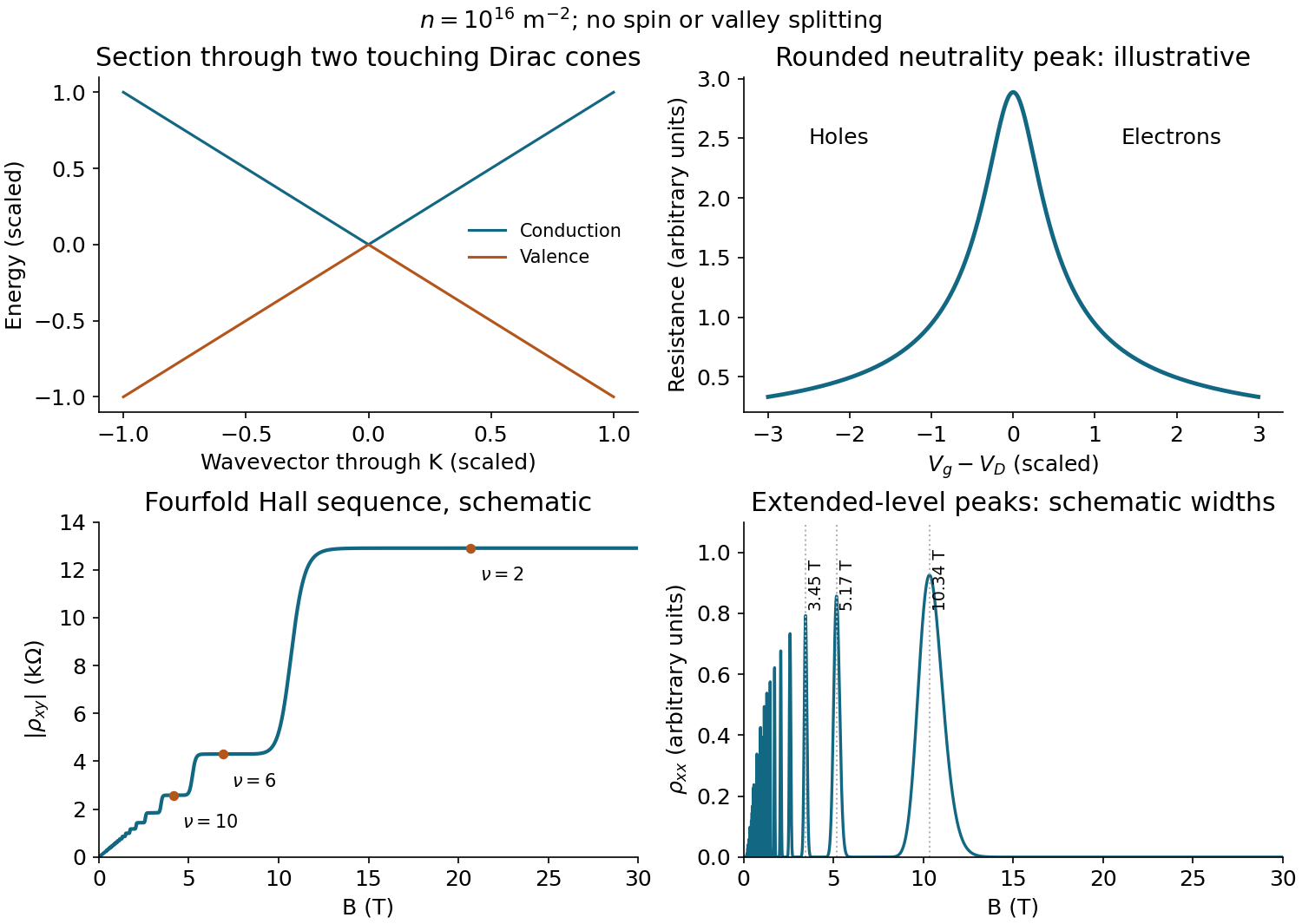
Codex 0 2026-10-25The conduction and valence dispersions are two cones touching at the Dirac point, with slopes . Here is measured relative to one valley centre. Each cone has a density of states proportional to , which vanishes at the touching energy. Gate-induced carriers satisfy approximately per unit area. Negative and positive offsets from produce holes and electrons, respectively. Away from neutrality a simple charge carrier mobility model gives , so resistance decreases on either side of a maximum near . Disorder, electron–hole puddles, contacts and quantum transport round the peak; the cone dispersion alone fixes neither its height nor its width, nor does it require exact electron–hole symmetry in a real device.
A direct derivation of the magnetic spectrum starts from the single-valley Dirac Hamiltonian operator . Introduce oscillator operators using the magnetic length . Up to exchanging sublattices or valleys,Squaring gives adjacent oscillator number operators, henceThe positive expression printed in the source describes the electron branch only; the negative-energy partners must also be included. The same square-root dependence follows from quantizing circular orbit area, with the Dirac Berry phase cancelling the usual half-integer offset.
Each spin and valley contributes states in area . Including two spins and two valleys gives , or areal degeneracy . The zero-energy level is half-filled at charge neutrality: the carrier density counts departures from that state.
For , the filling factor and fourfold graphene Hall sequence areIn a plateau, and . The Hall sign reverses between electron and hole doping; the sketch uses its magnitude to avoid tensor-index sign conventions. Representative plateau-centre fields are , , and for . Between plateaux, crossing extended states in broadened levels gives longitudinal peaks and Hall steps. Their ideal filling-centre positions have , namelyThus peaks near , and separate the first prominent plateaux as field increases. Many weak oscillations accumulate toward zero field and are damped there. Finite-width plateaux require localized states between extended-state energies; an exactly clean Landau spectrum does not by itself prescribe plateau widths. The illustration uses an explicitly schematic broadening, not inferred experimental widths.
At , , close to the plateau. With , and . The relevant adjacent gap near the chemical potential is therefore , rather than the gap from the zero level. Resolving levels requires quantum-lifetime broadening and thermal broadening appreciably smaller than , giving the order-of-magnitude limitsThe upper temperature is an energy-scale estimate, not a guaranteed sharp-feature temperature. For oscillation amplitudes the thermal damping factor is , , with and . Requiring gives the more conservative scale for little thermal damping. Visible weaker features may persist above that scale; their actual cutoff depends on resolution, disorder and temperature-dependent scattering. The transport lifetime and quantum lifetime also need not coincide.
Past exam of the condensed matter physics major option course of the University of Oxford 2016 5 Solution by Codex 0 2026-10-25
Codex 0 2026-10-25For a periodic single-electron Hamiltonian operator, Bloch's theorem givesTwo bands at the same have the same translation eigenvalues but different cell-periodic eigenfunctions, generally different energies and different orbital/nodal character. They may be chosen orthogonal even at a band degeneracy. The basis choices are treated in the two scoped branches below.
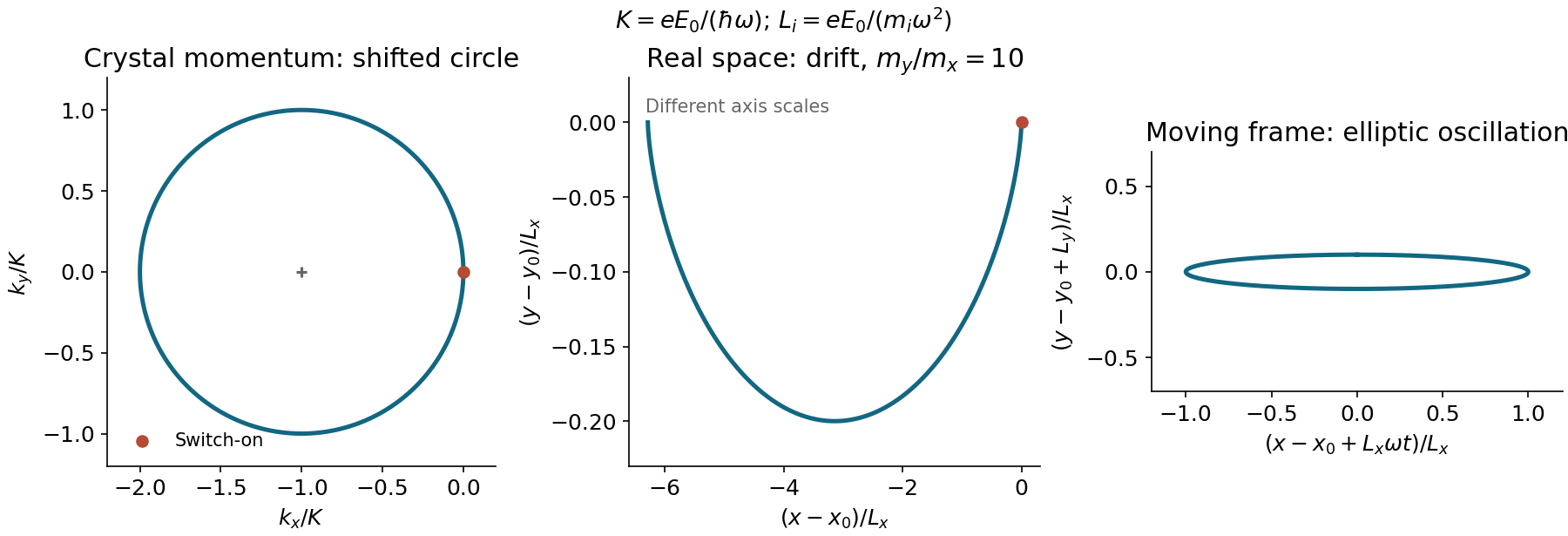
For a slowly varying external potential , the semiclassical wavepacket Hamiltonian is . Hamilton's equation for the conjugate variables gives . Equivalently the electric perturbation changes the translation phase at the rate . This is the single-band acceleration theorem, requiring a slowly varying field and negligible interband tunnelling/scattering; it refers to crystal momentum, not free-space mechanical momentum.
Let and . Integrating from the specified initial condition gives, with the first field alone,With both components switched on,This is a circle centred at , not at the band minimum. Since , integration givesThe switch-on drift in a circularly driven parabolic band accompanies unequal transverse scales: it is a stretched cycloid. In a frame moving with that drift, the oscillation is an ellipse with semiaxis ratio . A closed real-space ellipse would require different initial momentum. Indeed, after one period , an explicit check against that interpretation.
Writing , the kinetic energy above the band minimum isFor it is largest at , with value . Equating this to the optical-phonon energy gives the emission threshold estimateThis treats the optical branch as approximately dispersionless and assumes a momentum-allowed final state, a cold initial electron, and negligible phonon absorption. It is the amplitude of each Cartesian field component; the circular field has constant magnitude . A steady periodic orbit centred at would instead give twice this amplitude, but fails the stated switch-on condition.
Past exam of the condensed matter physics major option course of the University of Oxford 2016 4 Solution by Codex 0 2026-10-25
Codex 0 2026-10-25For competing exchanges on a body-centred cubic antiferromagnet, use the Heisenberg model convention , with each bond counted once, dimensionless spins, and positive antiferromagnetic . There are eight nearest and six next-nearest neighbours. Bond counting in the two classical collinear structures givesFor type II the eight contributions cancel, while all six bonds are antiparallel. Their crossing yields . One can also exclude a lower spiral within the classical bilinear model: writing givesFor a favourable sign of the product, . Hence when its minimum is at , the type-II ordering vectors. When , compare with the type-I value and use to obtain the complementary bound. ThusThis is a classical/mean-field energy comparison; an exact quantum ground state is not generally a collinear product state.
For type I a magnetic cell is the simple cube of side , with opposite moments at and . Its magnetic structure factor is proportional to . Allowed magnetic reflections have integer with odd. The first two families are and , with symmetry-equivalent members understood.
For type II choose magnetic primitive translations , and , enclosing four spins in volume . Equivalently, a side- cube is a convenient nonprimitive magnetic cell. On each original simple-cubic sublattice the moment at is proportional to . Accordingly,The translated body-centre basis gives , so there is no further extinction. The first two families are and . The neutron polarization factor may additionally suppress a reflection for a particular moment direction; the stated rules are the positional selection rules.
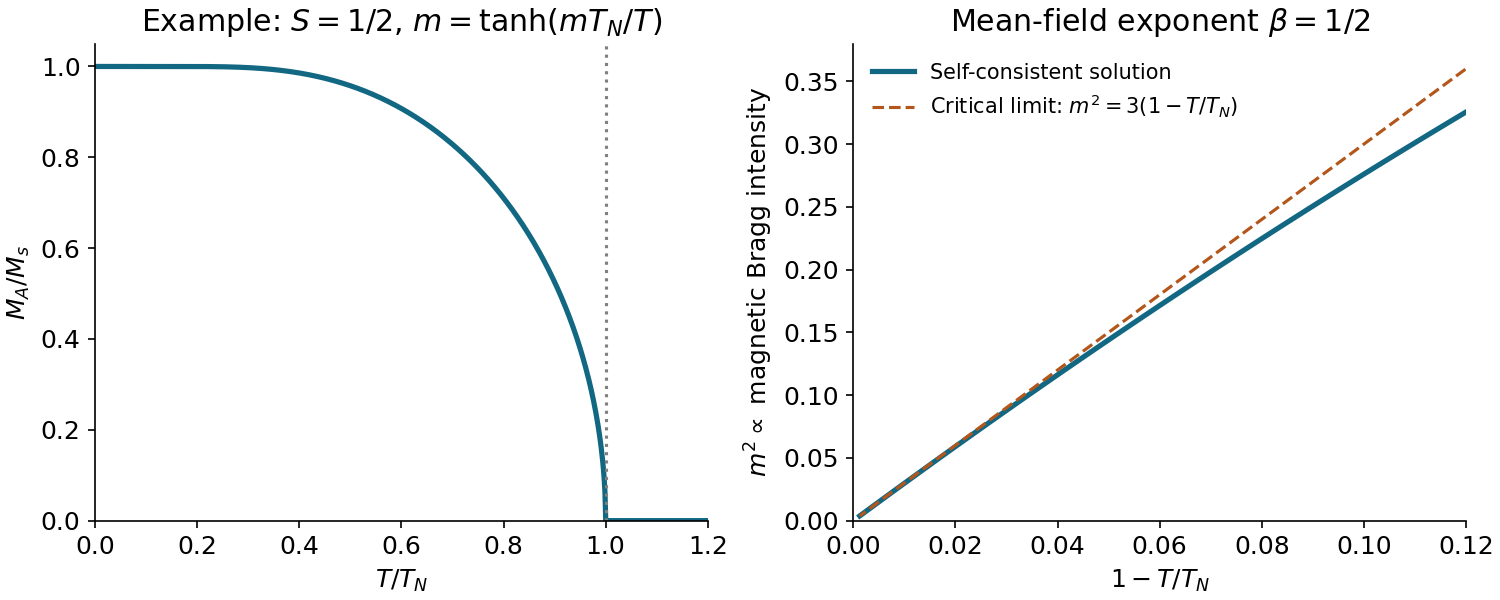
Each sublattice has number density and saturation magnetization . Replacing neighbouring spins by their averages makes their exchange energy equivalent to a molecular magnetic field. Its minus sign expresses antiferromagnetic exchange, not an externally applied field. Since ,For , . Linearizing the Brillouin magnetization formula givesThe g-factor cancels because exchange is specified in energy units. A convention with doubles these exchange energies and .
Let , and let denote the cubic coefficient of the Brillouin magnetization formula. The argument is . Thus impliesConsequently in mean-field theory. The positive branch falls from saturation at zero temperature to zero at and remains zero above it. An elastic magnetic neutron-reflection intensity scales as ; a log–log fit against has slope . Background subtraction and a suitable critical interval are needed. Fluctuations can change the measured exponent from its mean-field value; uniform bulk magnetization vanishes for a compensated antiferromagnet and is not itself this order parameter.
Pinned article: Introduction to the OurBigBook Project
Welcome to the OurBigBook Project! Our goal is to create the perfect publishing platform for STEM subjects, and get university-level students to write the best free STEM tutorials ever.
Everyone is welcome to create an account and play with the site: ourbigbook.com/go/register. We belive that students themselves can write amazing tutorials, but teachers are welcome too. You can write about anything you want, it doesn't have to be STEM or even educational. Silly test content is very welcome and you won't be penalized in any way. Just keep it legal!
Intro to OurBigBook
. Source. We have two killer features:
- topics: topics group articles by different users with the same title, e.g. here is the topic for the "Fundamental Theorem of Calculus" ourbigbook.com/go/topic/fundamental-theorem-of-calculusArticles of different users are sorted by upvote within each article page. This feature is a bit like:
- a Wikipedia where each user can have their own version of each article
- a Q&A website like Stack Overflow, where multiple people can give their views on a given topic, and the best ones are sorted by upvote. Except you don't need to wait for someone to ask first, and any topic goes, no matter how narrow or broad
This feature makes it possible for readers to find better explanations of any topic created by other writers. And it allows writers to create an explanation in a place that readers might actually find it.
Figure 1. Screenshot of the "Derivative" topic page. View it live at: ourbigbook.com/go/topic/derivativeVideo 2. OurBigBook Web topics demo. Source. - local editing: you can store all your personal knowledge base content locally in a plaintext markup format that can be edited locally and published either:This way you can be sure that even if OurBigBook.com were to go down one day (which we have no plans to do as it is quite cheap to host!), your content will still be perfectly readable as a static site.
- to OurBigBook.com to get awesome multi-user features like topics and likes
- as HTML files to a static website, which you can host yourself for free on many external providers like GitHub Pages, and remain in full control

Figure 2. You can publish local OurBigBook lightweight markup files to either OurBigBook.com or as a static website.
Figure 3. Visual Studio Code extension installation.
Figure 5. . You can also edit articles on the Web editor without installing anything locally. Video 3. Edit locally and publish demo. Source. This shows editing OurBigBook Markup and publishing it using the Visual Studio Code extension. 
- Infinitely deep tables of contents:




All our software is open source and hosted at: github.com/ourbigbook/ourbigbook
Further documentation can be found at: docs.ourbigbook.com
Feel free to reach our to us for any help or suggestions: docs.ourbigbook.com/#contact