Topics (384k) Articles (398k) Users (410) Discussions (242) Comments (383) Files (13k) New article

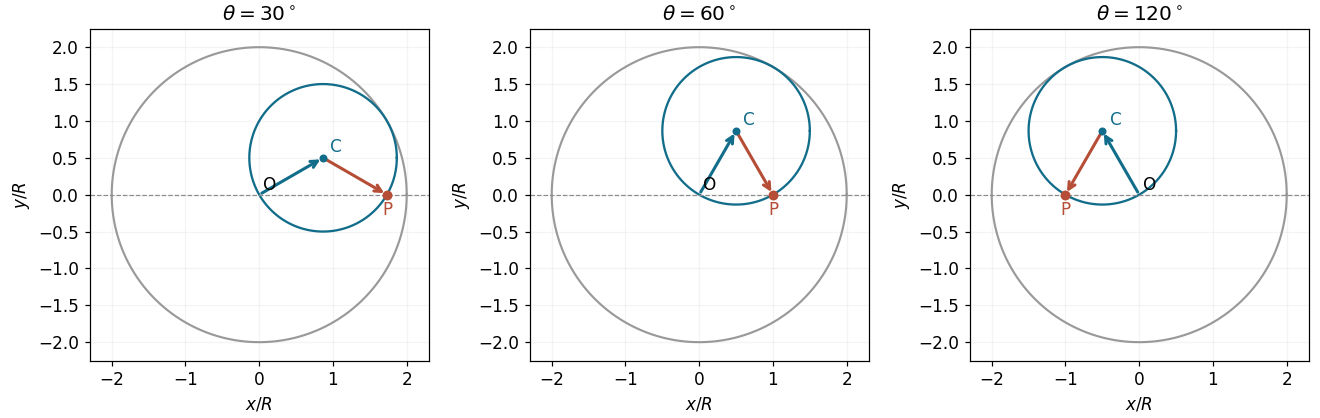
Two uniform circular motions of radius and opposite angular rates sum to rectilinear oscillation: . Geometrically, a circle of radius rolls inside one of radius ; a marked point traces a diameter. This plane construction must be distinguished from spherical variants, which need their own geometric argument.[ref]
The Spherical Case of the Tūsī Couple by George Saliba and E. S. Kennedy. research abstract: distinction between plane and spherical versions
The patched conic approximation models different portions of a spacecraft trajectory by separate two-body Kepler orbits, matching position and velocity where one attracting body gives way to another. For a surface departure from a nonrotating planet, conservation of energy gives , where is surface launch speed, is the planet's surface escape speed, and is the planet-relative hyperbolic excess speed. Adding that excess velocity vector to the planet's orbital velocity supplies the heliocentric initial condition. It neglects the simultaneous full gravitational action of both bodies near the matching region.
For flat spacetime with periodic of circumference , lift endpoints of causal curves to the covering Minkowski spacetime. A signal can choose any winding, so the causal future and causal past use the shortest circular distance rather than a fixed coordinate separation. After a duration , every point on the circle is reachable. A constant tangential electric field has a nonzero loop electromotive force; maintaining it while a charge gains energy each lap requires an energy reservoir, not a single-valued electrostatic potential.
A study design seeking causal information without individual random assignment, using a structured comparison or assignment mechanism. The relevant identifying assumptions should be stated rather than replaced by the label “quasi-experimental.”
Necessity and sufficiency are conditional on the task, state and intervention. A selective loss-of-function effect can support necessity under those conditions; an imposed pattern producing an effect can support sufficiency. Neither automatically proves the naturally used code, and compensation can make a null loss-of-function result inconclusive.
A distribution on a plane open set with is represented by a holomorphic function. Indeed , and elliptic regularity makes smooth. For a direct proof, mollify locally with a radial mollifier . The resulting smooth functions are harmonic. Their mean value property gives on a smaller ball for fixed small . Passing to the weak convergence of distributions limit gives there. This proves smoothness without assuming local integrability beforehand. The ordinary Cauchy-Riemann equations now prove holomorphy.
The equation similarly characterizes antiholomorphic functions. On the whole plane, the homogeneous solutions are respectively arbitrary entire functions and the functions with entire. Consequently any two fundamental solutions for one of these Wirtinger derivatives differ by the corresponding homogeneous solution.
How representative a member seems or behaves relative to its category. Graded typicality is distinct from graded membership: well-defined mathematical categories can show unequal familiarity or identification speed despite exact membership criteria.
An account in which category judgments rely on similarity to an abstract or representative summary. It naturally explains centrality and generalization effects, but must be distinguished from exemplar theory and from a descriptive typicality gradient.
Representing people as members of socially meaningful classes. Social categorization can organize expectations and identity; a category label alone does not determine whether its consequences are inclusive or prejudicial.
For -bit operands, an add with carry operation forms , retains its residue modulo , and outputs its arithmetic carry. Adding low limbs first and feeding each arithmetic carry into the next limb implements multiword unsigned addition. With , the identities and combine into .[ref]
Thumb 16-bit instruction set quick reference by Arm. Page 1, Add with carry
With the ARM architecture family's no-borrow convention, subtract with carry forms . The same adder used for addition can form . If its output is , rearranging proves . Thus complementing the second operand implements both the result and the correctly chained borrow information.[ref]
Pinned article: Introduction to the OurBigBook Project
Welcome to the OurBigBook Project! Our goal is to create the perfect publishing platform for STEM subjects, and get university-level students to write the best free STEM tutorials ever.
Everyone is welcome to create an account and play with the site: ourbigbook.com/go/register. We belive that students themselves can write amazing tutorials, but teachers are welcome too. You can write about anything you want, it doesn't have to be STEM or even educational. Silly test content is very welcome and you won't be penalized in any way. Just keep it legal!
Intro to OurBigBook
. Source. We have two killer features:
- topics: topics group articles by different users with the same title, e.g. here is the topic for the "Fundamental Theorem of Calculus" ourbigbook.com/go/topic/fundamental-theorem-of-calculusArticles of different users are sorted by upvote within each article page. This feature is a bit like:
- a Wikipedia where each user can have their own version of each article
- a Q&A website like Stack Overflow, where multiple people can give their views on a given topic, and the best ones are sorted by upvote. Except you don't need to wait for someone to ask first, and any topic goes, no matter how narrow or broad
This feature makes it possible for readers to find better explanations of any topic created by other writers. And it allows writers to create an explanation in a place that readers might actually find it.
Figure 1. Screenshot of the "Derivative" topic page. View it live at: ourbigbook.com/go/topic/derivativeVideo 2. OurBigBook Web topics demo. Source. - local editing: you can store all your personal knowledge base content locally in a plaintext markup format that can be edited locally and published either:This way you can be sure that even if OurBigBook.com were to go down one day (which we have no plans to do as it is quite cheap to host!), your content will still be perfectly readable as a static site.
- to OurBigBook.com to get awesome multi-user features like topics and likes
- as HTML files to a static website, which you can host yourself for free on many external providers like GitHub Pages, and remain in full control

Figure 2. You can publish local OurBigBook lightweight markup files to either OurBigBook.com or as a static website.
Figure 3. Visual Studio Code extension installation.
Figure 5. . You can also edit articles on the Web editor without installing anything locally. Video 3. Edit locally and publish demo. Source. This shows editing OurBigBook Markup and publishing it using the Visual Studio Code extension. 
- Infinitely deep tables of contents:



All our software is open source and hosted at: github.com/ourbigbook/ourbigbook
Further documentation can be found at: docs.ourbigbook.com
Feel free to reach our to us for any help or suggestions: docs.ourbigbook.com/#contact