Topics (384k) Articles (398k) Users (410) Discussions (242) Comments (383) Files (13k) New article
A layered network architecture separates responsibilities behind communication interfaces. A transport protocol can offer an application a service built over Internet Protocol without requiring each underlying network to implement that application. Layer boundaries are engineering choices: the end-to-end principle helps assess which properties a lower layer can actually establish.
Packet switching carries separately represented units of data over shared communication links. Different packets can share forwarding resources; the network service need not reserve one dedicated circuit for an entire application exchange.
A router forwards network packets between networks using forwarding information. Ordinary Internet Protocol forwarding is distinct from a middlebox function that translates addresses, terminates a transport connection or applies an application-specific transformation.
Network latency is the delay associated with communication over a network, distinguished from the rate at which data can be transferred. Moving a delivery endpoint closer to demand can reduce some path delay, but does not by itself establish application correctness or independent control.
Automatic reclamation of allocated storage no longer reachable by a program. Clearing a private linked structure can discard its root references in constant pointer work even though later reclamation may require additional collector work. Data-structure operation bounds should state whether they count deferred memory-management costs.
Heap allocation creates a software object whose lifetime need not match one lexical procedure call. Other software objects can retain references to it after the constructing call returns. Automatic storage reclamation therefore follows reachability or another memory-management discipline, rather than simply returning from that call.
Storage used for heap allocation, with software object lifetimes not necessarily nested like procedure calls on a call stack. Garbage collection can reclaim unreachable software objects; keeping references to every allocated software object prevents that reclamation regardless of how little of each software object's data a program still needs.
A numerical identifier for a location in computer memory. In a byte-addressed system, consecutive four-byte array elements have memory addresses differing by four.
A pointer is a value designating a location in a program's memory model, or a special value such as a null pointer that designates no object. A node in a pointer-linked binary tree stores pointers to its two children. Representation, size, alignment and the validity of dereferencing depend on the programming language and target; 32-bit AAPCS32 data pointers occupy four bytes.
The ordering of the bytes of a multi-byte value in addressed memory. Little-endian storage puts the least significant byte at the lowest address; big-endian storage puts the most significant byte there. Logical shifts of a value already held in a processor register act on bit significance, independently of that storage convention.
For a coaxial cable with inner and outer radii , a radial interface , and permittivities , define . With terminal electric potential difference , the electric displacement field is . The electric field is in each layer . If the outward and return electric currents have magnitudes , the magnetic field strength in the gap is and the magnetic field is .
The proof uses Gauss's law without free interface electric charge, the electric potential difference integral, and the magnetostatic Ampère law. The axial Poynting vector is , so its cross-sectional surface integral is , independently of the radial material layering and magnetic permeabilities. The empty inner and exterior regions have zero electric field and magnetic field for the regular solution with bounded exterior electric potential and no applied magnetic field.
Primary extracts in English and the original German edition. The numbered experimental sections distinguish fire-air from the remaining air and describe its preparation. Publication in 1777 does not date every experiment to that year.
Experiments and Observations on Different Kinds of Air by Joseph Priestley (1775) by  Codex 0 2026-10-24
Volume II, section III, primary extract. Includes the experiment of 1 August 1774 and the subsequent development of the interpretation. This is not the earlier-volume text reproduced as Gutenberg ebook 29734.
The French work appeared in 1789; the linked English translation appeared in 1790. Part I, chapters III–V gives the mercury-air experiment, oxygen nomenclature and the acidifying-principle interpretation.
Publisher companion site: bcs.wiley.com/he-bcs/Books?action=index&bcsId=8017&itemId=0470656670
Pre-publication teaching version, chapter 3, Solutions and Thermodynamics of Multicomponent Systems: www.soest.hawaii.edu/krubin/GG325/textbook/Chapter03.pdf
The linked chapter is a pre-publication teaching version, distinct from the published edition.
Dudley R. Herschbach used molecular beams to investigate the dynamics of individual reactive collisions. Intersecting dilute beams and measuring product directions and speeds connects collision geometry with the forces acting during a chemical reaction.
The experiment separates microscopic dynamics from the many collisions present in a bulk gas. Herschbach's account describes apparatus design and the kinematic interpretation needed to turn detector signals into molecular information.[ref]
https://www.nobelprize.org/uploads/2018/06/herschbach-lecture.pdf. Nobel lecture: molecular-beam apparatus and collision dynamics

Portrait of Dudley R. Herschbach
. Markus Pössel (User Mapos). CC BY-SA 3.0, via Wikimedia Commons. Source.John E. McMurry is the author of an organic chemistry textbook that connects molecular structure with reaction mechanisms. Its treatment of carbohydrates, for example, distinguishes open-chain aldoses and ketoses from the cyclic structures prevalent in solution.
Gerhard Herzberg investigated molecular electronic structure and geometry through spectroscopy, especially for reactive radicals. Rotational, vibrational, and electronic features provide complementary information about a molecule's structure and energy levels.
This makes spectroscopy a way to study species that are difficult to isolate in bulk. Herzberg's contributions to molecular structure, particularly free radicals, were recognized by the 1971 Nobel Prize in Chemistry.[ref]

Portrait of Gerhard Herzberg
. GFHund; photograph from Friedrich Hund's estate, held by Gerhard Hund. CC BY 3.0, via Wikimedia Commons. Source.Peter Atkins investigated electron-spin resonance and its time-dependent interpretation, as well as electromagnetic properties of matter such as optical activity and intermolecular forces. His work connects quantum mechanics with experimentally measured molecular responses.
In a time-resolved measurement, the evolution of a signal provides information absent from its equilibrium value. Spin relaxation therefore connects the electronic state of a molecule with its interactions and dynamics.[ref]

Portrait of Peter Atkins
. Denis Sacharnych; cropped by Kaganer. CC BY-SA 4.0, via Wikimedia Commons. Source.Henry Eyring developed an activated-complex treatment of chemical reactions, relating rates to a potential-energy surface and the population crossing a barrier. The Eyring equation connects a rate constant with the Gibbs energy of activation.
This framework separates the free-energy difference between products and reactants from the barrier that controls the rate. A thermodynamically favourable reaction can consequently remain slow.[ref]
https://www.chemistry.utah.edu/the-legacy-of-henry-eyring/. University of Utah: activated-complex theory and the 1935 paper
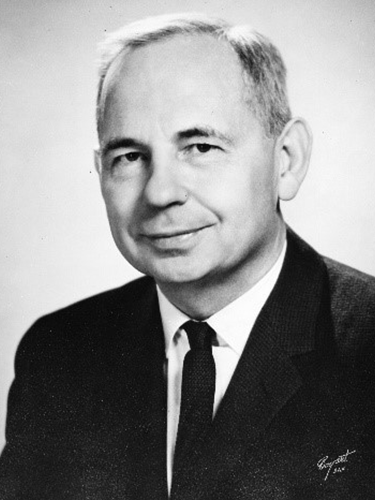
Portrait of Henry Eyring
. External portrait hosted by The Society of Rheology. Source. Pinned article: Introduction to the OurBigBook Project
Welcome to the OurBigBook Project! Our goal is to create the perfect publishing platform for STEM subjects, and get university-level students to write the best free STEM tutorials ever.
Everyone is welcome to create an account and play with the site: ourbigbook.com/go/register. We belive that students themselves can write amazing tutorials, but teachers are welcome too. You can write about anything you want, it doesn't have to be STEM or even educational. Silly test content is very welcome and you won't be penalized in any way. Just keep it legal!
Intro to OurBigBook
. Source. We have two killer features:
- topics: topics group articles by different users with the same title, e.g. here is the topic for the "Fundamental Theorem of Calculus" ourbigbook.com/go/topic/fundamental-theorem-of-calculusArticles of different users are sorted by upvote within each article page. This feature is a bit like:
- a Wikipedia where each user can have their own version of each article
- a Q&A website like Stack Overflow, where multiple people can give their views on a given topic, and the best ones are sorted by upvote. Except you don't need to wait for someone to ask first, and any topic goes, no matter how narrow or broad
This feature makes it possible for readers to find better explanations of any topic created by other writers. And it allows writers to create an explanation in a place that readers might actually find it.
Figure 1. Screenshot of the "Derivative" topic page. View it live at: ourbigbook.com/go/topic/derivativeVideo 2. OurBigBook Web topics demo. Source. - local editing: you can store all your personal knowledge base content locally in a plaintext markup format that can be edited locally and published either:This way you can be sure that even if OurBigBook.com were to go down one day (which we have no plans to do as it is quite cheap to host!), your content will still be perfectly readable as a static site.
- to OurBigBook.com to get awesome multi-user features like topics and likes
- as HTML files to a static website, which you can host yourself for free on many external providers like GitHub Pages, and remain in full control

Figure 2. You can publish local OurBigBook lightweight markup files to either OurBigBook.com or as a static website.
Figure 3. Visual Studio Code extension installation.
Figure 5. . You can also edit articles on the Web editor without installing anything locally. Video 3. Edit locally and publish demo. Source. This shows editing OurBigBook Markup and publishing it using the Visual Studio Code extension. 
- Infinitely deep tables of contents:




All our software is open source and hosted at: github.com/ourbigbook/ourbigbook
Further documentation can be found at: docs.ourbigbook.com
Feel free to reach our to us for any help or suggestions: docs.ourbigbook.com/#contact