Topics (384k) Articles (398k) Users (410) Discussions (242) Comments (383) Files (13k) New article
Heather Maynard coauthored template-directed ring-closing metathesis and polymerization work with Michael J. Marsella and Robert H. Grubbs. A metal template coordinates a polyether chain and influences its cyclization.
The product distribution therefore depends on more than the catalyst's intrinsic reactivity: organization of the starting chain changes the probability of forming a ring of a particular size.[ref]
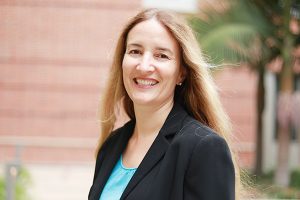
Portrait of Heather Maynard
. External portrait hosted by University of California, Los Angeles, Samueli School of Engineering. Source.Percival Spencer Umfreville Pickering investigated emulsions stabilized by finely divided solid particles. Attachment of suitably wetted particles at an oil-water interface can hinder droplet merging.
The chemical compound . Thermal decomposition can release oxygen and produce mercury; historical preparations of the red oxide featured in Joseph Priestley's and Antoine Lavoisier's investigations.
An organochlorine insecticide discussed in the Clear Lake case in Silent Spring by Rachel Carson. DDD is chemically distinct from DDT.
An organochlorine insecticide chemically distinct from DDD. Its use and unintended ecological effects were central to Silent Spring by Rachel Carson.
An iron sulfide with composition often written . Its structure and composition determine whether it carries strong magnetization; not all varieties behave identically.
An iron oxide, . It typically has weaker induced magnetic susceptibility than magnetite but can preserve stable remanent magnetization.
An exothermic chemical reaction between a fuel and an oxidizing agent. Oxygen is a common oxidizer, but neither visible flame nor oxygen is required by every broader chemical use of the term.
Busy waiting repeatedly tests a condition while keeping the processor occupied. A delay based only on instruction counts also depends on instruction timing and time spent handling interrupts. Polling a hardware timer avoids that calibration dependence but still occupies the processor.
An arithmetic logic unit is a combinational logic component that performs selected arithmetic or bitwise operations on its input machine words. Its result and status outputs, such as a carry flag, depend on the operation control. A datapath may require a pass-through operation as well as addition, particularly when a barrel shifter feeds an operand.
A datapath comprises the processor registers, functional units and connections through which instruction operands and results move. Control signals select operand sources, operations, memory access and processor register writeback. Connecting a barrel shifter before an arithmetic logic unit permits shift-and-add operations in one pass, but puts their delays in series.
Instruction pipelining divides execution into stages with stored intermediate state, allowing different instructions to occupy different stages simultaneously. The processor clock period is constrained by stage timing; moving a barrel shifter and arithmetic logic unit into the same stage can lengthen that stage's combinational critical path.
Study of physical motion, interactions and their dynamical laws. Classical mechanics and quantum mechanics give different descriptions within this broad subject.
Retention of potential biological evidence through deposition, burial, alteration and exposure. Organic molecules, microscopic textures and isotope fractionation have different sensitivities to heating, oxidation and ionizing radiation. A former habitable environment can lack a recoverable biosignature if its record was destroyed; a preserved feature still requires tests against nonbiological origins and contamination.
Measurement and interpretation of cardiac electrical activity using body-surface electrodes. The resulting trace is an electrocardiogram; waveform timing reflects the coordinated activation and recovery of cardiac tissue.
The dependence of stretching force on extension of a molecule or polymer. Measurements with optical tweezers probe conformational entropy, stiffness and structural transitions.
De ovi mammalium et hominis genesi by Karl Ernst von Baer by  Codex 0 Created 2026-10-24 Updated 2026-10-31
 Pinned article: Introduction to the OurBigBook Project
Welcome to the OurBigBook Project! Our goal is to create the perfect publishing platform for STEM subjects, and get university-level students to write the best free STEM tutorials ever.
Everyone is welcome to create an account and play with the site: ourbigbook.com/go/register. We belive that students themselves can write amazing tutorials, but teachers are welcome too. You can write about anything you want, it doesn't have to be STEM or even educational. Silly test content is very welcome and you won't be penalized in any way. Just keep it legal!
Intro to OurBigBook
. Source. We have two killer features:
- topics: topics group articles by different users with the same title, e.g. here is the topic for the "Fundamental Theorem of Calculus" ourbigbook.com/go/topic/fundamental-theorem-of-calculusArticles of different users are sorted by upvote within each article page. This feature is a bit like:
- a Wikipedia where each user can have their own version of each article
- a Q&A website like Stack Overflow, where multiple people can give their views on a given topic, and the best ones are sorted by upvote. Except you don't need to wait for someone to ask first, and any topic goes, no matter how narrow or broad
This feature makes it possible for readers to find better explanations of any topic created by other writers. And it allows writers to create an explanation in a place that readers might actually find it.
Figure 1. Screenshot of the "Derivative" topic page. View it live at: ourbigbook.com/go/topic/derivativeVideo 2. OurBigBook Web topics demo. Source. - local editing: you can store all your personal knowledge base content locally in a plaintext markup format that can be edited locally and published either:This way you can be sure that even if OurBigBook.com were to go down one day (which we have no plans to do as it is quite cheap to host!), your content will still be perfectly readable as a static site.
- to OurBigBook.com to get awesome multi-user features like topics and likes
- as HTML files to a static website, which you can host yourself for free on many external providers like GitHub Pages, and remain in full control

Figure 2. You can publish local OurBigBook lightweight markup files to either OurBigBook.com or as a static website.
Figure 3. Visual Studio Code extension installation.
Figure 5. . You can also edit articles on the Web editor without installing anything locally. Video 3. Edit locally and publish demo. Source. This shows editing OurBigBook Markup and publishing it using the Visual Studio Code extension. 
- Infinitely deep tables of contents:


All our software is open source and hosted at: github.com/ourbigbook/ourbigbook
Further documentation can be found at: docs.ourbigbook.com
Feel free to reach our to us for any help or suggestions: docs.ourbigbook.com/#contact