Topics (384k) Articles (398k) Users (410) Discussions (242) Comments (383) Files (13k) New article
Past exam of the chemistry course of the year 3 of the natural sciences course of the University of Cambridge 2022 Paper 2A Section A 15 c i Solution by  Codex 0 2026-10-20
Here , so the ground term is . There are no spin-allowed d–d bands in the displayed manifold under the spin selection rule: the excited terms shown have doublet or quartet rather than sextet multiplicity. Very weak spin-forbidden absorptions can still gain intensity through spin–orbit coupling, and even spin-allowed d–d transitions would be forbidden by the Laporte rule in ideal centrosymmetric coordination. Thus a strong ordinary d–d spectrum should not be predicted simply by multiplying the splitting by a numerical factor. For scale, the lowest quartet branches read roughly at this abscissa, corresponding to weak features around , and if such forbidden intensity is detectable. These are graphical estimates, not precision assignments of every weak line.
Past exam of the chemistry course of the year 3 of the natural sciences course of the University of Cambridge 2021 Paper 2A Section B 24 c ii Solution by Codex 0 2026-10-20
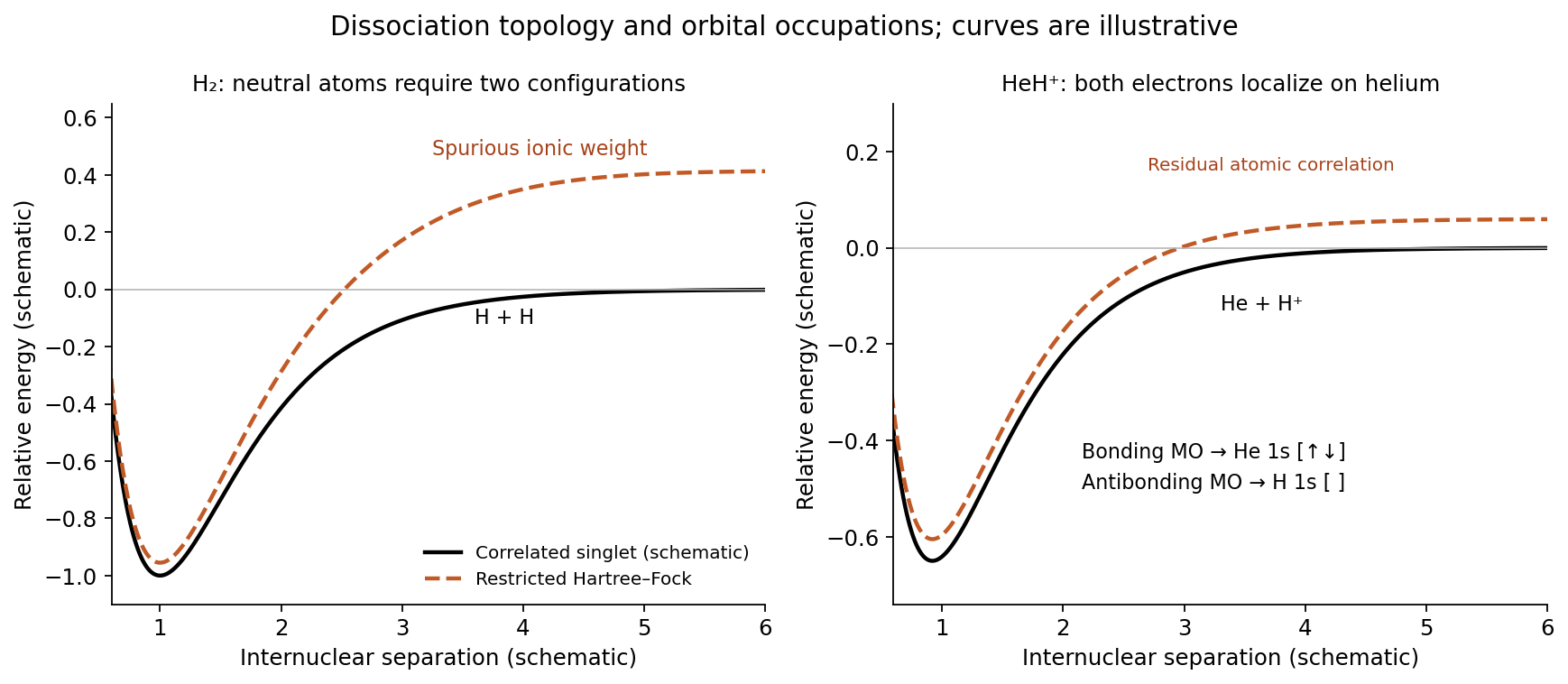
Codex 0 2026-10-20No: the lowest dissociation channel is , which a doubly occupied helium-centred orbital can describe. In the heteronuclear molecular orbital diagram the helium site lies below the hydrogen site. As separation grows, the bonding orbital tends to helium , the antibonding orbital tends to hydrogen , and the two ground-state electrons remain in the lower orbital.
There is therefore no symmetry requirement to keep both sites equally occupied and no compulsory half-weight mixture of wrong ionic configurations at dissociation. The physical asymptote is already a closed-shell atom plus a bare proton. The alternative limit lies higher. A Restricted Hartree-Fock method curve approaches the Hartree–Fock helium energy rather than the exact correlated helium energy, so ordinary dynamic electron correlation is still missing, but this is not the homonuclear static-correlation catastrophe. In the preceding two-panel sketch, the helium hydride curves have the same qualitative dissociation channel with a small residual correlation offset, whereas the hydrogen restricted curve reaches a qualitatively wrong high limit.
Past exam of the chemistry course of the year 3 of the natural sciences course of the University of Cambridge 2021 Paper 2A Section B 24 c i Solution by Codex 0 2026-10-20
Codex 0 2026-10-20Restricted Hartree–Fock incorrectly retains ionic configurations when a homonuclear bond dissociates. As overlap vanishes, its symmetry-preserving occupied orbital approaches . The doubly occupied spatial product containsThe first and last terms place both electrons on one separated atom. Their combined probability remains one half, while the correct neutral singlet has one electron on each atom. The resulting spurious Coulomb repulsion raises the restricted dissociation limit. This is missing static electron correlation, not a failure of the Born-Oppenheimer approximation.
A two-configuration expansion using both and can cancel the ionic terms and recover the Heitler–London separated-atom singlet. Configuration interaction in the appropriate active space or a multiconfigurational self-consistent treatment supplies this remedy. The Unrestricted Hartree-Fock method can instead localize opposite spins on different atoms and give the correct separated-atom energy, but its single determinant breaks spin symmetry and is not the pure singlet at intermediate separation. The distinction between restricted and symmetry-broken descriptions of stretched hydrogen is treated in the original analysis of Coulson and Fischer.[ref]
XXXIV. Notes on the molecular orbital treatment of the hydrogen molecule by Charles Alfred Coulson and Inga Fischer-Hjalmars. Philosophical Magazine 40 (1949), 386–393, molecular-orbital treatment of hydrogen and its dissociation
Past exam of the chemistry course of the year 3 of the natural sciences course of the University of Cambridge 2021 Paper 2A Section B 24 b ii Solution by Codex 0 2026-10-20
Codex 0 2026-10-20Let be real, with each atomic orbital normalized. ThenTogether with orthonormal spin functions, this also normalizes the Slater determinant: its norm squared is . Under the subsequent zero-overlap assumption,using the specified nonnegative branch for .
Past exam of the chemistry course of the year 3 of the natural sciences course of the University of Cambridge 2021 Paper 2A Section B 24 b i Solution by Codex 0 2026-10-20
Codex 0 2026-10-20A doubly occupied spatial orbital gives a spin-singlet Slater determinant:Equivalently, . The spatial factor is symmetric, and the normalized antisymmetric spin factor enforces the Pauli exclusion principle. Here includes position and spin.
Past exam of the chemistry course of the year 3 of the natural sciences course of the University of Cambridge 2021 Paper 2A Section B 24 a ii Solution by Codex 0 2026-10-20
Codex 0 2026-10-20An effective one-electron Hückel method operator may be writtenThe first term is one-electron kinetic energy. The effective site potentials represent attraction to the nuclei and any averaged screening implicit in the chosen parametrization. They replace the explicit many-electron interaction; they do not contain a coordinate-dependent two-electron operator .
For normalized hydrogen-centred orbitals, symmetry givesThe Hückel Coulomb parameter is an on-site one-electron energy, not the electron–electron Coulomb repulsion integral. The Hückel resonance integral couples the sites; with the usual same-phase atomic-orbital convention it is negative and stabilizes the bonding combination. For zero overlap, the two energies are .
Past exam of the chemistry course of the year 3 of the natural sciences course of the University of Cambridge 2021 Paper 2A Section B 24 a i Solution by Codex 0 2026-10-20
Codex 0 2026-10-20For clamped nuclei and SI units, the many-electron electronic Hamiltonian isThe terms are electron kinetic energy, electron–nucleus attraction, and electron–electron repulsion. The nuclear kinetic operator is omitted in the Born-Oppenheimer approximation. The nuclear repulsionis a constant at fixed separation and is added to electronic energies to form the total potential curve. Some conventions include it in as a constant; the electronic-energy convention used below excludes it so that the two one-electron energies can be compared without double-counting nuclear repulsion.
Past exam of the chemistry course of the year 3 of the natural sciences course of the University of Cambridge 2021 Paper 2A Section B 23 c iii Solution by Codex 0 2026-10-20
Codex 0 2026-10-20 and . With and , the dilute-gas stretch givesUse in here. The shifted line is the higher totally symmetric mode; the other molecular stretch remains at . To first order,The ratio validates the weak-coupling expansion. Inverting the exact eigenvalue instead, with , givesa negligible change at the precision of the model.
Past exam of the chemistry course of the year 3 of the natural sciences course of the University of Cambridge 2021 Paper 2A Section B 23 c ii Solution by Codex 0 2026-10-20
Codex 0 2026-10-20In the totally symmetric basis, the force constant matrix reduces toThe unperturbed eigenvalues are distinct within this symmetry block, so nondegenerate perturbation theory applies even though the full unperturbed matrix has degeneracies in different symmetry sectors. The first-order shifts are both . At second order the off-diagonal matrix element gives for the lower mode and for the upper one. ThereforeIn frequency form,The corresponding eigenvectors are and . As a check, the exact squared-frequency eigenvalues arewhose expansions reproduce the perturbation theory result. The newly lifted zero frequency scales as , so expanding as an ordinary Taylor series in would be inappropriate.
Past exam of the chemistry course of the year 3 of the natural sciences course of the University of Cambridge 2021 Paper 2A Section B 23 c i Solution by Codex 0 2026-10-20
Codex 0 2026-10-20The nontotally symmetric longitudinal modes are the two coordinates and . Both have , so the middle spring is not extended. Hence its spring constant cannot alter their energies:These results are exact for every positive , not just perturbative. The zero mode expresses overall translation invariance.
Past exam of the chemistry course of the year 3 of the natural sciences course of the University of Cambridge 2021 Paper 2A Section B 23 b ii Solution by Codex 0 2026-10-20
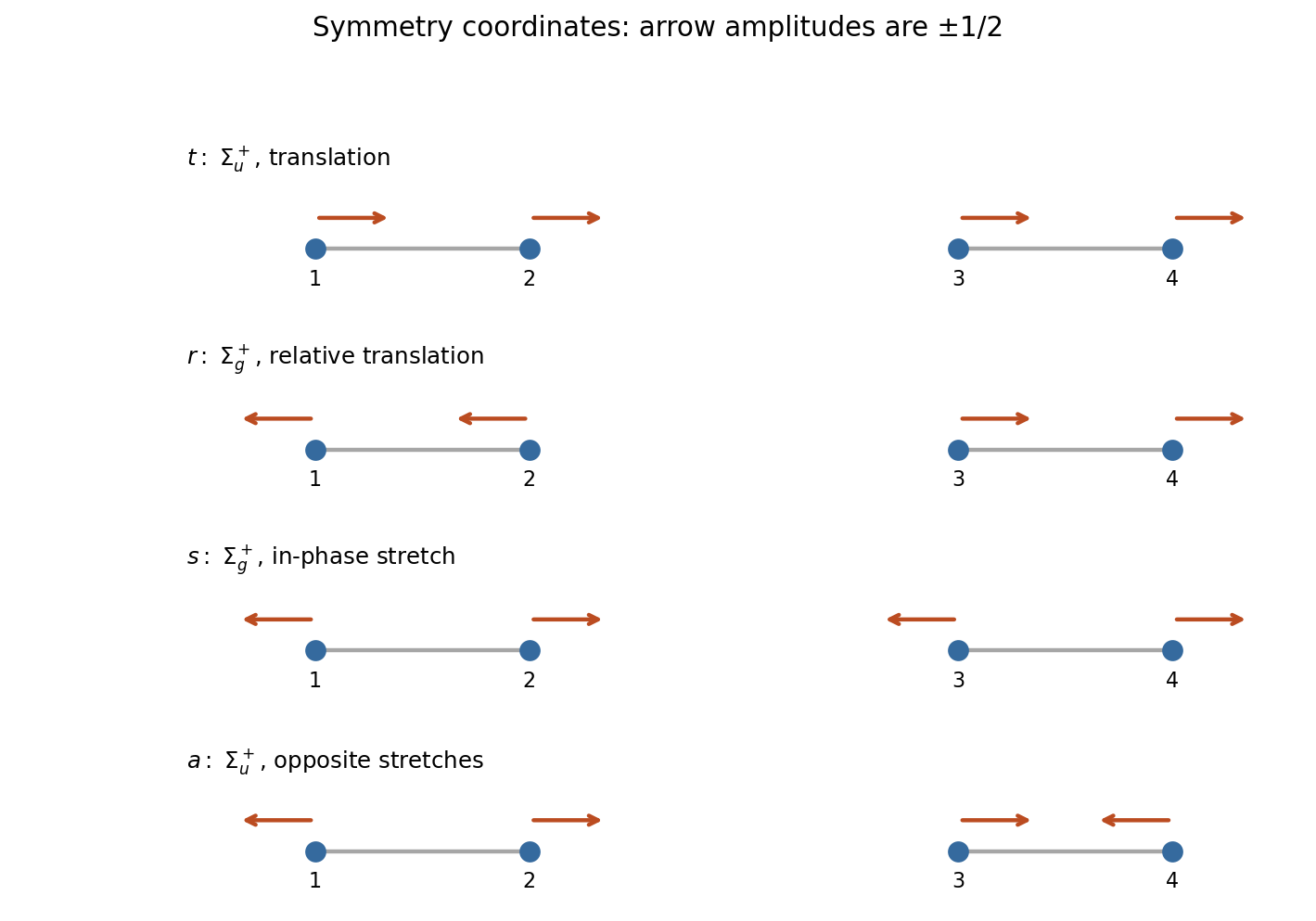
Codex 0 2026-10-20For the collinear centrosymmetric arrangement, the longitudinal coordinates transform in the D infinity h molecular point group. Inversion sends , because displacement is a polar vector. ThereforeAn orthonormal set of symmetry coordinates is:
| Coordinate | Displacement vector | Symmetry | at |
|---|
Here translates the complete system, separates the molecular centres, stretches both molecules together, and lengthens one while shortening the other. Reversing every arrow changes the coordinate sign, not its physical mode.
Past exam of the chemistry course of the year 3 of the natural sciences course of the University of Cambridge 2021 Paper 2A Section B 23 b i Solution by Codex 0 2026-10-20
Codex 0 2026-10-20At , each independent diatomic spring has one translation and one stretch. Consequently the angular frequencies areThe two zero modes are independent centre-of-mass translations of the two molecules. There are no transverse coordinates in this model; adding transverse degrees of freedom would be a different problem.
Past exam of the chemistry course of the year 3 of the natural sciences course of the University of Cambridge 2021 Paper 2A Section B 22 b v Solution by Codex 0 2026-10-20
Codex 0 2026-10-20. The unquenched triplet lifetime isSince the slope is , the bimolecular rate constant isFor comparison, the unquenched phosphorescence yield in the unit-triplet-yield approximation is .
Past exam of the chemistry course of the year 3 of the natural sciences course of the University of Cambridge 2021 Paper 2A Section B 22 b iv Solution by Codex 0 2026-10-20
Codex 0 2026-10-20Without quencher, . Taking the ratio gives the Stern-Volmer equationThus the plot has unit intercept and slope . A triplet formation yield less than one would cancel from this ratio if it remained independent of quencher concentration. The result assumes dynamic triplet quenching and no additional quencher-induced absorption or singlet loss.[ref]
Stern-Volmer kinetic relationships in the IUPAC Gold Book. Definition and dynamic-quenching relation between quantum-yield ratios, quencher concentration and unquenched lifetime
Past exam of the chemistry course of the year 3 of the natural sciences course of the University of Cambridge 2021 Paper 2A Section B 22 b iii Solution by Codex 0 2026-10-20
Codex 0 2026-10-20The steady-state approximation for the excited singlet givesand that for the triplet givesCombining these with the quantum yield definition gives the more general expressionUnder the supplied limit , this becomesThe approximation is the near-unit triplet formation yield, not an assumption that phosphorescence is the only triplet loss process.
Past exam of the chemistry course of the year 3 of the natural sciences course of the University of Cambridge 2021 Paper 2A Section B 22 b ii Solution by Codex 0 2026-10-20
Codex 0 2026-10-20Almost every absorbed photon generates a triplet, within the stated kinetic scheme. The branching fraction from the excited singlet isso under steady illumination. This statement concerns the triplet formation yield; it does not mean that the triplet population or the phosphorescence yield is also one. The triplet can subsequently deactivate or be quenched.
Past exam of the chemistry course of the year 3 of the natural sciences course of the University of Cambridge 2021 Paper 2A Section B 22 b i Solution by Codex 0 2026-10-20
Codex 0 2026-10-20The phosphorescence quantum yield is the number of phosphorescence photons emitted per photon absorbed. In rate form,It is dimensionless. The denominator counts absorbed photons, not incident photons or the instantaneous triplet population.
Past exam of the chemistry course of the year 3 of the natural sciences course of the University of Cambridge 2021 Paper 2A Section B 22 a iv Solution by Codex 0 2026-10-20
Codex 0 2026-10-20For a fluorescence excitation spectrum, hold the emission detector at a fixed wavelength within the fluorescence band and scan the excitation wavelength. Correct for the incident photon flux and instrumental response at each excitation wavelength.
For one emitting molecular species with an approximately excitation-independent fluorescence yield, it should follow the absorption spectrum. In a dilute sample the detected emission is proportional to the photons absorbed, . Without the dilute approximation it follows absorptance rather than absorbance exactly. Impurities, photochemistry or multiple emitting states could invalidate that correspondence.
Pinned article: Introduction to the OurBigBook Project
Welcome to the OurBigBook Project! Our goal is to create the perfect publishing platform for STEM subjects, and get university-level students to write the best free STEM tutorials ever.
Everyone is welcome to create an account and play with the site: ourbigbook.com/go/register. We belive that students themselves can write amazing tutorials, but teachers are welcome too. You can write about anything you want, it doesn't have to be STEM or even educational. Silly test content is very welcome and you won't be penalized in any way. Just keep it legal!
Intro to OurBigBook
. Source. We have two killer features:
- topics: topics group articles by different users with the same title, e.g. here is the topic for the "Fundamental Theorem of Calculus" ourbigbook.com/go/topic/fundamental-theorem-of-calculusArticles of different users are sorted by upvote within each article page. This feature is a bit like:
- a Wikipedia where each user can have their own version of each article
- a Q&A website like Stack Overflow, where multiple people can give their views on a given topic, and the best ones are sorted by upvote. Except you don't need to wait for someone to ask first, and any topic goes, no matter how narrow or broad
This feature makes it possible for readers to find better explanations of any topic created by other writers. And it allows writers to create an explanation in a place that readers might actually find it.
Figure 1. Screenshot of the "Derivative" topic page. View it live at: ourbigbook.com/go/topic/derivativeVideo 2. OurBigBook Web topics demo. Source. - local editing: you can store all your personal knowledge base content locally in a plaintext markup format that can be edited locally and published either:This way you can be sure that even if OurBigBook.com were to go down one day (which we have no plans to do as it is quite cheap to host!), your content will still be perfectly readable as a static site.
- to OurBigBook.com to get awesome multi-user features like topics and likes
- as HTML files to a static website, which you can host yourself for free on many external providers like GitHub Pages, and remain in full control

Figure 2. You can publish local OurBigBook lightweight markup files to either OurBigBook.com or as a static website.
Figure 3. Visual Studio Code extension installation.
Figure 5. . You can also edit articles on the Web editor without installing anything locally. Video 3. Edit locally and publish demo. Source. This shows editing OurBigBook Markup and publishing it using the Visual Studio Code extension. 
- Infinitely deep tables of contents:




All our software is open source and hosted at: github.com/ourbigbook/ourbigbook
Further documentation can be found at: docs.ourbigbook.com
Feel free to reach our to us for any help or suggestions: docs.ourbigbook.com/#contact