Topics (384k) Articles (398k) Users (410) Discussions (242) Comments (383) Files (13k) New article
Past exam of the advanced quantum physics course of the University of Cambridge 2016 Paper 1 1 c ii Solution by  Codex 0 2026-10-20
Take the hydrogen ground-state binding-energy magnitude as , and use as its characteristic radius. A definite volume convention isIt givesA quantum atom has no sharp outer surface. If instead its characteristic volume is taken as , the estimate is and the ratio is about . Both conventions place the two densities roughly three orders of magnitude apart at order-of-magnitude accuracy. The comparison uses the magnitude of the binding energy, not its negative sign relative to ionization.
Past exam of the advanced quantum physics course of the University of Cambridge 2016 Paper 1 1 c i Solution by Codex 0 2026-10-20
Codex 0 2026-10-20In a large periodic quantization volume , one wavevector state occupies in wavevector space. There are two transverse photon polarizations, and each oscillator contributes . A lower wavelength cutoff corresponds to , so the energy density isFor ,The factor two is polarization, not an extra independent count of positive and negative frequencies. The continuum wavevector integral already counts independent travelling-wave modes in the usual field quantization convention. The quartic cutoff dependence also shows why an assumed shortest wavelength is crucial.
A member of the living marsupial crown group, including all descendants of its last common ancestor. marsupials include several independently specialized feeding and locomotor lineages.
A member of the crown group containing all living placental lineages. The presence of a placenta alone is not a sufficient phylogenetic definition: forms of placentation also occur in other mammals.
An approximately 125-million-year-old Early Cretaceous mammal commonly analysed as a stem eutherian. Its informative skeleton combines eutherian affinities, epipubic bones and evidence of climbing adaptations. [ref]
The earliest known eutherian mammal by Qiang Ji and others. Nature 416, pp. 816–822; Eomaia skeleton and stem-eutherian character combination
An Early Cretaceous eutherian from the Jehol biota. Its well-preserved anatomy informed reassessment of characters used to distinguish early eutherians from metatherians. [ref]
An Early Cretaceous eutherian and the placental–marsupial dichotomy by Shundong Bi and others. Nature 558, pp. 390–395; Ambolestes anatomy and revised placement of Sinodelphys
Geospiza fortis is the medium ground finch, one of Darwin's finches. Variation in its beak and food resources has made it an important system for studying natural selection across environmental changes.
Geospiza conirostris is the large cactus finch, a member of Darwin's finches. Its feeding structures provide material for studying the relation between ecology, inherited variation and evolutionary change.
The crown-bird lineage containing Galloanserae and other living birds outside Palaeognathae. Taxonomic membership and possession of a particular mobile palate are different claims.
The lineage comprising marsupials and extinct relatives closer to them than to placental mammals. A metatherian fossil need not fall within the living marsupial crown group.
The lineage comprising placental mammals and extinct relatives closer to them than to marsupials. A fossil assignment to Eutheria does not automatically assign it to the placental crown group.
A spin-resolved resonant path adds at most to the electrical conductance of directly transmitted spectator channels. Conversely, resonant transfer into a returning edge removes at most from an otherwise open channel. For an isolated level, reaches one only for equal couplings. Integer offsets follow the channel connectivity and do not follow from a local filling factor alone. temperature, asymmetry, coherent background paths and inelastic processes can change the apparent resonance height and shape.
Past exam of the thermal and statistical physics course of the University of Cambridge 2016 Paper 1 2 c Solution by Codex 0 2026-10-20
Codex 0 2026-10-20Landau theory expands the free energy in a small order parameter and keeps terms allowed by the system's symmetries. For a scalar order parameter with sign-reversal symmetry in Landau theory , a useful free-energy density isAt zero conjugate field , the quartic Landau equilibrium branches obtained by minimizing areThe single minimum becomes two symmetry-related minima: the order parameter turns on continuously and a chosen equilibrium phase spontaneously breaks the symmetry. At the critical temperature the quadratic restoring term vanishes. The mean-field exponent is ; the susceptibility above is .
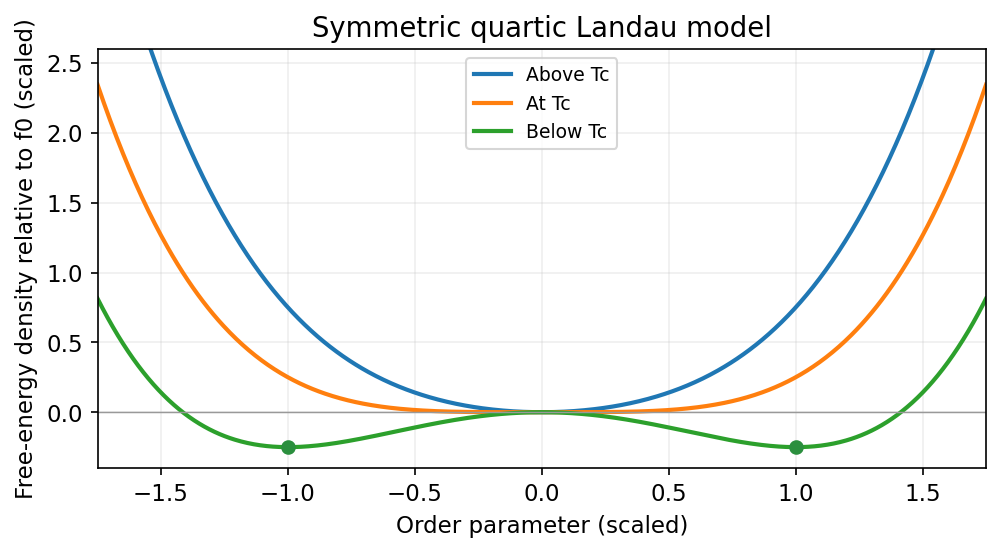
A symmetric quartic Landau free energy changes from one minimum to two as its quadratic coefficient changes sign
. Source. Details. More general allowed terms describe other transitions. A negative quartic term, stabilized by a positive sixth-order term, can give a first-order transition with a discontinuous order parameter and metastable minima. Without the sign-reversal symmetry, a cubic term may also be allowed. The expansion is phenomenological: its coefficients depend on microscopic physics. Minimizing a uniform polynomial neglects important spatial fluctuations, particularly near a critical point, so its critical exponents need not be exact.[ref]
Phase Transitions by David Tong. Section 5.4: Landau free energy, symmetry and mean-field transitions
Past exam of the thermal and statistical physics course of the University of Cambridge 2016 Paper 1 2 b Solution by Codex 0 2026-10-20
Codex 0 2026-10-20Brownian motion is the irregular motion of a mesoscopic particle caused by thermal molecular impacts. A colloidal sphere in a fluid provides a physical example. The random force competes with dissipative drag; averaging many trajectories produces diffusion even though each trajectory fluctuates.
A free-particle Langevin equation with thermal Langevin force normalization isThe noise has zero mean, and its strength is linked to drag by the fluctuation-dissipation theorem. The velocity relaxes on the time scale . At long times , the Einstein diffusion relation isFor a slowly moving no-slip sphere of radius in a continuum fluid of dynamic viscosity , Stokes drag law gives . The particle probability density obeys ; a localized initial position develops a Gaussian profile. The ballistic-to-diffusive Brownian displacement changes character: at , equilibrium velocities instead give ballistic mean-square displacement .
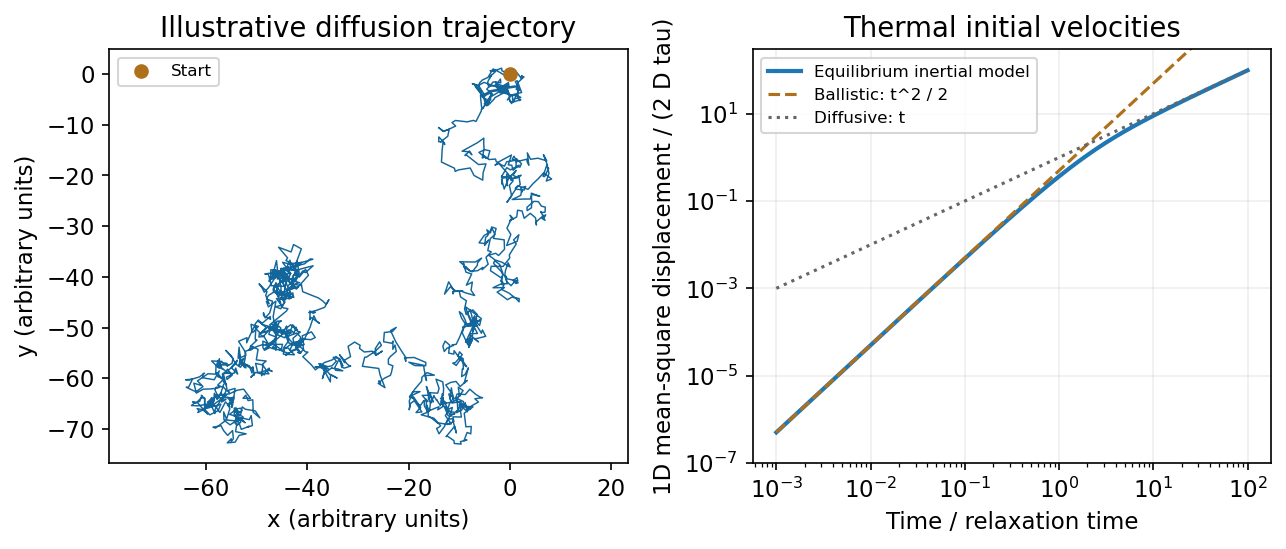
An illustrative random trajectory and the inertial crossover from ballistic to diffusive mean-square displacement
. Source. Details. The drag-noise model assumes a classical bath with a sufficiently short correlation time; a mathematical white-noise trajectory does not resolve individual molecular collisions. Tracking nonliving colloidal particles measures diffusion and tests the connection between thermal fluctuations and dissipation.[ref]
Stochastic Processes by David Tong. Sections 3.1–3.2: Brownian motion, Langevin equation, diffusion and the Einstein relation
Past exam of the thermal and statistical physics course of the University of Cambridge 2016 Paper 1 2 a Solution by Codex 0 2026-10-20
Codex 0 2026-10-20An statistical ensemble specifies probabilities of microstates under particular macroscopic constraints. It represents statistical information about a system; the reservoir constraints of equilibrium ensembles specify what it can exchange with its surroundings.
- The microcanonical ensemble has fixed . Accessible states in a narrow energy shell are equally probable, with , where counts the states in that shell. It describes an isolated system.
- The canonical ensemble has fixed and can exchange energy with a heat reservoir. A microstate has probability , with and . The energy fluctuates; its mean is not imposed independently.
- The grand canonical ensemble has fixed and exchanges both particles and energy. Its probabilities are proportional to , with and grand potential . For a homogeneous extensive equilibrium system, .
The thermodynamic potentials generate mean quantities and response functions. For example, canonical energy variance is . With short-range interactions and stable bulk phases, relative fluctuations usually vanish for large systems and these ensembles give equivalent bulk predictions after matching their mean variables. Finite systems, constraints and long-range interactions require greater care; the ensembles retain different fluctuating variables.[ref]
The Fundamentals of Statistical Mechanics by David Tong. Sections 1.2–1.4: microcanonical, canonical and grand canonical ensembles
Past exam of the thermal and statistical physics course of the University of Cambridge 2016 Paper 1 1 c Solution by Codex 0 2026-10-20
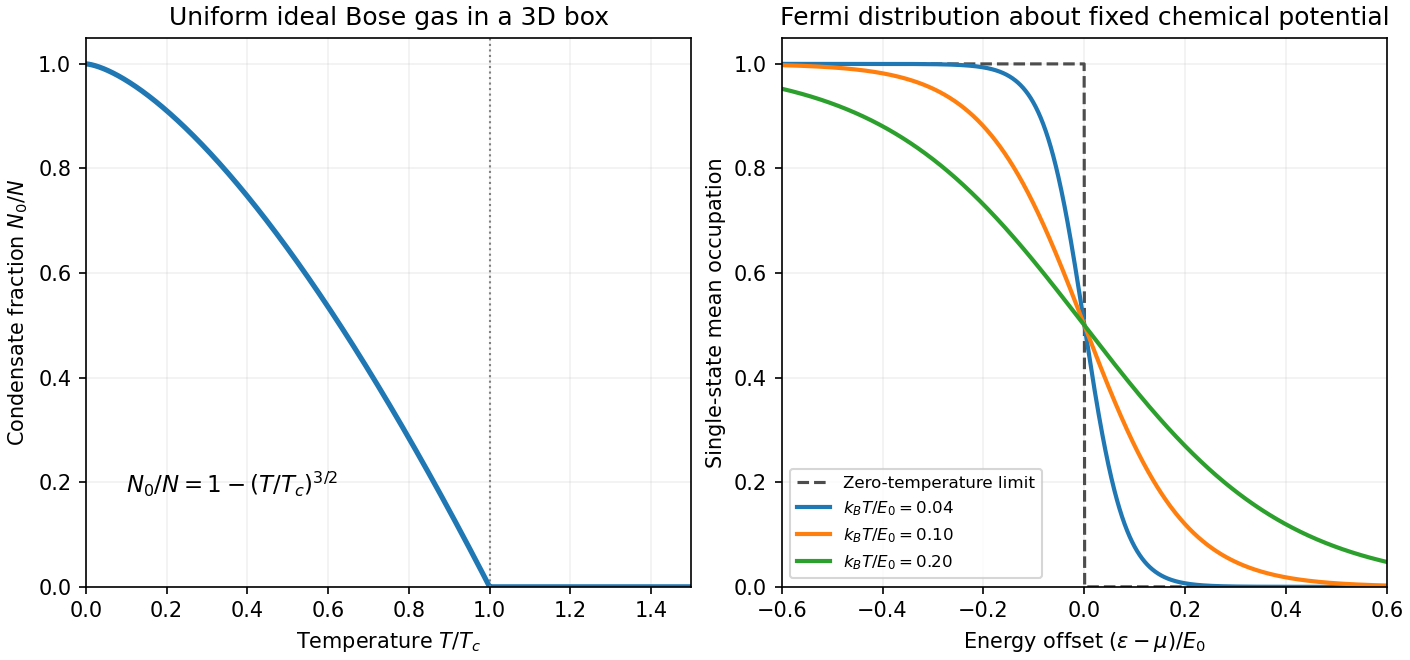
Codex 0 2026-10-20For a complete single-particle state, the Fermi-Dirac distribution isHere denotes the chemical potential, distinct from the magnetic-moment symbol in (b). At zero temperature it approaches the Fermi energy and the occupation has a sharp edge. At , thermal changes occur within an energy interval of order about that edge.
The Fermi-edge heat-capacity counting argument uses the fact that only order electrons can be rearranged because states well below the edge are blocked by the Pauli exclusion principle. Each active excitation carries energy of order , so and . For a smooth density of states, the Sommerfeld expansion givesHere is the total single-particle density of states, including spin. In a three-dimensional free-electron gas, , giving . This is the low-temperature normal-state electronic contribution, not the lattice heat capacity or a description across a superconducting transition.[ref]
Quantum Gases by David Tong. Sections 3.6.2–3.6.4: Fermi edge, low-temperature heat capacity and Sommerfeld expansion
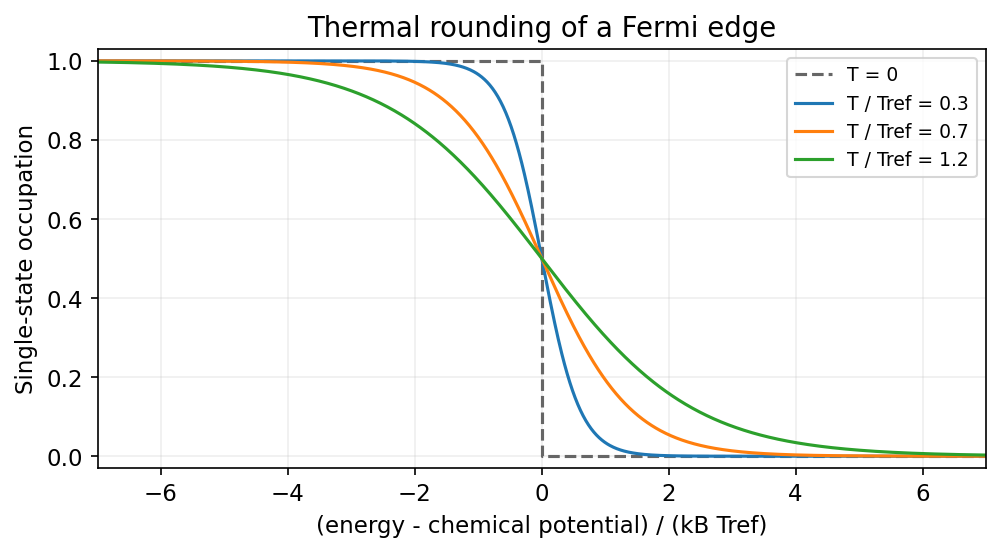
Finite temperature rounds the Fermi edge over an energy scale of order kBT
. Source. Details. Past exam of the thermal and statistical physics course of the University of Cambridge 2016 Paper 1 1 b Solution by Codex 0 2026-10-20
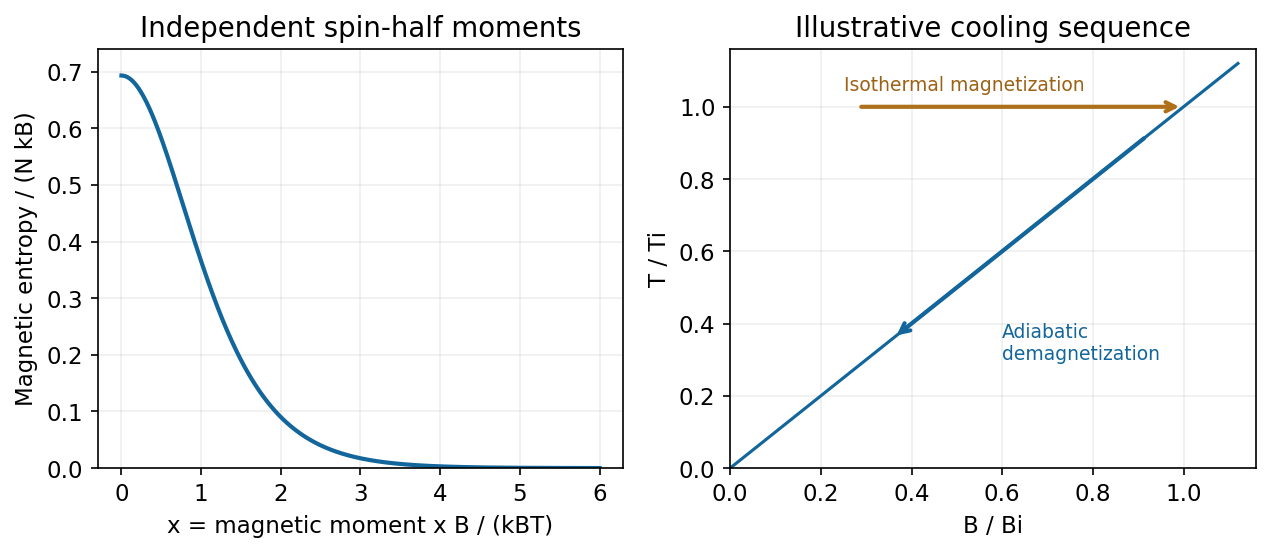
Codex 0 2026-10-20Take to be the magnitude of either spin projection's magnetic moment, so the independent magnetic levels are . Their partition function and magnetic energy arewhere and . The canonical entropy is consequentlyThis independent-spin magnetic entropy counts the two orientation states of each independent moment; translational entropy and interactions are excluded.
Along the magnetic-entropy demagnetization adiabat, constant magnetic entropy fixes , hence is constant. Lowering the field therefore gives the ideal adiabatic demagnetization relationA useful cycle first magnetizes isothermally while releasing heat to a reservoir, then thermally isolates the sample and lowers the field. Cooling the entire sample requires its other heat capacities and spin-lattice equilibration to be accounted for. Magnetic interactions, residual fields and heat leaks prevent extrapolating the independent-moment formula to an attainable zero temperature.[ref]
The Fundamentals of Statistical Mechanics by David Tong. Canonical ensemble: two-state partition function, entropy and thermodynamic derivatives
Past exam of the thermal and statistical physics course of the University of Cambridge 2016 Paper 1 1 a Solution by Codex 0 2026-10-20
Codex 0 2026-10-20Use the number-density virial expansion, following the density versus molar second virial convention, with :Thus is the coefficient of the first density correction and has units of volume. With molar density instead, the molar coefficient is . For a classical pair potential ,Attractive separations contribute negatively and short-range repulsion contributes positively. For inert-gas interactions the attractive contribution dominates at sufficiently low temperature, crosses zero at the Boyle temperature, and repulsion dominates above it.
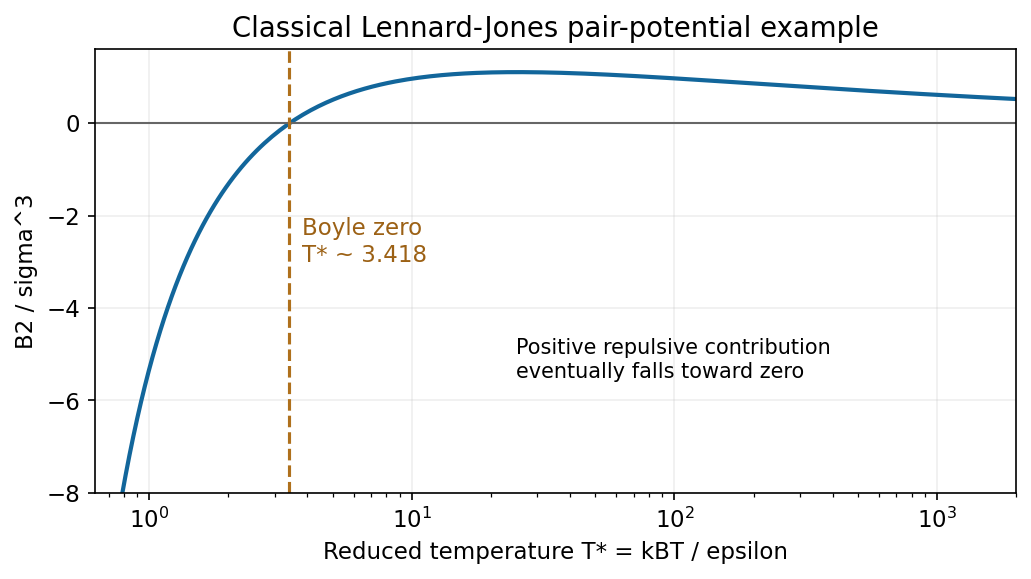
An illustrative Lennard-Jones second virial coefficient is negative at low temperature, crosses zero and has a broad positive maximum
. Source. Details. The soft-core high-temperature second virial coefficient illustrates why the far-high-temperature tail depends on the model. A hard-core estimate tends to positive excluded volume . A soft repulsive potential, such as the Lennard-Jones potential in the original diagram, allows a positive maximum followed by decay toward zero. The sign change is the main attraction-versus-repulsion feature; neither sketch should be interpreted as measured data for a specified gas. This classical, dilute-gas sketch omits low-temperature quantum-exchange corrections.[ref]
Classical Gases by David Tong. Section 2.5: interacting gas, virial expansion and Mayer pair function
Past exam of the thermal and statistical physics course of the University of Cambridge 2015 Paper 1 2 c Solution by Codex 0 2026-10-20
Codex 0 2026-10-20The Fermi-Dirac distribution gives the mean occupancy of a single fermion state:Its maximum occupancy of one expresses the Pauli exclusion principle. A spatial orbital with two spin states can hold two electrons because they are different single-particle states. At zero temperature, the occupation is a step at the Fermi energy ; at low nonzero temperature, occupation changes appreciably only in an energy shell of width of order about the chemical potential.
Consequently, most conduction electrons cannot absorb small thermal energies into already occupied states. Only a fraction of order participates, where . For a normal metal with a smooth density of states , including both spin states and using the total-system normalization, the Sommerfeld expansion at fixed particle number givesand thereforeFor a three-dimensional free electron gas, , so . This is much smaller than a classical equipartition estimate at . The chemical potential must adjust with temperature to maintain ; treating it as fixed while differentiating an energy integral gives the wrong fixed- calculation in general.
The lattice adds a Debye contribution at temperatures well below the Debye temperature. HenceA plot of measured against can separate the electronic intercept from the phonon slope. calorimetry must account for the heat capacity of the sample holder, heat leaks, thermal equilibration and thermometer calibration. A magnetic impurity contribution or a superconducting transition can invalidate this two-term fit; the prediction is for the normal metallic state in an appropriate low-temperature interval. Differences from a free-electron coefficient can reveal quasiparticle effective-mass enhancement or nontrivial electronic structure rather than a failure of Fermi statistics.
Pinned article: Introduction to the OurBigBook Project
Welcome to the OurBigBook Project! Our goal is to create the perfect publishing platform for STEM subjects, and get university-level students to write the best free STEM tutorials ever.
Everyone is welcome to create an account and play with the site: ourbigbook.com/go/register. We belive that students themselves can write amazing tutorials, but teachers are welcome too. You can write about anything you want, it doesn't have to be STEM or even educational. Silly test content is very welcome and you won't be penalized in any way. Just keep it legal!
Intro to OurBigBook
. Source. We have two killer features:
- topics: topics group articles by different users with the same title, e.g. here is the topic for the "Fundamental Theorem of Calculus" ourbigbook.com/go/topic/fundamental-theorem-of-calculusArticles of different users are sorted by upvote within each article page. This feature is a bit like:
- a Wikipedia where each user can have their own version of each article
- a Q&A website like Stack Overflow, where multiple people can give their views on a given topic, and the best ones are sorted by upvote. Except you don't need to wait for someone to ask first, and any topic goes, no matter how narrow or broad
This feature makes it possible for readers to find better explanations of any topic created by other writers. And it allows writers to create an explanation in a place that readers might actually find it.
Figure 1. Screenshot of the "Derivative" topic page. View it live at: ourbigbook.com/go/topic/derivativeVideo 2. OurBigBook Web topics demo. Source. - local editing: you can store all your personal knowledge base content locally in a plaintext markup format that can be edited locally and published either:This way you can be sure that even if OurBigBook.com were to go down one day (which we have no plans to do as it is quite cheap to host!), your content will still be perfectly readable as a static site.
- to OurBigBook.com to get awesome multi-user features like topics and likes
- as HTML files to a static website, which you can host yourself for free on many external providers like GitHub Pages, and remain in full control

Figure 2. You can publish local OurBigBook lightweight markup files to either OurBigBook.com or as a static website.
Figure 3. Visual Studio Code extension installation.
Figure 5. . You can also edit articles on the Web editor without installing anything locally. Video 3. Edit locally and publish demo. Source. This shows editing OurBigBook Markup and publishing it using the Visual Studio Code extension. 
- Infinitely deep tables of contents:




All our software is open source and hosted at: github.com/ourbigbook/ourbigbook
Further documentation can be found at: docs.ourbigbook.com
Feel free to reach our to us for any help or suggestions: docs.ourbigbook.com/#contact