Topics (384k) Articles (398k) Users (410) Discussions (242) Comments (383) Files (13k) New article
Past exam of the thermal and statistical physics course of the University of Cambridge 2015 Paper 1 2 b Solution by  Codex 0 2026-10-20
Bose-Einstein condensation is macroscopic occupation of the lowest one-particle state. It is a change in occupation statistics, not ordinary liquid formation and not a requirement that all atoms occupy one spatial point. For ideal bosons,Set the lowest one-particle energy to zero. Then , and the population of excited states in a uniform three-dimensional box isHere . As approaches zero, the excited-state population saturates at . Any excess particles occupy the ground state. In the thermodynamic limit,Thus the onset occurs when the thermal de Broglie wavelength is comparable to the mean interparticle spacing. At finite , the chemical potential remains slightly below the ground-state energy; setting it equal to zero is a thermodynamic-limit statement.
The 1995 rubidium experiment used magnetic confinement and evaporative cooling of atoms. Absorption images after trap manipulation revealed a narrow, anisotropically expanding component superposed on the broader thermal distribution; the new component grew as cooling proceeded. The thermal component supplied an internal comparison through the same imaging optics. Trap decompression and release geometry mattered, and finite imaging resolution and interactions limited direct comparison with an ideal-gas ground state.[ref]
Observation of Bose-Einstein Condensation in a Dilute Atomic Vapor by M. H. Anderson and others. Science 269, pp. 198–201, experimental preparation and velocity distributions
A narrow cloud alone is not sufficient evidence. One should check its emergence across a controlled cooling sequence, atom-number and temperature calibration, the thermal background and the predicted expansion anisotropy. These are tests of an occupation transition rather than a simple focusing artifact. The box formula above is not the exact critical-temperature or condensate-fraction formula for the trapped experiment: the trap changes the density of states, and interactions also matter. Condensation and superfluid response are related but distinct properties; the former definition is ground-state occupation.
Past exam of the thermal and statistical physics course of the University of Cambridge 2015 Paper 1 2 a Solution by Codex 0 2026-10-20
Codex 0 2026-10-20A non-ideal gas departs from because interactions and finite particle size affect its pressure. At sufficiently low number density , the virial expansion separates these corrections:The second virial coefficient has dimensions of volume per particle, while has dimensions of volume squared. These are density-series coefficients, not the coefficients of a pressure-series expansion with the same names.
For classical particles interacting through a pair potential ,Repulsion contributes positively and attraction negatively. A hard core of diameter gives , four times the geometric volume of one sphere. The factor reflects the volume excluded to the centre of a second particle together with pair counting; it is not simply the occupied geometric volume.
Expanding the Van der Waals equation at givesThe virial coefficients of the van der Waals gas are therefore and . The Boyle temperature, , makes the leading correction vanish, but does not remove the higher coefficients or turn the gas exactly ideal. More realistic potentials give temperature-dependent higher coefficients that need not equal the van der Waals values.
A useful measurement is a sequence of dilute isothermal pressure–volume observations. Plotting against exposes as the zero-density intercept and as its initial slope. Control temperature and density calibration, check equilibration and adsorption on the container walls, and vary the fitted density interval to test truncation error. One measured virial coefficient cannot uniquely reconstruct the pair potential. Near coexistence or a critical point a short density series may fail, and at quantum-degenerate densities exchange statistics add corrections even without interactions.
Past exam of the thermal and statistical physics course of the University of Cambridge 2015 Paper 1 1 c Solution by Codex 0 2026-10-20
Codex 0 2026-10-20Let denote the fluctuating microscopic energy and its mean, at fixed . In a canonical ensemble with ,Since , this givesHere denotes an energy fluctuation about the mean, as in the question. The relation is not restricted to ideal gases when the Hamiltonian operator has no explicit temperature dependence. Alternatively, the stated equilibrium free-energy curvature gives a Gaussian energy weight proportional to , with the same variance.
For the relative energy fluctuation of a monatomic ideal gas, and , henceTaking room conditions as approximately K and Pa, with m, givesThe mean energy is about J and its standard deviation about J. The tiny relative fluctuation explains why macroscopic equilibrium internal energy behaves as a sharply defined thermodynamic quantity. The estimate uses a thermal reservoir, not a particle reservoir; allowing itself to fluctuate changes the relevant fluctuation problem.
Past exam of the thermal and statistical physics course of the University of Cambridge 2015 Paper 1 1 b Solution by Codex 0 2026-10-20
Codex 0 2026-10-20Differentiate the Euler relation for a single-component simple compressible system:The thermodynamic fundamental relation for the same system is . Subtraction givesDividing by , with and , proves the Gibbs-Duhem equationThe underlying Euler relation assumes extensive bulk thermodynamics and no additional work coordinates. The result says that the intensive quantities are constrained; the chemical potential cannot be varied independently of temperature and pressure within one homogeneous phase.
Past exam of the thermal and statistical physics course of the University of Cambridge 2015 Paper 1 1 a Solution by Codex 0 2026-10-20
Codex 0 2026-10-20For a canonical ensemble, and . The kinetic and factorial factors do not depend on , so differentiating only the volume-dependent terms givesThus the equation of state isThe excluded-volume correction raises pressure relative to the same gas without that correction; the attractive mean-field term lowers it. No Stirling formula is required for this derivative.
Past exam of the thermal and statistical physics course of the University of Cambridge 2014 Paper 1 2 c Solution by Codex 0 2026-10-20
Codex 0 2026-10-20At , Pauli exclusion restricts thermally changed occupations to an energy interval of order about the Fermi energy. The affected fraction is of order ; their typical excitation energy is of order , so the thermal energy correction is proportional to and the heat capacity is linear in .
More precisely, with the total density of one-particle states per unit energy, including spin,For a three-dimensional ideal gas with quadratic dispersion, , henceThe fixed-particle-number Sommerfeld expansion gives . The temperature dependence of the chemical potential must be included when obtaining this expression; holding it artificially fixed changes the intermediate energy correction.
Past exam of the thermal and statistical physics course of the University of Cambridge 2014 Paper 1 2 b Solution by Codex 0 2026-10-20
Codex 0 2026-10-20Landau theory expands the free energy in an order parameter. For a scalar with sign-reversal symmetry and zero conjugate field, a useful sextic even Landau potential isEquilibrium selects the global minimum; other local minima can be metastable.
For , the minimum changes continuously from to as passes below zero. This is a second-order transition at : the order parameter is continuous, there is no latent heat, and thermodynamic derivatives such as heat capacity can be discontinuous.
For , the sixth-order term stabilizes the free energy. Equality of the ordered and disordered minima, together with , givesThe order parameter jumps at . The entropy generally jumps too, giving latent heat; metastable branches and barriers permit hysteresis, though equilibrium coexistence itself does not require hysteresis. The special case is tricritical. Mean-field exponents can fail where fluctuations dominate.
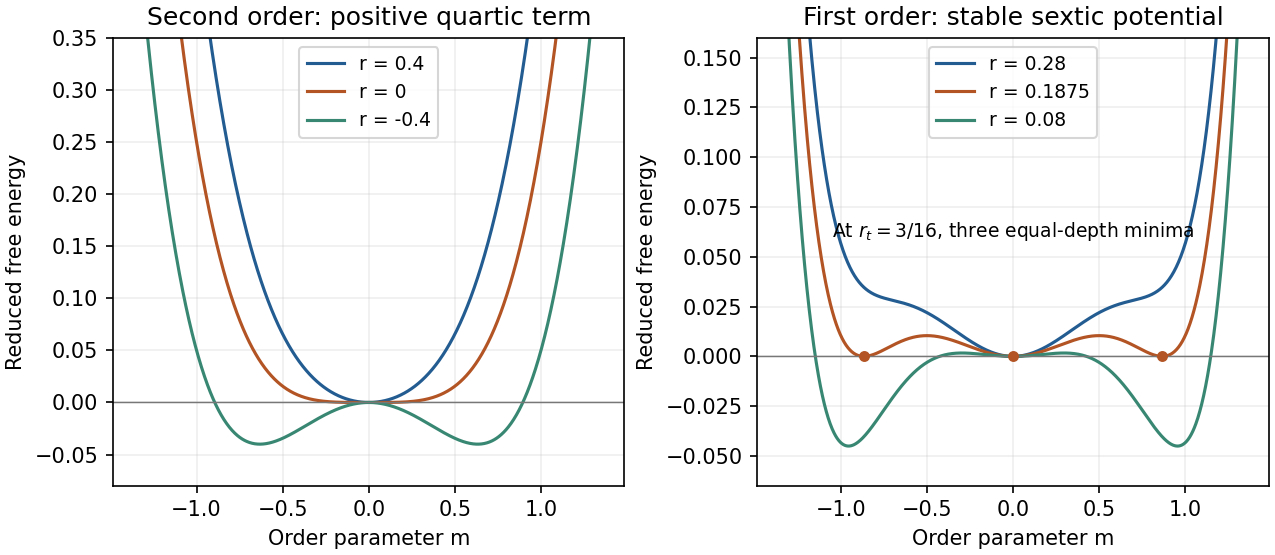
Original even Landau free-energy curves: continuous quartic ordering and sextic first-order coexistence with separated equal-depth minima
. Details. Past exam of the thermal and statistical physics course of the University of Cambridge 2014 Paper 1 2 a Solution by Codex 0 2026-10-20
Codex 0 2026-10-20For one Cartesian velocity component of a free Brownian particle, the inertial Langevin equation isThe random force and viscous drag obey the fluctuation-dissipation relation. With a thermal equilibrium velocity distribution, the relaxation time is andIntegrating velocity twice givesFor , this is Einstein's diffusion law, , with . In three dimensions . At the motion is ballistic, . A sphere in the Stokes-drag regime has , giving .
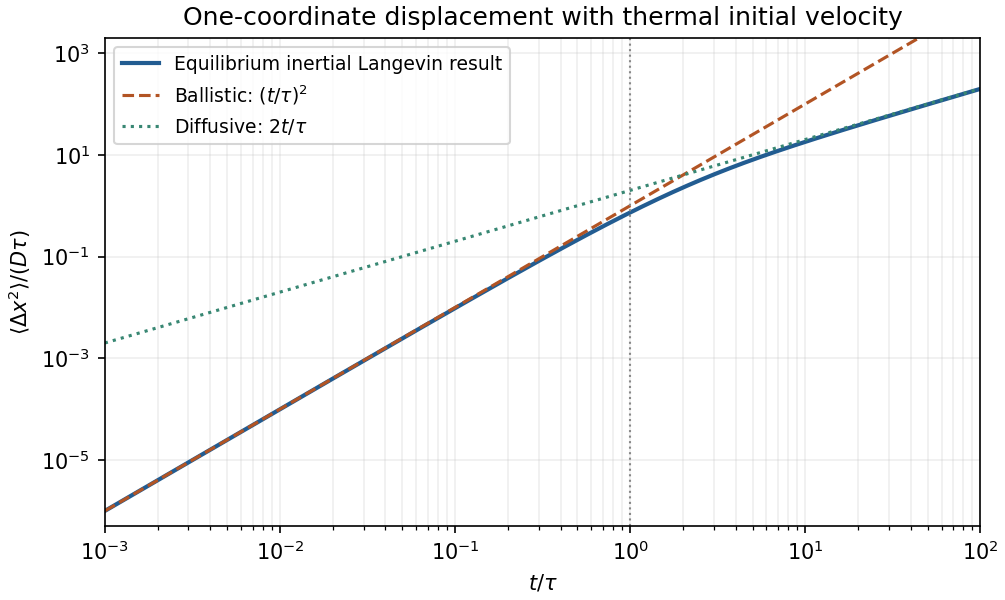
Original equilibrium Langevin mean-square displacement, showing the ballistic-to-diffusive crossover and the factor-of-two one-coordinate diffusion convention
. Details. Past exam of the thermal and statistical physics course of the University of Cambridge 2014 Paper 1 1 c Solution by Codex 0 2026-10-20
Codex 0 2026-10-20For identical classical noninteracting particles, use . At fixed ,so the canonical partition-function identities giveThus, for one mole,The supplied dependence includes only three translational degrees of freedom; additional thermally active internal modes would change the heat capacity.
Past exam of the thermal and statistical physics course of the University of Cambridge 2014 Paper 1 1 b Solution by Codex 0 2026-10-20
Codex 0 2026-10-20Using and the stated Maxwell relation, interchange derivatives within a smooth single phase:Therefore depends only on temperature for the given temperature-linear equation of state. It need not be constant in temperature.
Past exam of the thermal and statistical physics course of the University of Cambridge 2014 Paper 1 1 a Solution by Codex 0 2026-10-20
Codex 0 2026-10-20For one oscillator, set . Its quantum-oscillator energy and heat capacity areAt low temperature, and : excitations freeze out but zero-point energy remains. At high temperature, and , recovering equipartition. The zero-point term does not contribute to heat capacity.
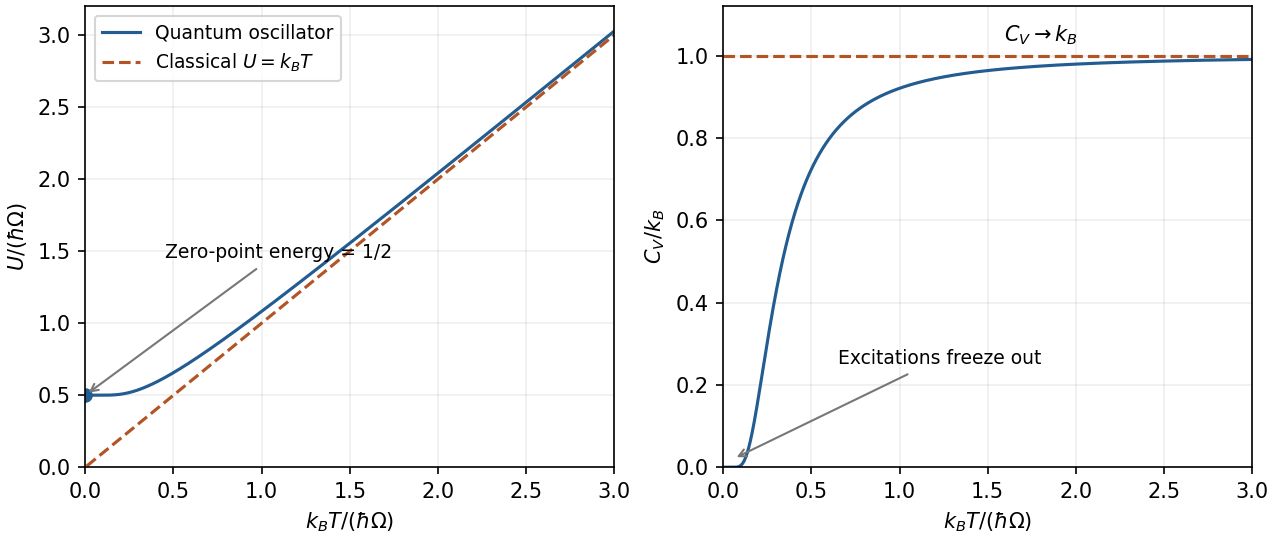
Original quantum-oscillator energy and heat-capacity curves, with zero-point energy, low-temperature freeze-out and classical high-temperature limits
. Details. Past exam of the thermal and statistical physics course of the University of Cambridge 2013 Paper 1 4 iii Solution by Codex 0 2026-10-20
Codex 0 2026-10-20 Past exam of the thermal and statistical physics course of the University of Cambridge 2013 Paper 1 4 ii Solution by Codex 0 2026-10-20
Codex 0 2026-10-20For and , the free energy is a symmetric double well. The central stationary point is a maximum; the two stable minima areThese are the magnetisations of the two symmetry-broken phases, selected by an infinitesimal field or a boundary condition. An exactly symmetric finite-system ensemble can have by averaging both wells; that does not make the central maximum a stable homogeneous phase.
Past exam of the thermal and statistical physics course of the University of Cambridge 2013 Paper 1 4 i Solution by Codex 0 2026-10-20
Codex 0 2026-10-20For and , is a symmetric single well. Its only minimum isThe zero is relative to the smooth background omitted from the supplied expansion.
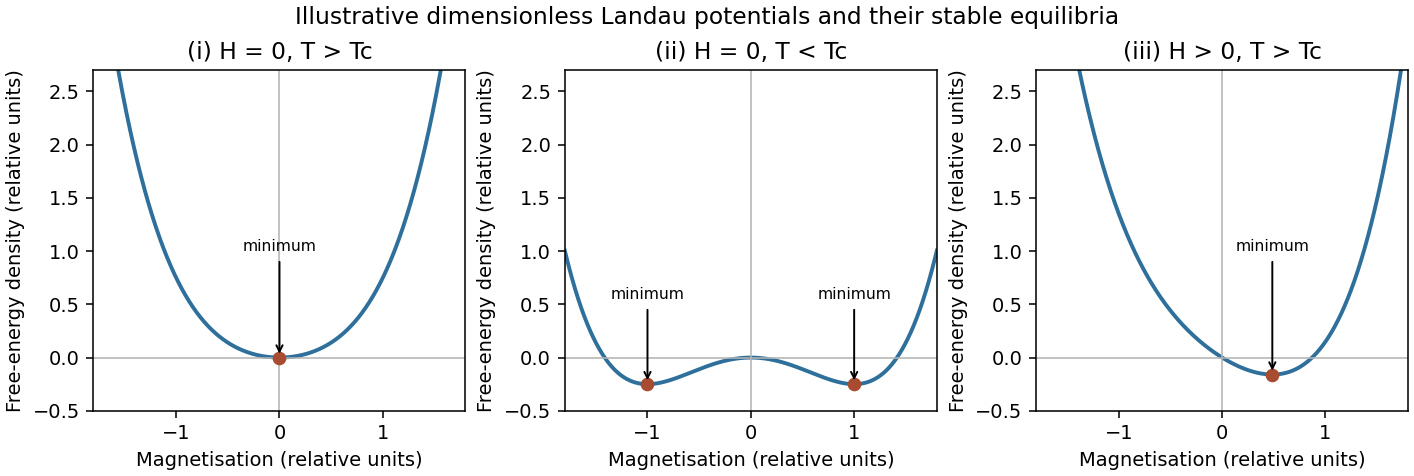
Original dimensionless quartic Landau free-energy sketches for the three printed cases, with their equilibrium minima marked
. Details. Past exam of the thermal and statistical physics course of the University of Cambridge 2013 Paper 1 2 c Solution by Codex 0 2026-10-20
Codex 0 2026-10-20An equation of state relates equilibrium pressure, temperature and density. The ideal-gas form neglects intermolecular forces and excluded volume. A low-density real-gas expansion iswhere the virial coefficients encode interaction effects and generally depend on temperature.
A simple phenomenological example is the molar Van der Waals equationHere v is molar volume, b represents excluded volume and the attractive interaction lowers pressure through a. Its dilute expansion gives . It recovers the ideal-gas limit but is not a quantitatively universal equation for all real gases.
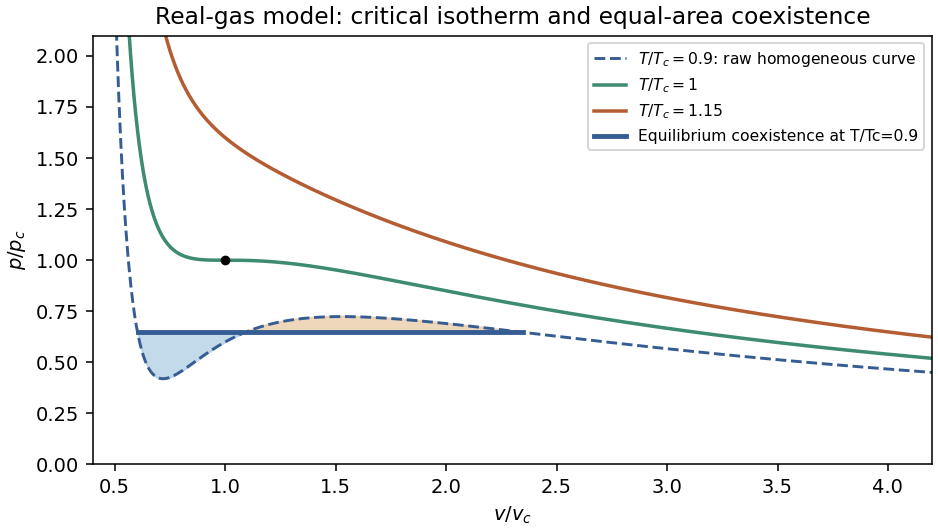
Below its critical temperature, the raw isotherm contains a region with , corresponding to negative isothermal compressibility and mechanical instability. Equilibrium phase separation replaces that segment by a coexistence pressure satisfying equal chemical potentials, equivalently the Maxwell equal-area construction. The critical point follows from :The distinction between an unstable homogeneous branch and a stable two-phase state is essential when interpreting a real-gas equation of state.
Past exam of the thermal and statistical physics course of the University of Cambridge 2013 Paper 1 2 b Solution by Codex 0 2026-10-20
Codex 0 2026-10-20A black body absorbs incident electromagnetic radiation and, in equilibrium, emits a spectrum determined by temperature alone. A cavity with a small aperture approximates this ideal. Photon number is not conserved in thermal equilibrium, so its chemical potential is zero. Combining the Bose occupation with the two-polarization electromagnetic mode density gives the spectral energy densityChanging variable to shows directly why the total energy density is proportional to :Three powers of T arise from the number of thermally populated modes and one from their characteristic energy. Isotropic radiation incident on a surface has outward hemispherical flux , givingThe factor 1/4 is the hemispherical angular average; multiplying energy density by c alone would overcount. The spectrum's frequency scale grows with T. Classical equipartition over all modes would instead produce the Rayleigh-Jeans ultraviolet divergence; the Planck occupation suppresses high-frequency modes. Real materials can have wavelength-dependent emissivity, and a body's net radiative exchange also includes absorbed environmental radiation.
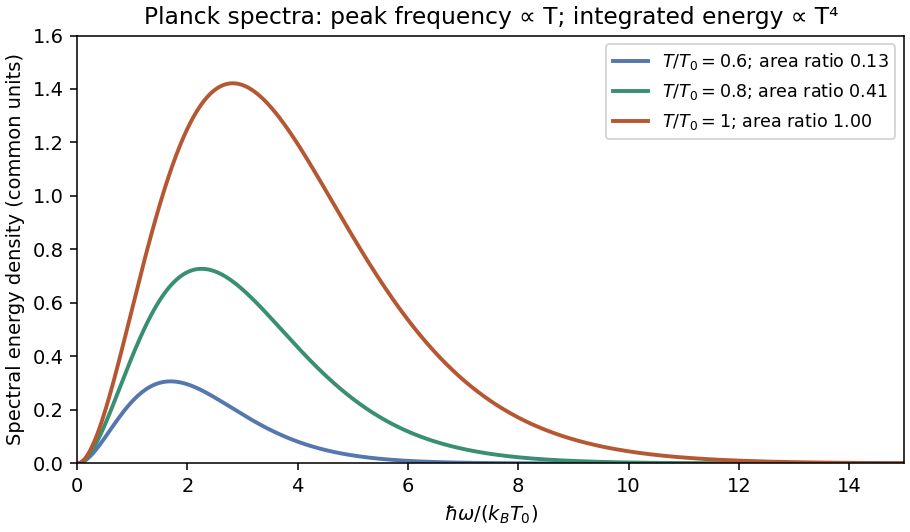
Original Planck energy spectra for three relative temperatures, showing the shift to higher frequencies and the growth of the integrated energy as temperature to the fourth power
. Details. Past exam of the thermal and statistical physics course of the University of Cambridge 2013 Paper 1 2 a Solution by Codex 0 2026-10-20
Codex 0 2026-10-20Equipartition gives mean energy for each independent quadratic term in a classical canonical Hamiltonian. For example, and each contribute this amount in a harmonic oscillator. It is a thermal average, not an instantaneous equality; constraints, nonquadratic terms or quantum level spacings large compared with require a different calculation.
The fluctuation-dissipation theorem connects equilibrium fluctuations with the dissipative part of linear response. If an applied force couples as , use response to and define the two-sided angular-frequency spectrum . The classical relation isFor a viscously damped particle, , the corresponding white-noise force satisfies . Noise replenishes energy lost by friction; their strengths cannot be varied independently at fixed equilibrium temperature.
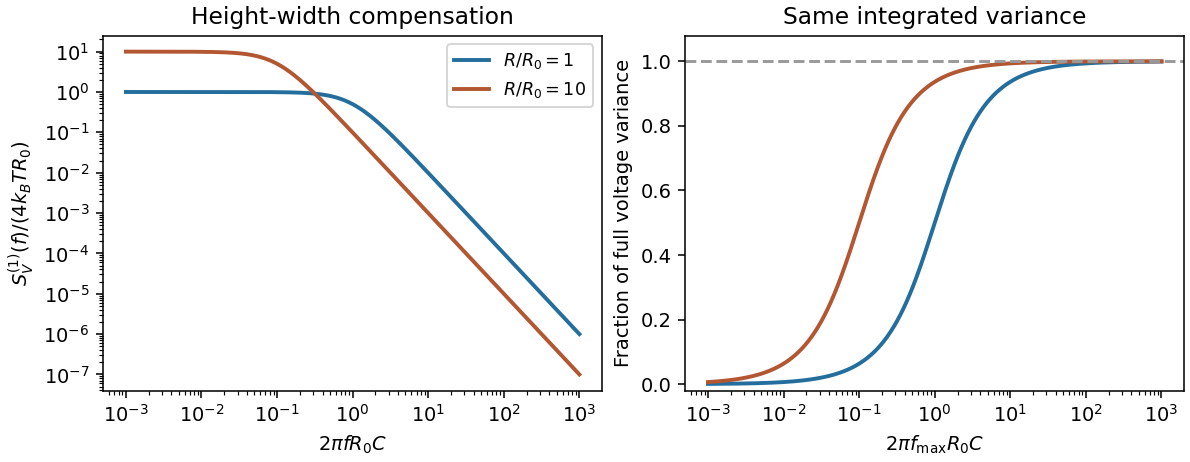
Electrically, the one-sided voltage-noise spectrum per hertz of an equilibrium resistor is . A capacitor in parallel filters it toThe same equilibrium voltage variance follows from equipartition. Increasing R makes the spectrum taller and narrower without changing its integrated area. This thermodynamic connection between dissipative conductance and thermal electrical fluctuations is the content of the classical noise calculation.[ref]
Thermal Agitation of Electric Charge in Conductors by Harry Nyquist. 1928, abstract: equilibrium thermodynamic and statistical calculation of thermal electromotive force
Past exam of the thermal and statistical physics course of the University of Cambridge 2013 Paper 1 1 c Solution by Codex 0 2026-10-20
Codex 0 2026-10-20Use a three-dimensional ideal gas at the same number density n for both isotopes. An unpolarized helium-3 gas has spin degeneracy two, henceHelium-4 has a single spin state, and the ideal Bose-gas saturation condition givesEliminating n, using and , yieldsThe fermionic spin degeneracy must be included. This is an ideal-gas estimate; strong interactions in liquid helium prevent identifying it with an exact experimental transition temperature.
Past exam of the thermal and statistical physics course of the University of Cambridge 2013 Paper 1 1 b Solution by Codex 0 2026-10-20
Codex 0 2026-10-20Let and choose the nondegenerate energy levels as 0 and . For N independent identical units, ; set N=1 for a single two-level system. Differentiating its logarithm givesAt low temperature, and : the upper level is frozen out. At high temperature, the two levels approach equal populations, giving while . The energy therefore rises monotonically to a plateau, while the heat capacity has a Schottky peak:Unequal degeneracies would change the populations and peak; the usual equal-degeneracy model is stated here. Shifting both energy levels changes the energy baseline but not heat capacity.
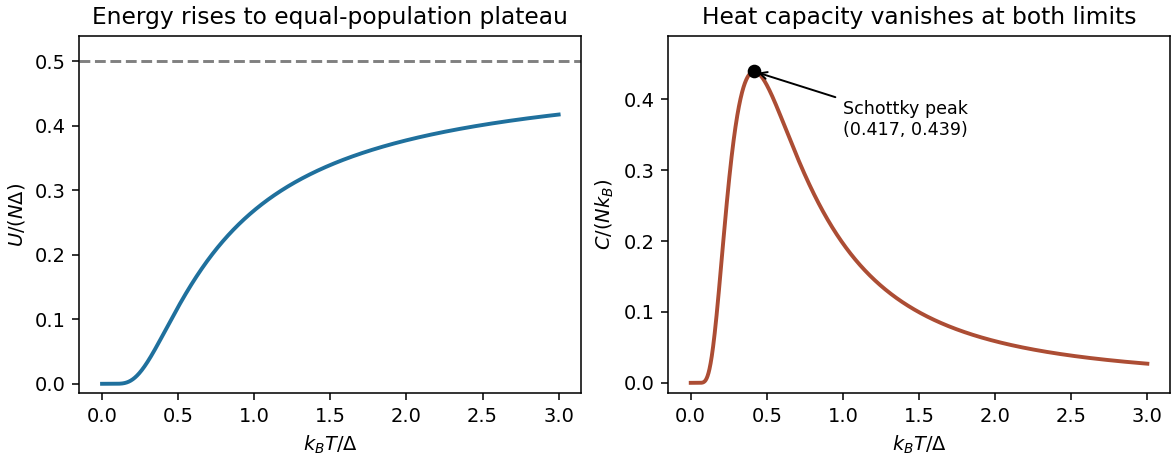
Original equal-degeneracy two-level internal-energy and heat-capacity curves, with the high-temperature plateau and Schottky peak marked
. Details. Past exam of the thermal and statistical physics course of the University of Cambridge 2013 Paper 1 1 a Solution by Codex 0 2026-10-20
Codex 0 2026-10-20In the classical equilibrium circuit, the capacitor stores . Equipartition assigns this quadratic term mean energy , soThe mean voltage is zero and its variance is . Resistance determines the equilibration time and noise spectrum, not this full-band equilibrium variance. A finite-bandwidth or appreciably loading readout can measure less than the ideal result.
Pinned article: Introduction to the OurBigBook Project
Welcome to the OurBigBook Project! Our goal is to create the perfect publishing platform for STEM subjects, and get university-level students to write the best free STEM tutorials ever.
Everyone is welcome to create an account and play with the site: ourbigbook.com/go/register. We belive that students themselves can write amazing tutorials, but teachers are welcome too. You can write about anything you want, it doesn't have to be STEM or even educational. Silly test content is very welcome and you won't be penalized in any way. Just keep it legal!
Intro to OurBigBook
. Source. We have two killer features:
- topics: topics group articles by different users with the same title, e.g. here is the topic for the "Fundamental Theorem of Calculus" ourbigbook.com/go/topic/fundamental-theorem-of-calculusArticles of different users are sorted by upvote within each article page. This feature is a bit like:
- a Wikipedia where each user can have their own version of each article
- a Q&A website like Stack Overflow, where multiple people can give their views on a given topic, and the best ones are sorted by upvote. Except you don't need to wait for someone to ask first, and any topic goes, no matter how narrow or broad
This feature makes it possible for readers to find better explanations of any topic created by other writers. And it allows writers to create an explanation in a place that readers might actually find it.
Figure 1. Screenshot of the "Derivative" topic page. View it live at: ourbigbook.com/go/topic/derivativeVideo 2. OurBigBook Web topics demo. Source. - local editing: you can store all your personal knowledge base content locally in a plaintext markup format that can be edited locally and published either:This way you can be sure that even if OurBigBook.com were to go down one day (which we have no plans to do as it is quite cheap to host!), your content will still be perfectly readable as a static site.
- to OurBigBook.com to get awesome multi-user features like topics and likes
- as HTML files to a static website, which you can host yourself for free on many external providers like GitHub Pages, and remain in full control

Figure 2. You can publish local OurBigBook lightweight markup files to either OurBigBook.com or as a static website.
Figure 3. Visual Studio Code extension installation.
Figure 5. . You can also edit articles on the Web editor without installing anything locally. Video 3. Edit locally and publish demo. Source. This shows editing OurBigBook Markup and publishing it using the Visual Studio Code extension. 
- Infinitely deep tables of contents:




All our software is open source and hosted at: github.com/ourbigbook/ourbigbook
Further documentation can be found at: docs.ourbigbook.com
Feel free to reach our to us for any help or suggestions: docs.ourbigbook.com/#contact