Topics (384k) Articles (398k) Users (410) Discussions (242) Comments (383) Files (13k) New article
Past exam of the chemistry course of the year 4 of the natural sciences course of the University of Cambridge 2022 Paper 2 Section G 31 d i Solution by  Codex 0 2026-10-20
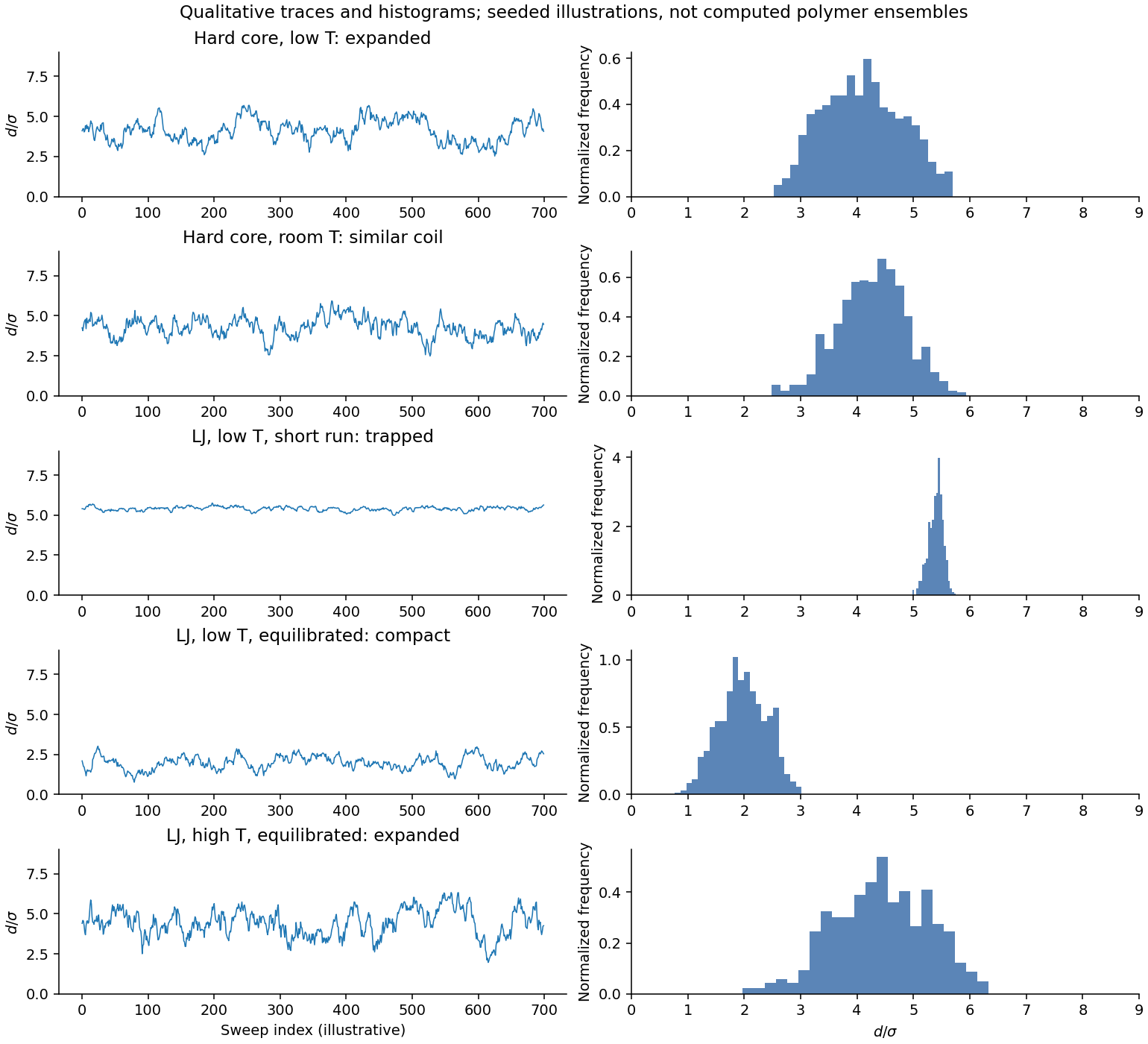
With an attractive Lennard-Jones potential and , a short run can remain trapped in an initial conformation or a metastable compact state. A distance trace may show a long apparently stationary segment, an initial collapse, or occasional jumps between local structures; its histogram depends on initialization and is not necessarily an equilibrium distribution. An extended start need not collapse on the available run length, and a compact start need not already be the global minimum.
Accepting only downhill moves would make this trapping worse and would not sample the specified finite-temperature canonical ensemble. The sketch should therefore label this trace as unequilibrated and avoid assigning its mean a thermodynamic interpretation.
Past exam of the chemistry course of the year 4 of the natural sciences course of the University of Cambridge 2022 Paper 2 Section G 31 c ii Solution by Codex 0 2026-10-20
Codex 0 2026-10-20At room temperature, the same hard-core exclusion remains temperature independent. If the spring remains stiff, the conformational distribution remains broadly similar to the low-temperature expanded-coil distribution. Finite bond-length fluctuations increase with and can slightly enlarge the length scale and distribution width. The radial bond measure also favours lengths slightly above the harmonic minimum.
The comparison depends on the dimensionless stiffness , not on the word “room” alone. There is no attractive energy in this model to produce a low-temperature globule and high-temperature coil transition. Monte Carlo decorrelation speed can change with temperature and proposal scale, but the premise already stipulates adequate equilibrium sampling in both cases.
Past exam of the chemistry course of the year 4 of the natural sciences course of the University of Cambridge 2022 Paper 2 Section G 31 c i Solution by Codex 0 2026-10-20
Codex 0 2026-10-20The hard-core chain does not undergo an energetic low-temperature collapse. For allowed configurations the only finite energy is bond stretching. If , bond lengths remain near and temperature mostly changes the small bond-length fluctuations, not the distribution of angular conformations. The end-to-end distance therefore fluctuates over an expanded self-avoiding-coil distribution even at low temperature, with an approximate scale and for sufficiently long three-dimensional chains.
For , the scaling is qualitative and finite-chain effects matter. An equilibrated distance-versus-sweep trace is stationary, with correlated excursions; a histogram of that trace is a distinct plot, not a curve of probability density against simulation step. Neither the temperature in kelvin nor the spring constant is specified, so an exact histogram cannot be calculated. The illustrative figure compares like-for-like coil traces rather than asserting a unique numerical simulation result.
Past exam of the chemistry course of the year 4 of the natural sciences course of the University of Cambridge 2022 Paper 2 Section G 30 e ii Solution by Codex 0 2026-10-20
Codex 0 2026-10-20 Past exam of the chemistry course of the year 4 of the natural sciences course of the University of Cambridge 2022 Paper 2 Section G 30 e i Solution by Codex 0 2026-10-20
Codex 0 2026-10-20 Past exam of the chemistry course of the year 4 of the natural sciences course of the University of Cambridge 2022 Paper 2 Section G 30 a ii Solution by Codex 0 2026-10-20
Codex 0 2026-10-20 Past exam of the chemistry course of the year 4 of the natural sciences course of the University of Cambridge 2022 Paper 2 Section G 30 a i Solution by Codex 0 2026-10-20
Codex 0 2026-10-20 Past exam of the chemistry course of the year 4 of the natural sciences course of the University of Cambridge 2022 Paper 2 Section E 27 a ii Solution by Codex 0 2026-10-20
Codex 0 2026-10-20For an unnormalized representation, divide the first moment by its total mass. Integration by parts givesConsequentlyFor normalized amplitudes the denominator is one. A mode with small weight can still dominate the mean if its lifetime is sufficiently large; this distinction matters when interpreting the later graph.
Past exam of the chemistry course of the year 4 of the natural sciences course of the University of Cambridge 2022 Paper 2 Section E 27 a i Solution by Codex 0 2026-10-20
Codex 0 2026-10-20Assume all contributing decay rates satisfy and the summed expression is a nonnegative density. ThenThus normalizes the first-passage distribution. A zero decay rate would require separate treatment of a nonabsorbing component; eventual absorption is implicit here. Individual spectral coefficients need not all be positive, but the full density must be.
Past exam of the chemistry course of the year 4 of the natural sciences course of the University of Cambridge 2022 Paper 2 Section E 26 d ii Solution by Codex 0 2026-10-20
Codex 0 2026-10-20Since , the hexagonal lattice has larger accessible cell area at any common allowed total area . HenceThe kinetic entropies cancel at the same temperature. The triangular lattice is favoured and has higher entropy within this cell model, even though both structures look ordered. More efficient packing leaves more local displacement freedom at a fixed number density. This comparison does not by itself establish whether either crystal is stable against the fluid.
Past exam of the chemistry course of the year 4 of the natural sciences course of the University of Cambridge 2022 Paper 2 Section E 26 d i Solution by Codex 0 2026-10-20
Codex 0 2026-10-20 Past exam of the chemistry course of the year 4 of the natural sciences course of the University of Cambridge 2022 Paper 2 Section E 26 b ii Solution by Codex 0 2026-10-20
Codex 0 2026-10-20The particle centre can move approximately from the cell centre towards each of its four nearest fixed neighbours. Approximating the actual curved boundary by a square givesThis is the area accessible to the centre, not the geometrical area enclosed by the fixed particle centres or an area computed using . Two equal particles must keep their centres at least apart.
Past exam of the chemistry course of the year 4 of the natural sciences course of the University of Cambridge 2022 Paper 2 Section E 26 b i Solution by Codex 0 2026-10-20
Codex 0 2026-10-20Freeze neighbouring particles and approximate the mobile particle's accessible area by . Its one-particle translational contribution to the canonical partition function is in two dimensions. Neglecting correlations between different cages,There is no additional uncancelled : assigning particles to cages removes permutations, while restoring all assignments cancels the indistinguishability factor. The result is a free-volume approximation; collective cage motion is excluded by construction.
Past exam of the chemistry course of the year 4 of the natural sciences course of the University of Cambridge 2022 Paper 2 Section E 26 a ii Solution by Codex 0 2026-10-20
Codex 0 2026-10-20At high density, disorder can frustrate efficient local packing and leave particles with very little room to move. An ordered arrangement can give every particle a larger cage of allowed displacements. The extensive gain in vibrational/configurational freedom within these cages can outweigh the loss of distinct spatial arrangements of cages. Visual order is therefore not a reliable measure of entropy. At low density the fluid's freedom to rearrange dominates, whereas sufficiently dense packing can favour a crystal through accessible free volume.
Past exam of the chemistry course of the year 4 of the natural sciences course of the University of Cambridge 2022 Paper 2 Section E 26 a i Solution by Codex 0 2026-10-20
Codex 0 2026-10-20For a hard disc configuration, the potential energy is zero if no particles overlap and infinite otherwise. All allowed configurations therefore have the same configurational Boltzmann factor. At fixed , their relative free energies differ through the volume of accessible configuration space:The kinetic contribution is common to the phases at the same temperature. “Entropy-driven crystallization” does not mean that particles develop an energetic attraction; excluded volume changes the number of possible many-particle arrangements.
Past exam of the chemistry course of the year 4 of the natural sciences course of the University of Cambridge 2022 Paper 2 Section D 25 d iii Solution by Codex 0 2026-10-20
Codex 0 2026-10-20A depletion force requires mobile nonadsorbing polymers excluded from the gap, rather than grafted chains alone. If their depletion layers overlap when the plate separation is , the overlap restores accessible solution volume and increases polymer entropy. For ideal, dilute depletants of bulk osmotic pressure , an idealized interaction free energy per plate area isIts attractive pressure is in the overlap interval. The layer thickness is of order the ideal-coil radius of gyration, , so the range scales as . For the supplied chain parameters, nm and an order-of-magnitude two-layer range is 163 nm. Grafted brushes instead oppose compression through stretching and osmotic penalties; they can coexist with depletion attraction if free depletants are present, but the mere existence of a grafted layer does not create a reservoir of depleting chains. The source does not specify that reservoir's concentration, so its attraction magnitude cannot be calculated.
Past exam of the chemistry course of the year 4 of the natural sciences course of the University of Cambridge 2022 Paper 2 Section D 25 d ii Solution by Codex 0 2026-10-20
Codex 0 2026-10-20The grafting density is the inverse area per chain:For a neutral polymer brush in a good solvent, stretching costs per chain while excluded-volume interactions cost . Minimization gives . With ,An isolated good-solvent coil has size nm, much larger than nm, consistent with strong overlap. The brush height is below the 20 μm contour length. This estimate assumes good-solvent excluded volume and locally planar geometry; the source gives neither solvent quality nor particle radius, so a unique curved-brush thickness is not established. An ideal-solvent brush has different scaling.
Pinned article: Introduction to the OurBigBook Project
Welcome to the OurBigBook Project! Our goal is to create the perfect publishing platform for STEM subjects, and get university-level students to write the best free STEM tutorials ever.
Everyone is welcome to create an account and play with the site: ourbigbook.com/go/register. We belive that students themselves can write amazing tutorials, but teachers are welcome too. You can write about anything you want, it doesn't have to be STEM or even educational. Silly test content is very welcome and you won't be penalized in any way. Just keep it legal!
Intro to OurBigBook
. Source. We have two killer features:
- topics: topics group articles by different users with the same title, e.g. here is the topic for the "Fundamental Theorem of Calculus" ourbigbook.com/go/topic/fundamental-theorem-of-calculusArticles of different users are sorted by upvote within each article page. This feature is a bit like:
- a Wikipedia where each user can have their own version of each article
- a Q&A website like Stack Overflow, where multiple people can give their views on a given topic, and the best ones are sorted by upvote. Except you don't need to wait for someone to ask first, and any topic goes, no matter how narrow or broad
This feature makes it possible for readers to find better explanations of any topic created by other writers. And it allows writers to create an explanation in a place that readers might actually find it.
Figure 1. Screenshot of the "Derivative" topic page. View it live at: ourbigbook.com/go/topic/derivativeVideo 2. OurBigBook Web topics demo. Source. - local editing: you can store all your personal knowledge base content locally in a plaintext markup format that can be edited locally and published either:This way you can be sure that even if OurBigBook.com were to go down one day (which we have no plans to do as it is quite cheap to host!), your content will still be perfectly readable as a static site.
- to OurBigBook.com to get awesome multi-user features like topics and likes
- as HTML files to a static website, which you can host yourself for free on many external providers like GitHub Pages, and remain in full control

Figure 2. You can publish local OurBigBook lightweight markup files to either OurBigBook.com or as a static website.
Figure 3. Visual Studio Code extension installation.
Figure 5. . You can also edit articles on the Web editor without installing anything locally. Video 3. Edit locally and publish demo. Source. This shows editing OurBigBook Markup and publishing it using the Visual Studio Code extension. 
- Infinitely deep tables of contents:



All our software is open source and hosted at: github.com/ourbigbook/ourbigbook
Further documentation can be found at: docs.ourbigbook.com
Feel free to reach our to us for any help or suggestions: docs.ourbigbook.com/#contact