Topics (384k) Articles (398k) Users (410) Discussions (242) Comments (383) Files (13k) New article
Past exam of the formation of Structure in the Universe course of the University of Cambridge 2015 Paper 1 2 d Solution by  Codex 0 2026-10-20
The dust-cooled equilibrium is thermally stable under the stated constant irradiation, with fixed dust properties and dust-to-gas ratio. At a fixed position, absorbed power per grain is independent of its temperature, while emission is . A positive temperature perturbation increases cooling, causing a restoring energy loss; a negative perturbation reduces cooling, allowing reheating.
For heat capacity of a grain together with its thermally coupled gas,so the perturbation decays. The thermal stability of externally heated blackbody dust relies on remaining below sublimation with the grain population intact; destruction, variable illumination or finite dust-gas equilibration can change the response. An isobaric parcel with a fixed grain-to-gas ratio has the same restoring sign when heating and cooling are compared per particle.
Past exam of the formation of Structure in the Universe course of the University of Cambridge 2015 Paper 1 2 c Solution by Codex 0 2026-10-20
Codex 0 2026-10-20At distance , one grain intercepts power through its projected area and emits through its full surface:The blackbody dust sublimation radius follows by setting :Here the supplied luminosity is . The grain radius cancels because both cross-sections scale as . The temperature exterior to this boundary scales as . This estimate assumes isotropic illumination, no shielding, and unit absorption/emission efficiency as specified; real grain emissivities can change it. The numerical evaluation uses the external conversion values and .[ref]
CODATA recommended values of the fundamental physical constants 2014 by National Institute of Standards and Technology. Stefan-Boltzmann constant, rounded at the precision relevant here
Past exam of the formation of Structure in the Universe course of the University of Cambridge 2015 Paper 1 2 b Solution by Codex 0 2026-10-20
Codex 0 2026-10-20For inside-out collapse of a singular isothermal sphere, the expansion front is at . The original mass swept by this front isThus the only time-independent accretion scale is . The front-sweeping estimate has coefficient two, but gas takes time to fall from the front to the object; it is not an exact central accretion coefficient. Writefor fixed mean particle mass . Determining the dimensionless coefficient requires the collapse solution; it is not fixed by front propagation alone and is not needed for the requested temperature scaling.[ref]
Self-Similar Collapse of Isothermal Spheres and Star Formation by Frank H. Shu. 1977 expansion-wave solution: central accretion and the free-falling envelope
Well inside the front, where the point mass dominates and infall is approximately pressureless and locally steady, . Conserving the radial mass flux gives the free-fall density profile around a growing point mass:The inner slope is , versus in the undisturbed outer cloud. For constant and negligible initial object mass, and the inner normalization varies as . These are inner asymptotes, not an assertion of an abrupt exact power-law join at the front.
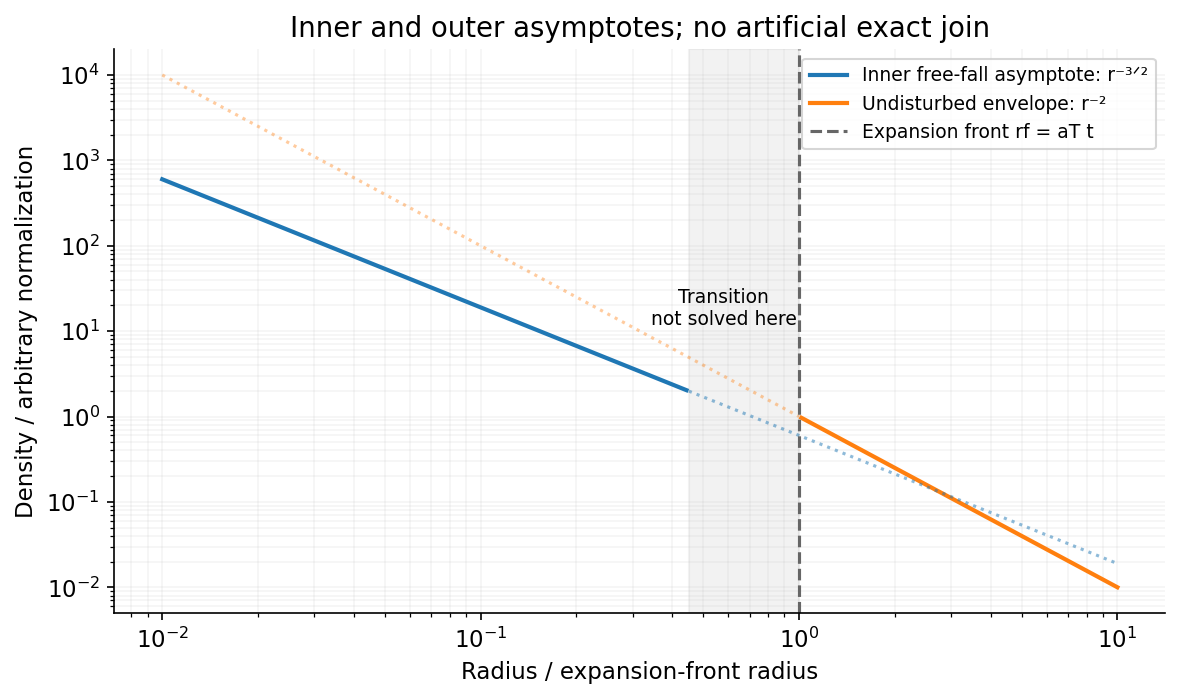
Past exam of the formation of Structure in the Universe course of the University of Cambridge 2015 Paper 1 2 a Solution by Codex 0 2026-10-20
Codex 0 2026-10-20With constant isothermal sound speed , the equation of state is . Spherical hydrostatic equilibrium and mass continuity requireTry . With no central point mass, , and hydrostatic balance becomes . The positive-density branch is thereforeThe constant external pressure fixes the truncation radius through , givingThis is the pressure-truncated singular isothermal gas sphere, one hydrostatic solution, not a claim that every isothermal cloud has a singular centre. Its central density diverges, but its enclosed mass tends to zero as .
Past exam of the formation of Structure in the Universe course of the University of Cambridge 2015 Paper 1 1 d Solution by Codex 0 2026-10-20
Codex 0 2026-10-20In a matter-dominated Einstein-de Sitter universe, the growing linear density contrast is proportional to the scale factor. When , linear evolution no longer describes collapse. An overdense region initially expands more slowly than the background, reaches cosmological turnaround, and then contracts under self-gravity.
The spherical top-hat collapse model supplies a useful idealization: pressureless shells obey . At formal collapse, the linearly extrapolated growing mode isThis is a linear extrapolation, not the true finite nonlinear density at that instant. In the ideal energy-conserving spherical model, virial equilibrium gives a virial radius about half the turnaround radius; its mean density at the collapse time is times the cosmic matter density.
Real perturbations are nonspherical: tides and anisotropic collapse produce sheets, filaments and haloes. Collisionless dark matter develops shell crossing and phase mixing rather than radiatively losing its orbital energy. Baryonic gas can shock, cool and collect within the resulting potential wells. Hierarchical merging then assembles larger systems where small-scale fluctuations have sufficient initial power. Press-Schechter formalism connects a collapse threshold with the statistics of the smoothed initial field, but halo abundances and internal structure need more than the single spherical model. These ideas apply after perturbations become nonlinear; one must not extend pressureless subhorizon equations through all radiation-era or horizon-scale conditions.[ref]
Past exam of the formation of Structure in the Universe course of the University of Cambridge 2015 Paper 1 1 c Solution by Codex 0 2026-10-20
Codex 0 2026-10-20Galactic star formation requires gas to collect into cold dense regions that can become self-gravitating. Disk-scale gravity, turbulent motions, shear, pressure and magnetic fields affect this collection; formation then proceeds within molecular clouds. A useful local parametrization iswhere the star-formation efficiency per free-fall time summarizes inefficient conversion rather than requiring every cloud to collapse at once.
Across galactic disks the empirical Kennicutt–Schmidt law relates star formation rate surface density to gas surface density, . A slope near is a familiar integrated total-gas fit, while molecular-gas relations in ordinary disks can be closer to linear; the slope and normalization depend on tracer, averaging scale and environment. The gas-depletion time is the corresponding fuel-consumption scale, not a prediction that inflow and recycling cease.
Massive stars supply ionizing radiation, winds and supernova energy and momentum. This stellar feedback can disperse clouds, sustain turbulence and drive outflows, regulating rather than simply extinguishing all future star formation. Fresh accretion and recycled gas replenish the reservoir. UV and recombination-line emission trace young stars, while infrared emission traces absorbed and re-radiated light; extinction, stellar populations and the assumed initial mass function affect inferred rates. A galactic rate reflects supply, cloud formation and feedback together, rather than only the free-fall time of its densest gas.[ref]
Star Formation in the Milky Way and Nearby Galaxies by Robert C. Kennicutt Jr. and Neal J. Evans II. Sections3–6: diagnostics, gas relations and physical interpretation
Past exam of the formation of Structure in the Universe course of the University of Cambridge 2015 Paper 1 1 b Solution by Codex 0 2026-10-20
Codex 0 2026-10-20Supermassive black holes are compact galactic nuclei with masses typically of millions to billions of solar masses. Their gravitational influence is measured from the motion of surrounding matter; accretion luminosity is evidence of feeding, not a necessary property of every black hole. Keplerian stellar orbits near the Galactic Centre and molecular-maser rotation curves in other nuclei provide particularly direct compact-mass constraints. A rough black-hole sphere of influence is ; resolving it helps dynamical mass estimates.
Accretion converts binding energy into radiation,The latter is the Eddington luminosity for isotropic radiation opposed by electron-scattering opacity, not an absolute luminosity ceiling for every geometry. The retained black-hole mass grows at . Sustained feeding can produce an active galactic nucleus, whereas gas-poor nuclei may be faint. Loss of gas angular momentum is a central feeding problem.
Black-hole mass correlates with classical-bulge stellar velocity dispersion through the M-sigma relation. Accretion-powered radiation, winds and jets can heat or remove gas, linking nuclear growth to galaxy evolution. Such correlations do not establish one universal feedback history, and disks and pseudobulges do not follow the same tight relations as classical bulges. Seed formation, accretion and mergers all contribute; seed masses and feeding histories remain model dependent.[ref]
Coevolution (Or Not) of Supermassive Black Holes and Host Galaxies by John Kormendy and Luis C. Ho. Dynamical evidence, bulge-dependent correlations and different feedback regimes
Past exam of the formation of Structure in the Universe course of the University of Cambridge 2015 Paper 1 1 a Solution by Codex 0 2026-10-20
Codex 0 2026-10-20A spiral density wave is an organized density and gravitational-potential perturbation through which stars and gas can move; it is not generally a permanently labelled set of stars. Differential rotation winds a material arm rapidly. In a wave description, a perturbation has phase , with pattern speed distinct from the local stellar angular speed.
For a thin fluid disk the local tightly wound dispersion relation isRotation and pressure resist self-gravity. A collisionless stellar disk requires its stellar response function instead of simply replacing by a dispersion; the familiar local axisymmetric stability parameter is . This is distinct from the gas .
Waves exchange angular momentum at Lindblad resonances and near corotation radius. Swing amplification can strengthen a leading disturbance as shear turns it into a trailing one. Bars or companions can force a coherent spiral; recurrent self-excited disturbances also occur. Thus a single indefinitely steady wave is one model, not a description established for every spiral galaxy. Gas compression and shocks along arms can organize star formation, while gravitational torques redistribute angular momentum. Arm brightness, recent star formation and stellar mass density need not trace precisely the same pattern.[ref]
Spirals in Galaxies by Jerry A. Sellwood and Karen L. Masters. Sections4–6: wave dynamics, recurrent versus quasi-steady patterns, and gas response
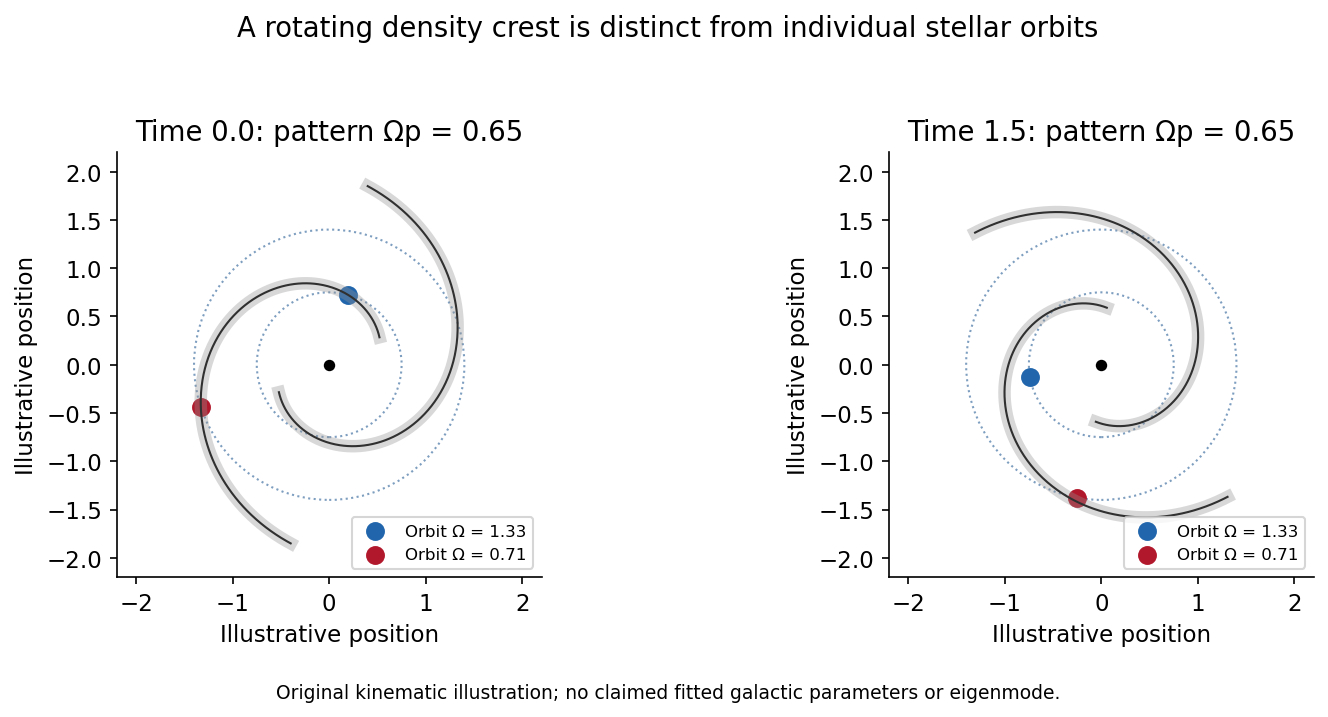
Past exam of the formation of Structure in the Universe course of the University of Cambridge 2014 Paper 1 3 d Solution by Codex 0 2026-10-20
Codex 0 2026-10-20Small primordial fluctuations seed later structure. For adiabatic cosmological perturbations on scales outside the horizon, the uniform-density curvature perturbation is conserved when the non-adiabatic pressure perturbation and the decaying mode can be neglected. A density contrast outside the horizon is gauge-dependent, so its apparent power-law growth should not be confused with directly measured local collapse.
For subhorizon, pressureless matter, the linearized continuity equation, Euler equation and Poisson equation combine intoHubble expansion damps peculiar motion; self-gravity amplifies overdensities. During radiation domination, radiation pressure drives acoustic oscillations and cold dark matter growth after horizon entry is only logarithmic. During matter domination the growing and decaying solutions are and . Dark-energy domination later suppresses growth relative to the matter-era law.
For a pressure-supported fluid the Fourier-mode equation also contains , giving a Jeans length separating acoustic support from gravitational growth. Before recombination, baryons are tightly coupled to photons and oscillate rather than freely following dark matter. Silk damping from photon diffusion damps small-scale photon-baryon fluctuations; after decoupling, baryons can fall into dark-matter potential wells. free streaming smooths species-dependent scales and distinguishes cold from warm or hot dark matter.
Schematically, the linear matter power spectrum can be written under the usual primordial-curvature normalization. The cosmological transfer function records horizon entry, matter-radiation equality, acoustic physics and damping; the linear growth factor records later amplification. density contrasts approaching unity require nonlinear collapse and halo formation beyond this approximation. cosmic microwave background anisotropies and galaxy clustering test the same initial perturbations through different transfer histories; galaxy bias, redshift-space distortions and observational selection enter the galaxy comparison.
Past exam of the formation of Structure in the Universe course of the University of Cambridge 2014 Paper 1 3 c Solution by Codex 0 2026-10-20
Codex 0 2026-10-20Stellar radiation, stellar winds and supernovae return energy, momentum, mass and metals to surrounding gas. Heating, ionization, turbulent support and gas removal can reduce subsequent star formation; swept-up shells can also compress gas locally. Whether thermal energy drives an outflow depends on its radiative gas cooling time relative to expansion: radiative losses can remove energy while leaving substantial momentum transfer. Thus deposited energy alone does not specify the dynamical effect.
The galactic gas regulator has mass budget , where is the returned fraction and is the mass-loading factor. In a quasi-steady state, . This connects feedback to the available gas supply. A wind's kinetic power and momentum flux must fit the source budget and gravitational binding cost. Gas that fails to escape may form a galactic fountain and later return; preferential metal loss changes chemical evolution.
Absorption against a galaxy's stellar continuum provides a concrete outflow test: compare interstellar sodium absorption with the systemic velocity and stellar absorption spectrum. A primary starburst survey found blueshifted interstellar absorption and an inclination dependence consistent with minor-axis outflows. Its saturated lines also illustrate why velocity detection is more direct than a unique column density or mass flux.[ref]
Absorption-Line Probes of Gas and Dust in Galactic Superwinds by Timothy M. Heckman and others. Abstract: NaD spectra, systemic velocities, viewing angle and optical depth
Deprojection, covering fraction, ionization, radius and the unseen hot phase limit total outflow-rate estimates.An accreting supermassive black hole adds radiation, winds and astrophysical jets. Coupling these to the interstellar or circumgalactic medium can suppress cooling or expel gas, especially in deep potentials where stellar driving alone may be inadequate. Jet cavities, line-emitting gas and multiphase outflows test different channels; coexisting activity and low star formation alone do not prove a causal feedback history.
Past exam of the formation of Structure in the Universe course of the University of Cambridge 2014 Paper 1 3 b Solution by Codex 0 2026-10-20
Codex 0 2026-10-20A cold self-gravitating core initially contracts on a dynamical scale if cooling prevents pressure from halting collapse. Increasing optical depth eventually traps radiation and forms a pressure-supported first hydrostatic core. Dissociation of molecular hydrogen absorbs compressional energy, softens the equation of state and triggers a second protostellar collapse to a compact protostar. Rotation produces a disk; angular-momentum transport permits continuing accretion, while outflows remove some mass and angular momentum.
An accreting object's luminosity includes a contribution of order , with a coefficient set by where accretion energy is radiated or retained. After accretion subsides, gravitational contraction supplies internal luminosity over the Kelvin-Helmholtz cooling time . Hydrostatic contraction heats the interior even while energy is radiated, as follows from the virial theorem and the negative heat capacity of a virialized gravitational system. accretion luminosity must not be substituted for in the contraction time without an energy-budget justification.
Low-mass, nearly fully convective pre-main-sequence stars contract down a Hayashi track at roughly constant effective temperature and decreasing radius and luminosity. A developing radiative core can lead onto a Henyey track toward higher effective temperature; the route depends on mass and opacity. The deuterium-burning energy-generation rate can temporarily moderate contraction, but sustained core hydrogen burning marks arrival on the main sequence. Massive objects may begin hydrogen burning while still accreting, and substellar objects never establish long-lived hydrogen burning. An infrared spectral class reflects envelope and disk emission as well as inclination and interstellar extinction, so it is not a unique stellar age or interior evolutionary track.
Past exam of the formation of Structure in the Universe course of the University of Cambridge 2014 Paper 1 3 a Solution by Codex 0 2026-10-20
Codex 0 2026-10-20For a monatomic ideal gas, write the thermal energy density as . At low optical depth, radiative loss uses an astrophysical cooling function, often written , while contains heating. At fixed density the net radiative gas cooling time is approximately when the denominator is positive; a cooling flow closer to constant pressure must include enthalpy and compressional work. Comparing this time with the free-fall time of a uniform sphere determines whether pressure can be lost during gravitational contraction.
Hot ionized gas cools by bremsstrahlung and recombination; collisional excitation followed by photon escape supplies atomic and metal-line cooling at lower temperatures. molecular line cooling through rotational or vibrational lines and dust thermal emission become important in cold dense gas. Abundances, ionization state, density-dependent collisional de-excitation, and photon trapping all change the cooling function. Optically thick gas requires radiative transfer, not a simple local density-squared loss law.
Heating comes from photoionization, grain photoelectric heating driven by ultraviolet light, cosmic rays, shocks, turbulent dissipation and compression. photoionization heating deposits the photon energy above the ionization threshold as electron kinetic energy. A thermal equilibrium satisfies ; its stability depends on how the net loss changes under the relevant pressure or density constraint, not merely on equality. Different stable balances permit a multiphase interstellar medium. Spectral-line ratios constrain temperature and ionization, but interpreting them requires density diagnostics, interstellar extinction corrections and a radiation-field model.
Past exam of the formation of Structure in the Universe course of the University of Cambridge 2013 Paper 1 1 d Solution by Codex 0 2026-10-20
Codex 0 2026-10-20A dense cloud core first collapses when self-gravity overwhelms its effective support. While radiation escapes readily, compression can remain approximately isothermal and the Jeans mass decreases as density rises, encouraging gravitational fragmentation. Angular momentum usually leads to a disk rather than unrestricted spherical infall.
As the central optical depth increases, cooling becomes slower than compression and pressure produces a first hydrostatic core. molecular hydrogen dissociation near absorbs compressional energy and lowers the effective adiabatic response, permitting a second collapse of a protostar. After dissociation the gas stiffens and a much more compact stellar core forms. An accretion shock and surrounding disk then convert infall energy into radiation. A small central core forms before most of the envelope arrives, as demonstrated in radiation-hydrodynamic collapse calculations.[ref]
Numerical Calculations of the Dynamics of a Collapsing Proto-Star by Richard B. Larson. Abstract: nonhomologous central core formation, subsequent envelope accretion and infrared reprocessing
The isothermal inside-out collapse of a singular isothermal sphere model provides one idealized supply law, , but rotation, magnetic fields and an unsteady reservoir modify real accretion. Its luminosity scale is . Dust can absorb the emerging short-wavelength radiation and re-emit it in the infrared, so an embedded source need not have a directly visible stellar photosphere.
As envelope accretion declines, gravitational contraction becomes important on the Kelvin-Helmholtz cooling time . deuterium-burning energy-generation rate can temporarily influence the radius; sustained core hydrogen burning eventually establishes the main sequence if the final mass is sufficient. A low-mass convective object approaches along a Hayashi-like track, while more massive objects need not share that track. accretion, contraction and nuclear burning are distinct energy sources, and a protostar is not generally a fixed-mass object.
Past exam of the formation of Structure in the Universe course of the University of Cambridge 2013 Paper 1 1 c Solution by Codex 0 2026-10-20
Codex 0 2026-10-20Galactic star formation is limited by how much gas becomes cold, shielded and self-gravitating, and by how long it remains in that state. A useful local estimate isThe star-formation efficiency per free-fall time absorbs the fact that turbulence, magnetic support and stellar feedback prevent all eligible gas from collapsing in one free-fall time of a uniform sphere. Rotation and disk stability influence the supply of dense clouds, while gravitational collapse and gravitational fragmentation operate inside them.
For galaxy-averaged measurements, the Kennicutt–Schmidt law has , with the classic mixed spiral/starburst sample giving . This empirical relation was obtained using H-alpha and far-infrared star-formation tracers together with atomic-hydrogen and CO gas measurements.[ref]
The Global Schmidt Law in Star Forming Galaxies by Robert C. Kennicutt Jr.. Abstract: sample, tracer combination and fitted index 1.4 plus or minus 0.15
Dust attenuation, contamination by older stellar heating, the stellar initial mass function and the CO-to-molecular-gas conversion must be controlled. A disk-averaged total-gas exponent is not automatically a small-scale cloud law.Young stars then photoionize gas, drive winds and eventually inject supernova energy and momentum. These processes can disrupt clouds, sustain random motions or expel gas; radiative cooling and fresh inflow rebuild the cold supply. Large-scale star formation is a regulated conversion of gas, rather than unimpeded free fall of the entire disk. A long gas-depletion time is compatible with short galactic dynamical times in the dense fraction.
Past exam of the formation of Structure in the Universe course of the University of Cambridge 2013 Paper 1 1 b Solution by Codex 0 2026-10-20
Codex 0 2026-10-20differential rotation winds a material arm because . A spiral density wave instead has a pattern speed different from the material speed: stars and gas can pass through its crests. Collective self-gravity, orbital resonances and shear can sustain or repeatedly amplify non-axisymmetric patterns; a visible spiral need not be a single permanent rigid material structure.
For a razor-thin gas disk, local tightly wound disturbances satisfyRotation stabilizes long wavelengths and pressure stabilizes short ones. Minimizing the axisymmetric right-hand side over gives andfor local axisymmetric stability. A collisionless stellar disk instead has ; the radial random velocity dispersion is not literally a gas sound speed.[ref]
On the Gravitational Stability of a Disk of Stars by Alar Toomre. Abstract: collisionless axisymmetric threshold and coefficient 3.36
Local axisymmetric stability does not guarantee global disk stability. Gas and stars gravitate together, thickness modifies the short-scale force, and a disk with may still have spiral or bar responses. Dissipation in gas can generate shock waves and concentrate star formation near a spiral crest; stellar random motions tend to reduce the collective response.
Past exam of the formation of Structure in the Universe course of the University of Cambridge 2013 Paper 1 1 a Solution by Codex 0 2026-10-20
Codex 0 2026-10-20heating and cooling balance in the interstellar medium depends on density, ionization, radiation and shielding. Write net cooling per volume as . Ultraviolet grain photoelectric heating is important in diffuse neutral gas; photoionization heats ionized regions, cosmic rays penetrate shielded gas, and shock waves from stellar winds and supernovae supply hot gas. Cooling includes collisionally excited atomic lines, fine-structure metal lines at lower temperatures, molecular lines in shielded clouds, and continuum radiation and dust emission where appropriate. The heating efficiency and cooling abundances matter as much as a nominal temperature.
A multiphase interstellar medium can contain a cold neutral medium near , a warm neutral medium and warm ionized medium near , a hot ionized medium near , and still colder molecular clouds. Cold and warm atomic equilibrium branches can coexist at similar thermal pressure over a finite pressure interval; this is a calculated heating/cooling balance, not a requirement that all galactic gas have the same pressure.[ref]
The Neutral Atomic Phases of the ISM in the Galaxy by Mark G. Wolfire and others. Abstract: cold and warm neutral equilibrium temperatures and coexistence between minimum and maximum pressures
For net cooling per unit mass , an isobaric perturbation at equilibrium obeys . Thus a negative constant-pressure cooling derivative is thermally unstable: a cool perturbation cools further and condenses. Sound crossing must be fast enough to maintain pressure balance; thermal conduction suppresses sufficiently short wavelengths. Supernova-driven motions, magnetic pressure, finite cooling times and interfaces make the actual medium dynamic, so equilibrium branches describe useful phases rather than a static collection of perfectly separated components.
Past exam of the exoplanets and Planetary Systems course of the University of Cambridge 2016 Paper 1 3 c Solution by Codex 0 2026-10-20
Codex 0 2026-10-20Oligarchic growth is the stage in which a relatively small number of planetary embryos dominate the dynamics of many smaller planetesimals. It follows runaway planetesimal growth. The embryos remain separated, grow to broadly comparable masses within similar local disk conditions, and regulate their accretion by stirring the population that supplies their material. The primary numerical study describes this embryo–planetesimal structure and typical separations of about ten individual Hill radii.[ref]
Oligarchic Growth of Protoplanets by Eiichiro Kokubo and Shigeru Ida. 1998, abstract: three-dimensional simulations, self-regulated comparable-mass protoplanets and typical orbital separation
The key feedback is gravitational focusing. In a dispersion-dominated encounter with approach speed and a small impactor, conservation of energy and conservation of angular momentum give the collision cross-sectionAt fixed internal mass density, and . If the background random speed initially is controlled by small planetesimals and varies little with embryo mass, strong focusing gives . For a disk with planetesimal thickness of order and a fixed ratio , the associated estimate isup to geometric factors. With nearly fixed , this gives and : the largest bodies have the shortest fractional growth times, the essence of runaway growth.
As embryos grow, their gravitational encounters increasingly excite the random eccentricities and inclinations of nearby planetesimals. This is viscous stirring of planetesimals, not molecular fluid viscosity. Higher encounter speeds lower the focusing factor. The largest local embryo heats its feeding population most strongly and thereby suppresses its own relative growth advantage. Gas drag and dissipative collisions oppose stirring; dynamical friction tends to keep the more massive embryos' random motions relatively small while transferring random energy to lighter bodies. The balance between these processes controls the accretion rate.
For an illustrative self-regulated scaling , the ratio is approximately fixed. The previous growth estimate becomesLarger embryos now grow more slowly in fractional terms, allowing neighboring embryos in comparable environments to approach similar masses. This scaling illustrates the feedback; it is not a universal exact exponent for every planetesimal size distribution, damping law or disk surface-density profile. In particular, a two-body focusing cross-section must be modified in the shear-dominated regime, where encounters are governed by the stellar tidal field.
The relevant gravitational interaction scale is the Hill radius,Close embryo encounters and orbital repulsion keep adjacent embryos separated by several Hill-scale lengths. The mutual Hill radius uses their combined mass; for equal neighboring masses it is . Stating which definition is used matters when quoting a spacing coefficient. The spacing is a dynamical scale, not an exact universal integer.
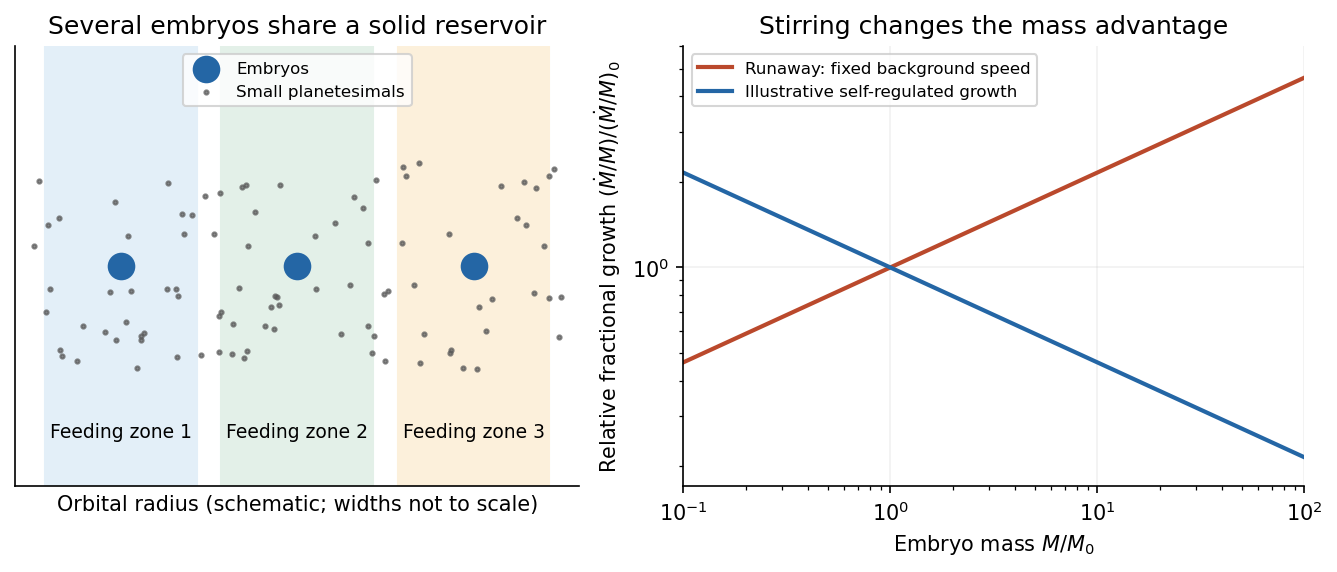
Neighboring feeding zones and the change from runaway to self-regulated fractional growth
. Details. Each feeding zone of a planetary embryo contains a finite solid reservoir. To estimate its isolation mass, let the full annular width be , where the dimensionless coefficient includes the stated choice of width and Hill-radius convention. For local solid surface density ,Solving givesThus denser solid disks and wider feeding annuli allow larger embryos. If , the estimate scales as at fixed host mass and . This is a local exhaustion estimate, not an absolute maximum planet mass: radial delivery of solids, pebble accretion, migration and embryo mergers can replenish or enlarge a feeding zone. No solid surface-density normalization is given, so a numerical isolation mass would require an invented disk model.
As the local supply is depleted, growth slows further. After gas damping weakens, embryo orbits may cross and giant collisions can assemble larger terrestrial planets. Farther out, sufficiently massive cores may instead acquire gas before protoplanetary disk dispersal. Oligarchic growth explains why a few comparable embryos share a disk while many smaller planetesimals remain: gravitational stirring weakens focusing and makes accretion self-regulating.
Past exam of the exoplanets and Planetary Systems course of the University of Cambridge 2016 Paper 1 3 b Solution by Codex 0 2026-10-20
Codex 0 2026-10-20Sub-Keplerian rotation means that the gas rotates more slowly than a pressure-free particle on a circular orbit at the same cylindrical radius. Let . Neglecting radial acceleration, radial force balance in the gas isAn outwardly decreasing pressure, , supplies part of the inward-gravity balance through an outward pressure force. Less centrifugal support is needed, so . Using , define the pressure-gradient parameter of a protoplanetary disk byThenFor a thin disk and a smooth radial pressure profile, is small, of order . The factor of two is part of this explicit convention; changing the convention for changes the drift formula correspondingly.
A solid particle feels essentially no continuum gas-pressure support. Left alone, it would orbit at , so in the gas it feels a headwind. Drag removes angular momentum, causing radial drift of solids in a gas disk. Define Stokes number using the aerodynamic stopping time . In a dilute test-particle limit with linear drag, negligible radial gas flow and small departures from a circular Keplerian orbit, let . The steady local radial and azimuthal balances areSolving givesThe sign is inward for the usual negative pressure gradient. Very small particles, , closely follow the gas and have a small relative drift . Very weakly coupled large bodies, , also drift slowly, with . The fastest pressure-driven inward drift occurs at , where . The corresponding physical grain or aggregate size depends on gas density, orbital radius and the drag regime; “metre-size barrier” is a conventional description of some disk models, not a universal size.
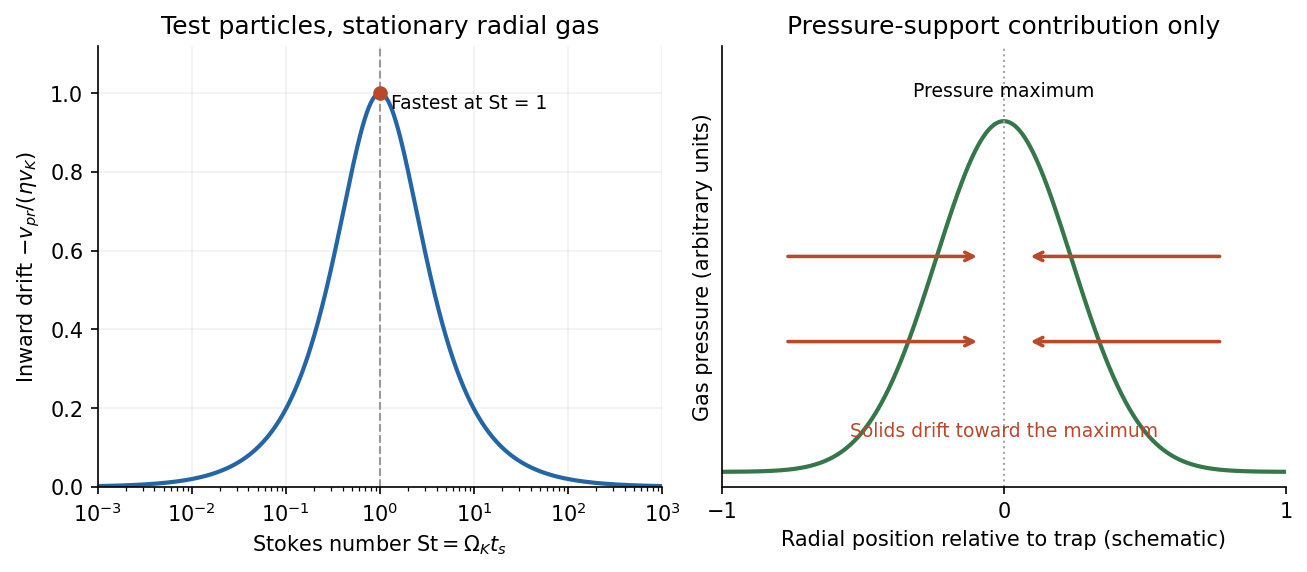
The drift timescale in this model isIt can be much shorter than the disk gas lifetime, threatening loss of the material needed to make planetesimals. Growth through the vulnerable coupling range must compete with this loss, while differential drift generates collisions that may stick, bounce or fragment. Radial redistribution also changes solid-to-gas ratios and moves material across condensation fronts. These are consequences for planet formation, rather than merely a small correction to an orbital frequency.
The same mechanism can help concentrate solids. At a local radial pressure maximum, , so this component of drift vanishes. On the inside, a positive pressure gradient gives outward drift; on the outside, a negative gradient gives inward drift. Particles therefore converge toward a dust trap. Turbulent diffusion and inward gas advection can limit retention. With a nonzero radial gas speed , the test-particle result generalizes to , so gas advection need not vanish even at a pressure maximum.
Finally, if local solid loading becomes large, backreaction on the gas can no longer be neglected. Coupled gas-particle drift can support streaming instability and strong solid concentrations, potentially enabling gravitational collapse into planetesimals. The simple test-particle drift formula is a useful starting point, but not a description of that nonlinear high-loading regime. Pressure support creates both a drift obstacle to growth and opportunities for concentration where the pressure structure changes.
Past exam of the exoplanets and Planetary Systems course of the University of Cambridge 2016 Paper 1 3 a Solution by Codex 0 2026-10-20
Codex 0 2026-10-20A protoplanetary disk is a flattened, rotating reservoir of gas and solids around a young star. Its radial gravity is usually dominated by the host, making its rotation close to Keplerian rotation, . Gas pressure provides vertical support and a small radial correction to the orbital speed; it does not make the disk a nonrotating spherical atmosphere.
At height , vertical hydrostatic equilibrium in the stellar gravitational field givesFor a locally vertically isothermal ideal gas, with , where is mean molecular weight. Integration givesHere is the vertically integrated gas surface density of a disk, and is the isothermal disk scale height. The disk aspect ratio is small in a geometrically thin disk. For it scales as , so produces disk flaring. This illustrative local vertical model does not determine a unique radial surface-density law or temperature normalization from the information given.
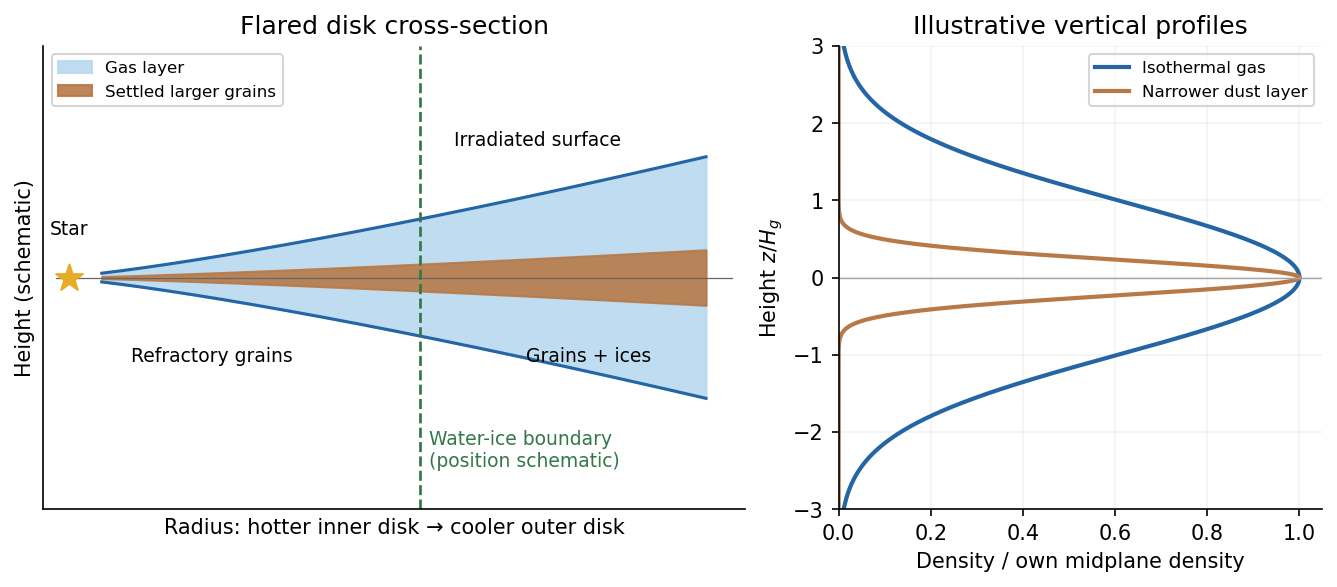
The gas is predominantly molecular hydrogen and helium. A much smaller component consists of heavier elements, partitioned between vapor, solid refractory grains and condensed volatile ices. A gas-to-solid mass ratio of order is a common initial fiducial model, not a universal measurement applying at every disk radius or evolutionary stage. Solids can grow and settle while gas accretes or disperses, changing the local ratio substantially.[ref]
Lecture notes on the formation and early evolution of planetary systems by Philip J. Armitage. 2007 v1, Section II.D, condensation sequence; Section III.A, settling and the fiducial global gas-to-solid ratio
Thermal structure organizes composition. In the hottest inner region, grains can sublimate and much of their material remains in the gas. Refractory silicate minerals and metallic grains survive at lower temperatures; farther out, water and then other sufficiently volatile species can condense when their local condensation conditions are met. The water snow line can raise the solid inventory available to planet formation. Its location depends on stellar irradiation, accretion heating, opacity and gas pressure, and evolves with time; it is not fixed merely by naming a star or adopting a solar-system distance.
Stellar radiation heats the exposed surface of a passive disk. Beneath it, shielding can leave a cooler, molecule-rich interior with a higher mass density. In the inner actively accreting disk, dissipation can instead make the optically thick midplane the hottest region. These are distinct heating regimes; a vertically isothermal profile is an analytic approximation rather than a claim that every real layer has the same temperature. Dust opacity controls how radiation is absorbed and re-emitted. Infrared and millimetre emission probe solid material, while spectral lines probe gas; neither observable alone supplies a model-free inventory of the whole disk.
Dust settling in an astrophysical disk makes larger, less tightly coupled particles more concentrated toward the midplane, while turbulence and mixing oppose that settling. For an aerodynamic stopping time short compared with , terminal vertical balance gives . Small grains remain better coupled to the gas. Radial drift also changes the distribution of solids and their access to snow lines and embryos.
The disk evolves through accretion and angular momentum transport, potentially involving turbulent stresses, magnetorotational instability or magnetically driven winds where conditions permit. Protoplanetary disk dispersal eventually removes gas through accretion and mass loss, including photoevaporation. In standard evolutionary pictures this occurs on a scale of a few million years, with substantial system-to-system variation. That finite reservoir lifetime is central to whether an embryo acquires a massive gaseous envelope.[ref]
Lecture notes on the formation and early evolution of planetary systems by Philip J. Armitage. 2007 v1, Section II.C.6, disk dispersal and accretion/photoevaporation timescale comparison
The essential structure is a nearly Keplerian gas disk with vertical pressure support, radial and vertical thermal gradients, and an evolving solid population concentrated by settling, growth and drift. Its composition is set jointly by the original elemental inventory, local condensation conditions and transport.
Past exam of the exoplanets and Planetary Systems course of the University of Cambridge 2015 Paper 1 3 d Solution by Codex 0 2026-10-20
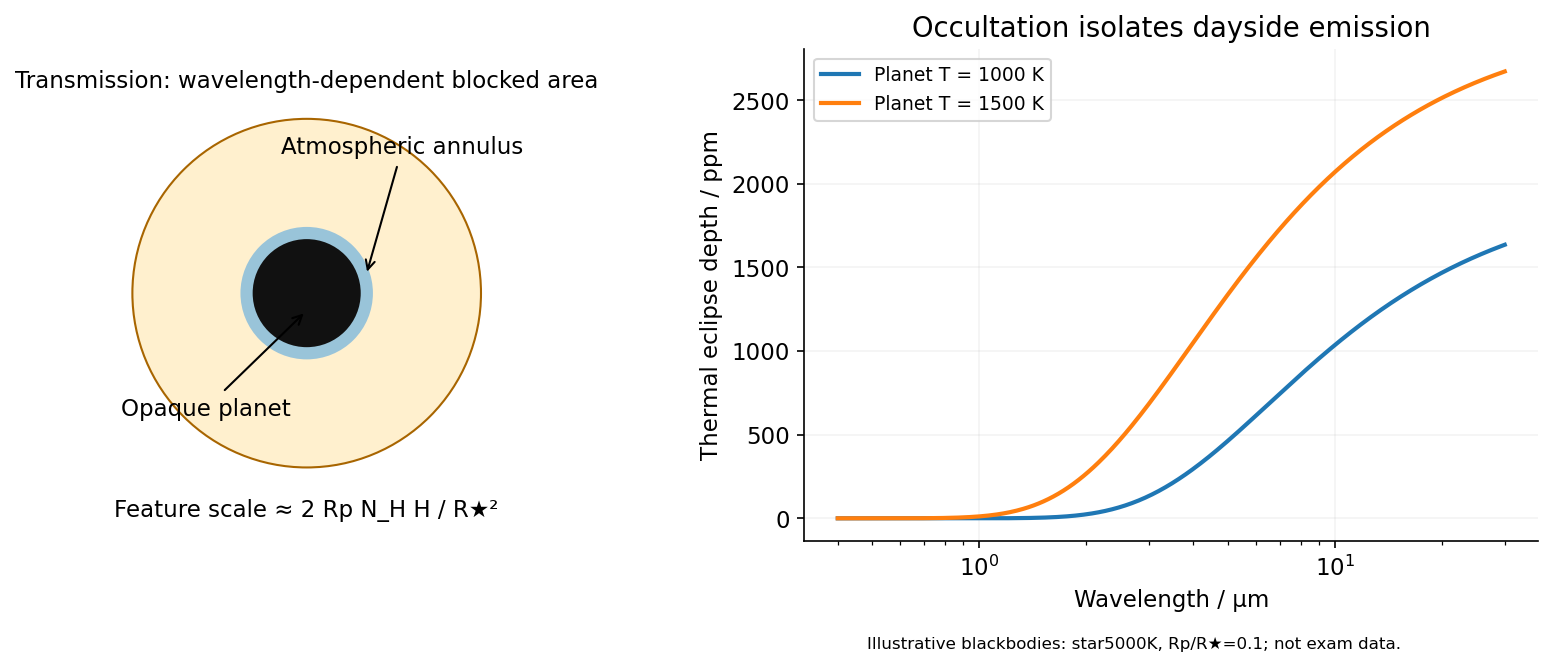
Codex 0 2026-10-20In transit spectroscopy, starlight passes tangentially through the planet's terminator atmosphere during primary transit. Wavelength-dependent opacity changes the effective occulting radius. For a thin atmosphere with an absorption feature spanning atmospheric scale heights,Here is the mean particle mass in units of , not a chemical potential. Large planets with warm low-gravity, low-molecular-weight atmospheres against small stars have larger signals. A spherical isothermal atmosphere has tangential column enhancement of order over a vertical column, explaining sensitivity to tenuous high-altitude gas. Molecular bands, atomic lines, scattering slopes and clouds constrain the terminator, but cloud opacity, reference pressure and abundance-temperature degeneracies limit unique retrievals.[ref]
Theoretical Transmission Spectra During Extrasolar Giant Planet Transits by Sara Seager and Dimitar Sasselov. Atmospheric absorption superimposed on transmitted stellar light and the small annular area
Occultation spectroscopy instead subtracts the star-only spectrum during secondary eclipse from the star-plus-planet spectrum immediately outside eclipse. It measures the dayside planet/star flux ratio. In the blackbody approximation the thermal eclipse depth isLonger infrared wavelengths generally improve contrast for a cooler planet; molecular absorption or emission depends on the vertical temperature gradient. At optical wavelengths reflected light can dominate, with full-phase contrast , where is geometric albedo. Eclipse spectra therefore probe dayside emission or reflection, rather than the transit's slant absorption. Clouds and temperature inversions affect interpretation.[ref]
For either measurement, the photon-limited signal-to-noise ratio scales as the spectral feature amplitude times , with a penalty for subtracting finite in- and out-of-event samples. Finer spectral bins reduce photons per bin; bright hosts, repeated events and stable instruments improve sensitivity. Detector systematics, telluric absorption for ground observations, and variable starspots can limit the practical gain. Space observations remove telluric contamination, not stellar variability or instrumental drift. Neither technique directly measures a unique bulk composition or samples all longitudes of the planet.
Pinned article: Introduction to the OurBigBook Project
Welcome to the OurBigBook Project! Our goal is to create the perfect publishing platform for STEM subjects, and get university-level students to write the best free STEM tutorials ever.
Everyone is welcome to create an account and play with the site: ourbigbook.com/go/register. We belive that students themselves can write amazing tutorials, but teachers are welcome too. You can write about anything you want, it doesn't have to be STEM or even educational. Silly test content is very welcome and you won't be penalized in any way. Just keep it legal!
Intro to OurBigBook
. Source. We have two killer features:
- topics: topics group articles by different users with the same title, e.g. here is the topic for the "Fundamental Theorem of Calculus" ourbigbook.com/go/topic/fundamental-theorem-of-calculusArticles of different users are sorted by upvote within each article page. This feature is a bit like:
- a Wikipedia where each user can have their own version of each article
- a Q&A website like Stack Overflow, where multiple people can give their views on a given topic, and the best ones are sorted by upvote. Except you don't need to wait for someone to ask first, and any topic goes, no matter how narrow or broad
This feature makes it possible for readers to find better explanations of any topic created by other writers. And it allows writers to create an explanation in a place that readers might actually find it.
Figure 1. Screenshot of the "Derivative" topic page. View it live at: ourbigbook.com/go/topic/derivativeVideo 2. OurBigBook Web topics demo. Source. - local editing: you can store all your personal knowledge base content locally in a plaintext markup format that can be edited locally and published either:This way you can be sure that even if OurBigBook.com were to go down one day (which we have no plans to do as it is quite cheap to host!), your content will still be perfectly readable as a static site.
- to OurBigBook.com to get awesome multi-user features like topics and likes
- as HTML files to a static website, which you can host yourself for free on many external providers like GitHub Pages, and remain in full control

Figure 2. You can publish local OurBigBook lightweight markup files to either OurBigBook.com or as a static website.
Figure 3. Visual Studio Code extension installation.
Figure 5. . You can also edit articles on the Web editor without installing anything locally. Video 3. Edit locally and publish demo. Source. This shows editing OurBigBook Markup and publishing it using the Visual Studio Code extension. 
- Infinitely deep tables of contents:




All our software is open source and hosted at: github.com/ourbigbook/ourbigbook
Further documentation can be found at: docs.ourbigbook.com
Feel free to reach our to us for any help or suggestions: docs.ourbigbook.com/#contact