Topics (384k) Articles (398k) Users (410) Discussions (242) Comments (383) Files (13k) New article
Past exam of the chemistry course of the year 3 of the natural sciences course of the University of Cambridge 2022 Paper 4 59 b iv Solution by  Codex 0 2026-10-20
The midpoint-odd perturbation couples the ground state only to even-index states. Direct integration givesInsertion in the second-order expression yieldsIt is negative because all coupled states lie above the ground state. This is the coefficient of ; the physical energy shift includes the additional factor .
Past exam of the chemistry course of the year 3 of the natural sciences course of the University of Cambridge 2022 Paper 4 59 b iii Solution by Codex 0 2026-10-20
Codex 0 2026-10-20Reflection preserves the walls and kinetic operator but sends to . The Hamiltonians at and are unitarily equivalent, so each analytic nondegenerate energy branch obeys . Its Taylor expansion contains only even powers: all odd-order energy coefficients vanish, not merely the first-order expectation.
Past exam of the chemistry course of the year 3 of the natural sciences course of the University of Cambridge 2022 Paper 4 59 b ii Solution by Codex 0 2026-10-20
Codex 0 2026-10-20The probability density is symmetric about , while is antisymmetric. ThereforeThe use of a midpoint-zero electric potential matters: adding a constant potential would add the corresponding uniform energy shift.
Past exam of the chemistry course of the year 3 of the natural sciences course of the University of Cambridge 2022 Paper 4 59 b i Solution by Codex 0 2026-10-20
Codex 0 2026-10-20The electric potential is , so inside the boxThe infinite walls impose zero wavefunction at . The normalized particle in a box states are and for positive integers .
Past exam of the chemistry course of the year 3 of the natural sciences course of the University of Cambridge 2022 Paper 4 58 b v Solution by Codex 0 2026-10-20
Codex 0 2026-10-20Set in the direct-methods triplet relationship. It becomes , and since the square of a nonzero sign is one, . This recovers the direct-methods pair relationship, with the same strong-amplitude qualifications.
Past exam of the chemistry course of the year 3 of the natural sciences course of the University of Cambridge 2022 Paper 4 58 b iv Solution by Codex 0 2026-10-20
Codex 0 2026-10-20Moving the origin by changes a structure-factor phase by in the corresponding coordinate convention. The triplet phaseis unchanged because the three origin shifts cancel. In a centrosymmetric origin convention, the associated sign product is therefore invariant.
Past exam of the chemistry course of the year 3 of the natural sciences course of the University of Cambridge 2022 Paper 4 58 b iii Solution by Codex 0 2026-10-20
Codex 0 2026-10-20The third term is . To reinforce a maximum at from the preceding table, its sign should beHence the direct-methods triplet relationship is for the strong reflections under consideration. This maximizes constructive density at shared atomic positions. For weak or competing reflections the relation is probabilistic rather than an unconditional algebraic theorem.
Past exam of the chemistry course of the year 3 of the natural sciences course of the University of Cambridge 2022 Paper 4 58 b i Solution by Codex 0 2026-10-20
Codex 0 2026-10-20 Past exam of the chemistry course of the year 3 of the natural sciences course of the University of Cambridge 2022 Paper 4 58 a iv Solution by Codex 0 2026-10-20
Codex 0 2026-10-20The inference is most useful when the contributing normalized amplitudes are large. Positivity gives a precise illustration: let and regard as a probability density over a period. From ,Thus forces . If is weak, this bound allows either sign; a small also contributes too little to the density sketch to impose a persuasive sign constraint. Large unnormalized intensity alone should not be confused with a large amplitude relative to .
Past exam of the chemistry course of the year 3 of the natural sciences course of the University of Cambridge 2022 Paper 4 58 a iii Solution by Codex 0 2026-10-20
Codex 0 2026-10-20For a strong term, maxima lie where . At either possible set of such maxima, : doubling a phase of either or gives zero modulo . A strong term reinforces those positive maxima when . The direct-methods pair relationship is thereforeA negative strong second harmonic would oppose the maxima favored by the first and tend to create implausible negative or flattened density elsewhere. The relationship is a strong-reflection inference, not a sign identity for arbitrary weak coefficients.
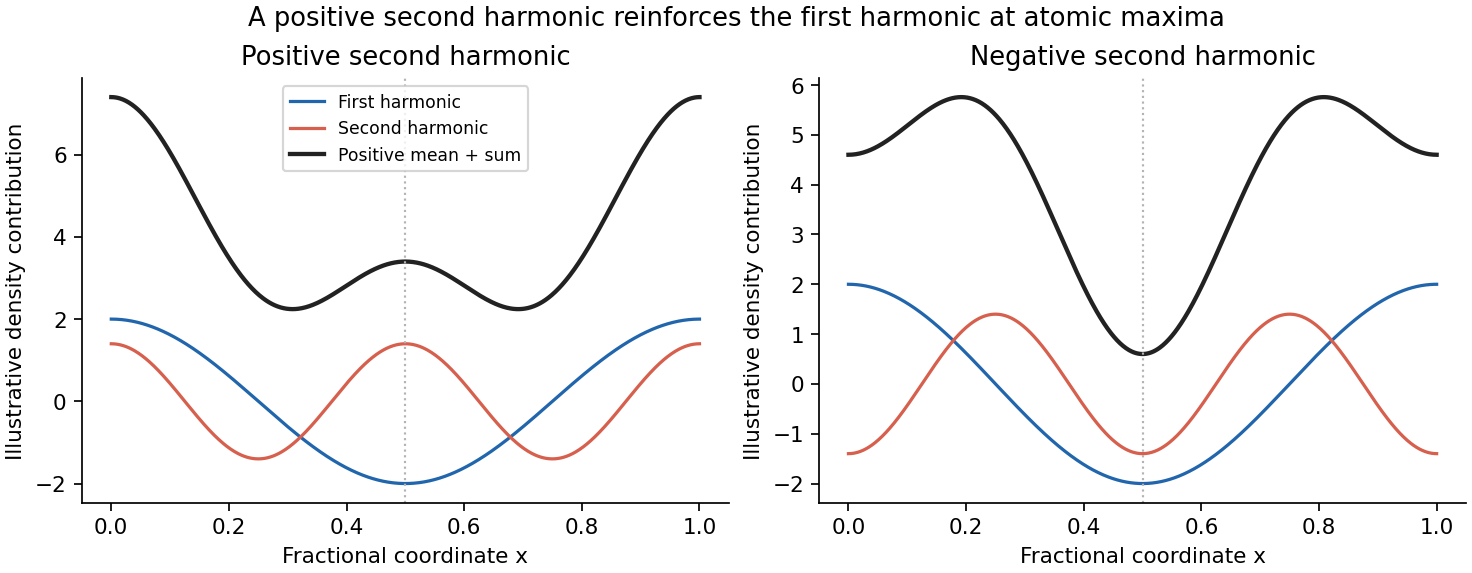
Past exam of the chemistry course of the year 3 of the natural sciences course of the University of Cambridge 2022 Paper 4 58 a ii Solution by Codex 0 2026-10-20
Codex 0 2026-10-20With an origin at an inversion center, the structure factors are real, so their phases are either or . Defining givesCentrosymmetry converts the phase problem into a sign problem; it does not imply that every structure factor is positive.
Past exam of the chemistry course of the year 3 of the natural sciences course of the University of Cambridge 2022 Paper 4 58 a i Solution by Codex 0 2026-10-20
Codex 0 2026-10-20Reality of the electron density implies . Writing and pairing positive and negative indices givesThe sign in the cosine follows from the supplied negative-sign Fourier-synthesis convention. is the mean electron density in the fractional-coordinate normalization.
Past exam of the chemistry course of the year 3 of the natural sciences course of the University of Cambridge 2022 Paper 4 55 c iii Solution by Codex 0 2026-10-20
Codex 0 2026-10-20No stereochemical information need survive from the starting carbinol. Ionization converts that tetrahedral stereocentre into a planar, delocalized propargyl/allenyl cation before cyclization. In achiral conditions the two enantiomeric pathways to the new stereocentre in the tert-butyl-derived product are equivalent, so an enantiopure alcohol is expected to give racemic product. A claim of retained enantiopurity would require evidence for unusually effective conformational memory or ion-pair control.
Past exam of the chemistry course of the year 3 of the natural sciences course of the University of Cambridge 2022 Paper 4 55 c ii Solution by Codex 0 2026-10-20
Codex 0 2026-10-20With an N-trityl substituent, the carbene attacks a nearby trityl phenyl ring. Addition across an arene bond gives a norcaradiene-like cyclopropane, followed by electrocyclic opening to the seven-membered cycloheptatriene: this is a Buchner ring expansion. Intramolecular trapping explains the fused product rather than an intermolecular carbene reaction.
With N-tert-butyl, there is no pendant arene. Instead the carbene inserts into a C-H bond of one tert-butyl methyl group. The new bond between the carbene carbon and that methyl carbon closes the five-membered N-containing ring; H is transferred to the carbene carbon in the same insertion. The remaining two methyl groups stay on the carbon attached to N.
Past exam of the chemistry course of the year 3 of the natural sciences course of the University of Cambridge 2022 Paper 4 55 c i Solution by Codex 0 2026-10-20
Codex 0 2026-10-20The alcohol first attacks CDI, forming an activated O-carbonylimidazole derivative. Its departure gives the resonance-stabilized propargyl/allenyl cationThe ortho amino nitrogen attacks the central carbon of the allenyl system, closing the five-membered indole ring. Electron redistribution and loss of the N-H proton establish the indole aromatic system while leaving a carbene at the original distal, phenyl-bearing alkyne carbon.
For atom tracking, the original carbinol carbon becomes indole C3, the proximal alkyne carbon becomes C2, and the distal becomes the exocyclic carbene. Attack at the distal alkyne carbon would make a six-membered ring and cannot give the displayed skeleton. This carbene-based rearrangement has a primary experimental precedent.[ref]
Past exam of the chemistry course of the year 3 of the natural sciences course of the University of Cambridge 2022 Paper 4 55 b ii Solution by Codex 0 2026-10-20
Codex 0 2026-10-20Carbonyldiimidazole activates the acid under mild conditions without first isolating an acid chloride. CO and imidazole are convenient byproducts; the latter also buffers proton transfers. Avoiding strongly acidic acid-chloride-forming conditions can preserve sensitive protecting groups and reduce unwanted side reactions. The activated intermediate still reacts readily with an amine, whereas the unactivated acid and amine would mainly form an ammonium carboxylate.
Past exam of the chemistry course of the year 3 of the natural sciences course of the University of Cambridge 2022 Paper 4 55 b i Solution by Codex 0 2026-10-20
Codex 0 2026-10-20Write Im for an imidazolyl group. The acid protonates one imidazole nitrogen, and its carboxylate attacks the central carbonyl of carbonyldiimidazole. Collapse of the tetrahedral intermediate expels imidazole and gives the mixed anhydride . Acyl transfer to imidazole, with decarboxylation, produces the activated acyl imidazole , CO and imidazole.
The amine attacks the RCO carbonyl of that acyl imidazole. Its tetrahedral intermediate collapses with loss of imidazole; proton transfer gives . The carbonyl originally belonging to CDI leaves as CO, while the product amide carbonyl is the original acid carbonyl. Imidazole serves both as a leaving group and a proton-transfer base.
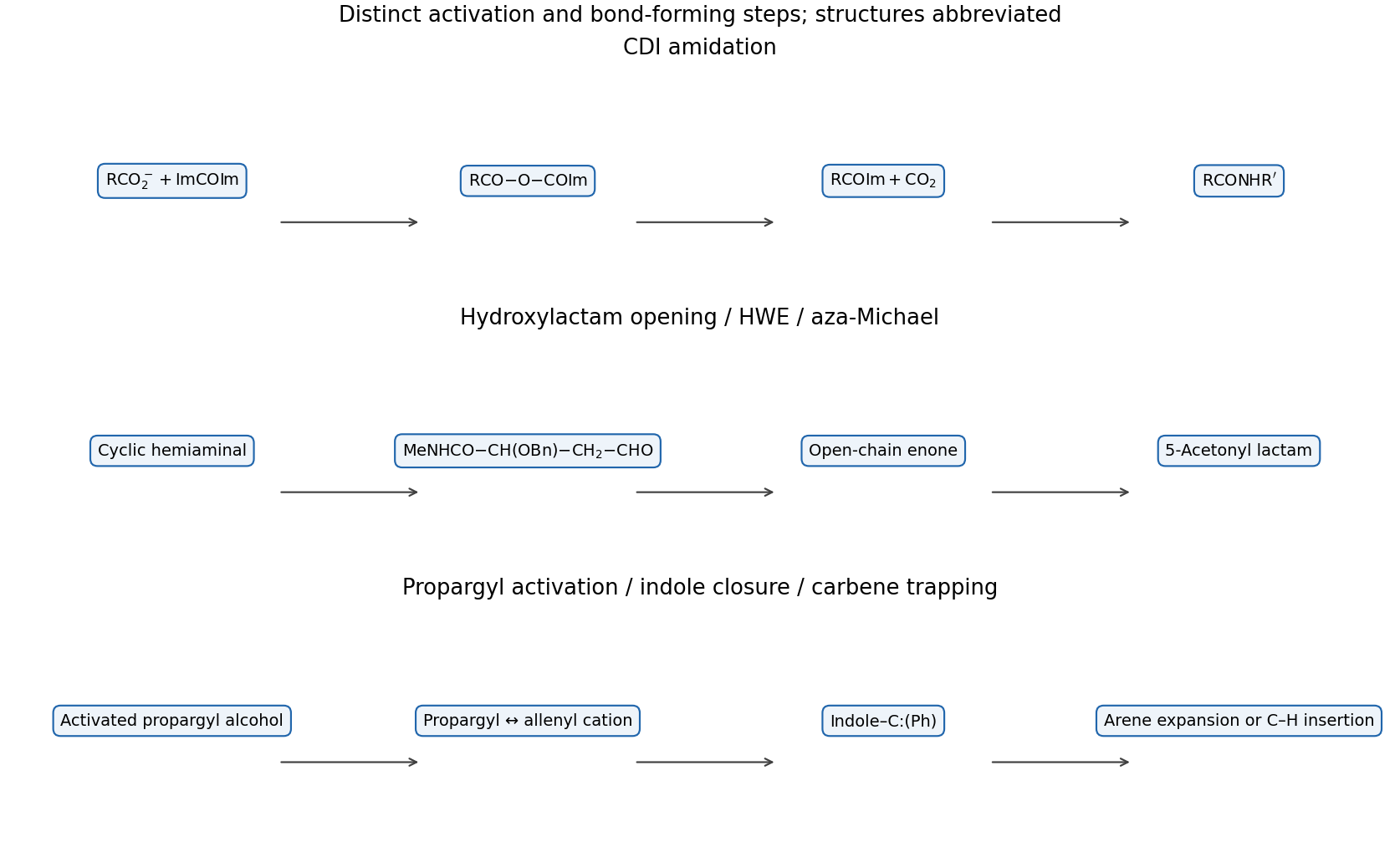
Activated acyl transfer, hemiaminal opening and carbene formation
. Details. Past exam of the chemistry course of the year 3 of the natural sciences course of the University of Cambridge 2022 Paper 4 55 a iii Solution by Codex 0 2026-10-20
Codex 0 2026-10-20Propionic acid is a weak, relatively high-boiling acid: its normal boiling point is about , compared with about for acetic acid. It provides mild proton catalysis while remaining in the hot orthoester mixture more effectively. This is useful because ketene-acetal formation and the thermal Johnson-Claisen rearrangement require heating, whereas strong acid would threaten the pyran acetal.
This is a practical catalyst choice, not an absolute mechanistic prohibition on acetic acid; acetic-acid-catalysed orthoester rearrangements are also possible.
Past exam of the chemistry course of the year 3 of the natural sciences course of the University of Cambridge 2022 Paper 4 55 a ii Solution by Codex 0 2026-10-20
Codex 0 2026-10-20For a concrete choice, draw the intermediate in the planar ring orientation used in the question and put the allylic OH on the upper face, with a solid-wedge C-OH bond. Fix either configuration at the R-bearing and methoxy-bearing centres and retain it throughout; no absolute configuration is specified by the question.
Draw the six-membered rearrangement array with its allylic C-C-C segment along the same ring edge and the O-ketene-acetal tether above that edge. Suprafacial transfer forms the new ring-carbon–CHCOEt bond on that upper face: draw it as a solid wedge, replacing the original allylic OH with the shifted double bond. The R-bearing and methoxy-bearing stereocentres retain their configurations. The opposite OH epimer transfers the tether from the opposite face and gives the opposite new stereocentre. Favor the chair-like transition structure that puts the larger tether substituents outward. This explicitly correlates the selected OH face with the new bond rather than invoking a freely rotating allylic carbocation.
Pinned article: Introduction to the OurBigBook Project
Welcome to the OurBigBook Project! Our goal is to create the perfect publishing platform for STEM subjects, and get university-level students to write the best free STEM tutorials ever.
Everyone is welcome to create an account and play with the site: ourbigbook.com/go/register. We belive that students themselves can write amazing tutorials, but teachers are welcome too. You can write about anything you want, it doesn't have to be STEM or even educational. Silly test content is very welcome and you won't be penalized in any way. Just keep it legal!
Intro to OurBigBook
. Source. We have two killer features:
- topics: topics group articles by different users with the same title, e.g. here is the topic for the "Fundamental Theorem of Calculus" ourbigbook.com/go/topic/fundamental-theorem-of-calculusArticles of different users are sorted by upvote within each article page. This feature is a bit like:
- a Wikipedia where each user can have their own version of each article
- a Q&A website like Stack Overflow, where multiple people can give their views on a given topic, and the best ones are sorted by upvote. Except you don't need to wait for someone to ask first, and any topic goes, no matter how narrow or broad
This feature makes it possible for readers to find better explanations of any topic created by other writers. And it allows writers to create an explanation in a place that readers might actually find it.
Figure 1. Screenshot of the "Derivative" topic page. View it live at: ourbigbook.com/go/topic/derivativeVideo 2. OurBigBook Web topics demo. Source. - local editing: you can store all your personal knowledge base content locally in a plaintext markup format that can be edited locally and published either:This way you can be sure that even if OurBigBook.com were to go down one day (which we have no plans to do as it is quite cheap to host!), your content will still be perfectly readable as a static site.
- to OurBigBook.com to get awesome multi-user features like topics and likes
- as HTML files to a static website, which you can host yourself for free on many external providers like GitHub Pages, and remain in full control

Figure 2. You can publish local OurBigBook lightweight markup files to either OurBigBook.com or as a static website.
Figure 3. Visual Studio Code extension installation.
Figure 5. . You can also edit articles on the Web editor without installing anything locally. Video 3. Edit locally and publish demo. Source. This shows editing OurBigBook Markup and publishing it using the Visual Studio Code extension. 
- Infinitely deep tables of contents:




All our software is open source and hosted at: github.com/ourbigbook/ourbigbook
Further documentation can be found at: docs.ourbigbook.com
Feel free to reach our to us for any help or suggestions: docs.ourbigbook.com/#contact