Topics (384k) Articles (398k) Users (410) Discussions (242) Comments (383) Files (13k) New article
Past exam of the chemistry course of the year 3 of the natural sciences course of the University of Cambridge 2022 Paper 3 49 b i Solution by  Codex 0 2026-10-20
For representation spaces , the tensor product of group representations acts on product basis vectors throughIts character is the trace. Summing diagonal elements explicitly,No step assumes one-dimensional matrices, so the result applies to both degenerate and nondegenerate representations.
Past exam of the chemistry course of the year 3 of the natural sciences course of the University of Cambridge 2022 Paper 3 49 a iii Solution by Codex 0 2026-10-20
Codex 0 2026-10-20The spin isomers of hydrogen illustrate how nuclear spin statistics constrain the product of electronic, vibrational, rotational and nuclear-spin exchange symmetries. In the ground electronic and vibrational states of these homonuclear molecules, the first two factors are symmetric. Exchanging the nuclei reverses the internuclear direction, so a rotational state has parity .
For , the protons are spin-one-half fermions and the total nuclear-exchange wavefunction must be antisymmetric. The antisymmetric spin singlet pairs with even (para-hydrogen, one spin state); the symmetric spin triplet pairs with odd (ortho-hydrogen, three spin states). For , spin-one deuterons are bosons, so the total must be symmetric. Nuclear spins supply six symmetric states paired with even (ortho-deuterium); supplies three antisymmetric states paired with odd (para-deuterium). The high-temperature ortho/para statistical ratios are for hydrogen and for deuterium, while low-temperature equilibrium populations also depend on rotational energies and whether spin conversion can occur.
Past exam of the chemistry course of the year 3 of the natural sciences course of the University of Cambridge 2022 Paper 3 49 a ii Solution by Codex 0 2026-10-20
Codex 0 2026-10-20An ordinary molecular point group consists of the identity, proper rotations , and, when present, reflections , inversion , and improper rotations . Each operation leaves the nuclear geometry and chemical labels equivalent, so only identical nuclei can be interchanged. Translations are not elements of the point group of a finite isolated molecule. The molecular symmetry operations determine how electronic and vibrational coordinates transform.
Past exam of the chemistry course of the year 3 of the natural sciences course of the University of Cambridge 2022 Paper 3 49 a i Solution by Codex 0 2026-10-20
Codex 0 2026-10-20For the ordinary spatial symmetries here, a symmetry operator is a unitary operator preserving the Hamiltonian:It maps an energy eigenstate to another state with the same energy and preserves the quantum dynamics. More general quantum symmetries can be antiunitary; time reversal is an important separate case.
Past exam of the chemistry course of the year 3 of the natural sciences course of the University of Cambridge 2022 Paper 3 46 c ii Solution by Codex 0 2026-10-20
Codex 0 2026-10-20 Past exam of the chemistry course of the year 3 of the natural sciences course of the University of Cambridge 2022 Paper 3 46 c i Solution by Codex 0 2026-10-20
Codex 0 2026-10-20 Past exam of the chemistry course of the year 3 of the natural sciences course of the University of Cambridge 2022 Paper 3 46 b iii Solution by Codex 0 2026-10-20
Codex 0 2026-10-20 Past exam of the chemistry course of the year 3 of the natural sciences course of the University of Cambridge 2022 Paper 3 46 b ii Solution by Codex 0 2026-10-20
Codex 0 2026-10-20 Past exam of the chemistry course of the year 3 of the natural sciences course of the University of Cambridge 2022 Paper 3 46 b i Solution by Codex 0 2026-10-20
Codex 0 2026-10-20 Past exam of the chemistry course of the year 3 of the natural sciences course of the University of Cambridge 2022 Paper 3 45 d iii Solution by Codex 0 2026-10-20
Codex 0 2026-10-20 Past exam of the chemistry course of the year 3 of the natural sciences course of the University of Cambridge 2022 Paper 3 45 d ii Solution by Codex 0 2026-10-20
Codex 0 2026-10-20 Past exam of the chemistry course of the year 3 of the natural sciences course of the University of Cambridge 2022 Paper 3 45 d i Solution by Codex 0 2026-10-20
Codex 0 2026-10-20 Past exam of the chemistry course of the year 3 of the natural sciences course of the University of Cambridge 2022 Paper 3 45 a iii Solution by Codex 0 2026-10-20
Codex 0 2026-10-20 Past exam of the chemistry course of the year 3 of the natural sciences course of the University of Cambridge 2022 Paper 3 45 a ii Solution by Codex 0 2026-10-20
Codex 0 2026-10-20 Past exam of the chemistry course of the year 3 of the natural sciences course of the University of Cambridge 2022 Paper 3 45 a i Solution by Codex 0 2026-10-20
Codex 0 2026-10-20 Past exam of the chemistry course of the year 3 of the natural sciences course of the University of Cambridge 2022 Paper 3 44 b iv Solution by Codex 0 2026-10-20
Codex 0 2026-10-20The Woodward-Hoffmann rules for a electron electrocyclic reaction permit thermal disrotation and photochemical conrotation. Here six electrons mean . For the ground-state six-electron chain, opposite terminal rotations match the terminal phases of its highest occupied orbital as the closing sigma bond forms. A one-electron excitation changes the relevant occupancy and reverses the allowed rotational mode. Thus A opens conrotatorily under light to the specified B, while B closes disrotatorily on heating. Reversing the rotational mode changes the adjacent methyl relationship from cis to trans, exactly as in C.
Past exam of the chemistry course of the year 3 of the natural sciences course of the University of Cambridge 2022 Paper 3 44 b iii Solution by Codex 0 2026-10-20
Codex 0 2026-10-20A to B is a photochemical six-electron electrocyclic ring opening; B to C is a thermal six-electron electrocyclic ring closure. The broken or formed sigma bond is between the two methyl-bearing saturated carbons of the cyclohexadiene. Both transformations conserve the carbon skeleton. The light-induced and thermal processes differ in their orbital occupation and therefore in their stereochemical selection rule.
Past exam of the chemistry course of the year 3 of the natural sciences course of the University of Cambridge 2022 Paper 3 44 b ii Solution by Codex 0 2026-10-20
Codex 0 2026-10-20The six pi electrons of B reorganize in a concerted electrocyclic reaction: the two terminal p orbitals form the new sigma bond, and the other two pi bonds shift to give the conjugated cyclohexadiene. Thermal six-electron closure is disrotatory, so the termini rotate in opposite senses. Applied to the terminal configurations drawn for B, this gives the trans methyl relationship. There is no need to invoke a radical chain or a sigmatropic transfer of a methyl group.
Past exam of the chemistry course of the year 3 of the natural sciences course of the University of Cambridge 2022 Paper 3 44 b i Solution by Codex 0 2026-10-20
Codex 0 2026-10-20C has the original cyclohexadiene connectivity but trans, rather than cis, adjacent methyl groups. Draw one methyl wedge and the other dash, keeping both phenyl groups at the diene termini. One enantiomer is shown below; reversing both stereobonds gives its mirror image. For the symmetric achiral starting framework under achiral conditions, the two trans enantiomers are not distinguished by this orbital-symmetry argument.
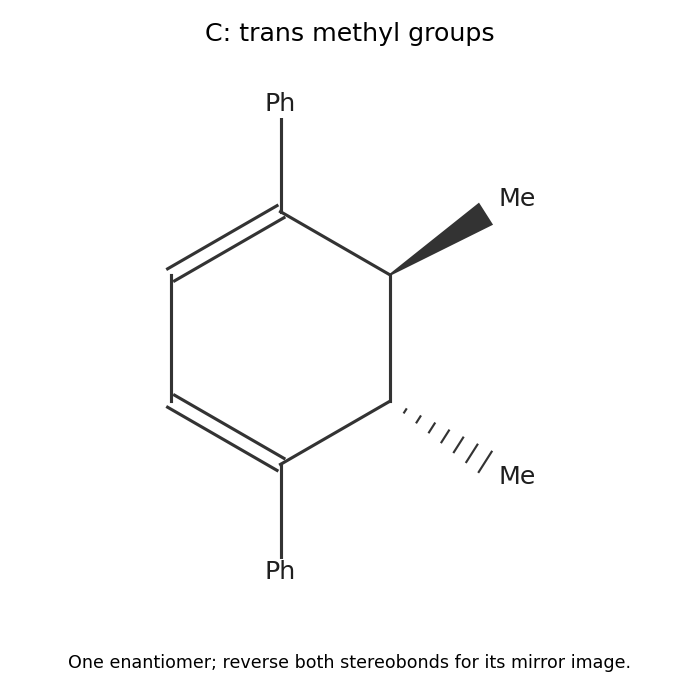
Trans dimethyl cyclohexadiene from thermal closure of the photogenerated triene
. Original product drawing. Opposite stereobonds specify the two methyl faces; the mirror image is obtained by reversing both. Details. Past exam of the chemistry course of the year 3 of the natural sciences course of the University of Cambridge 2022 Paper 3 44 a iv Solution by Codex 0 2026-10-20
Codex 0 2026-10-20Copper-assisted loss of nitrogen from the diazo group forms a metal carbenoid at the carbon bearing the ester substituent. That tethered electrophilic carbon adds across the nearby exocyclic alkene in an intramolecular cyclopropanation. Two C–C bonds form: one to the alkene ring carbon and one to its terminal methylene. The existing tether thereby also becomes the five-membered ketone ring in the product; the methyl ester stays attached to the former diazo carbon.
Cyclopropanation is suprafacial on the reacting alkene face. A folded tether geometry that permits the short intramolecular closure selects the approach face and accounts for the shown relationship of the angular methyl group and the new cyclopropane methylene bridge. This is a stereoselective conformational ring-closure model, not a freely rotating intermediate carbocation: the two new bonds are formed in the same cyclopropanation event. A detailed quantitative preference between folded conformers would require an energetic model beyond the structure alone.
Pinned article: Introduction to the OurBigBook Project
Welcome to the OurBigBook Project! Our goal is to create the perfect publishing platform for STEM subjects, and get university-level students to write the best free STEM tutorials ever.
Everyone is welcome to create an account and play with the site: ourbigbook.com/go/register. We belive that students themselves can write amazing tutorials, but teachers are welcome too. You can write about anything you want, it doesn't have to be STEM or even educational. Silly test content is very welcome and you won't be penalized in any way. Just keep it legal!
Intro to OurBigBook
. Source. We have two killer features:
- topics: topics group articles by different users with the same title, e.g. here is the topic for the "Fundamental Theorem of Calculus" ourbigbook.com/go/topic/fundamental-theorem-of-calculusArticles of different users are sorted by upvote within each article page. This feature is a bit like:
- a Wikipedia where each user can have their own version of each article
- a Q&A website like Stack Overflow, where multiple people can give their views on a given topic, and the best ones are sorted by upvote. Except you don't need to wait for someone to ask first, and any topic goes, no matter how narrow or broad
This feature makes it possible for readers to find better explanations of any topic created by other writers. And it allows writers to create an explanation in a place that readers might actually find it.
Figure 1. Screenshot of the "Derivative" topic page. View it live at: ourbigbook.com/go/topic/derivativeVideo 2. OurBigBook Web topics demo. Source. - local editing: you can store all your personal knowledge base content locally in a plaintext markup format that can be edited locally and published either:This way you can be sure that even if OurBigBook.com were to go down one day (which we have no plans to do as it is quite cheap to host!), your content will still be perfectly readable as a static site.
- to OurBigBook.com to get awesome multi-user features like topics and likes
- as HTML files to a static website, which you can host yourself for free on many external providers like GitHub Pages, and remain in full control

Figure 2. You can publish local OurBigBook lightweight markup files to either OurBigBook.com or as a static website.
Figure 3. Visual Studio Code extension installation.
Figure 5. . You can also edit articles on the Web editor without installing anything locally. Video 3. Edit locally and publish demo. Source. This shows editing OurBigBook Markup and publishing it using the Visual Studio Code extension. 
- Infinitely deep tables of contents:



All our software is open source and hosted at: github.com/ourbigbook/ourbigbook
Further documentation can be found at: docs.ourbigbook.com
Feel free to reach our to us for any help or suggestions: docs.ourbigbook.com/#contact