Topics (384k) Articles (398k) Users (410) Discussions (242) Comments (383) Files (13k) New article
Past exam of the chemistry course of the year 3 of the natural sciences course of the University of Cambridge 2022 Paper 3 37 c i Solution by  Codex 0 2026-10-20
These are inner-sphere electron transfer pathways distinguished by where Cr(II) attacks the coordinated thiocyanate. Cr(II) is substitution-labile and can replace an aqua ligand to form a bridged Co(III)/Cr(II) precursor.
- Remote attack at nitrogen: form . Electron transfer through the bridge gives Co(II)/Cr(III). Cleavage on the now labile Co(II) side leaves the N-bound product . This is the faster channel.
- Adjacent attack at sulfur: Cr binds the same sulfur that is attached to cobalt, giving a shared-S bridge, . Electron transfer and Co-S cleavage leave , the channel.
In both cases the product Co(II) rapidly loses its ammines to give the hexaaqua ion, whereas substitution-inert Cr(III) retains the bridge-end information. The two chromium linkage isomers are therefore a record of two precursor geometries, rather than evidence that one outer-sphere electron-transfer event somehow selects two arbitrary new ligands afterwards.
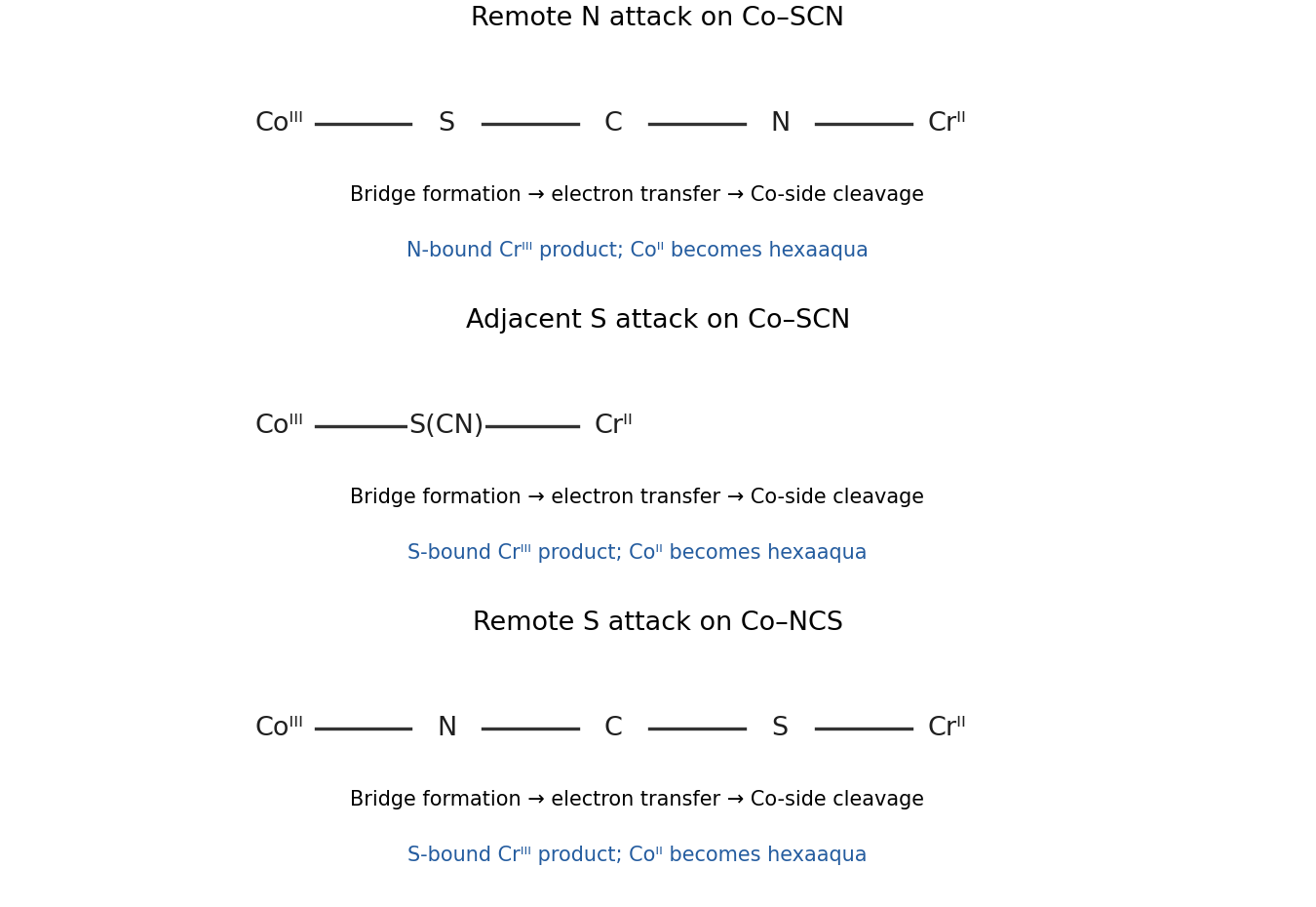
Remote and adjacent bridges retain different thiocyanate linkage information
. Details. Past exam of the chemistry course of the year 3 of the natural sciences course of the University of Cambridge 2022 Paper 3 37 b iv Solution by Codex 0 2026-10-20
Codex 0 2026-10-20Low-spin Co(III) is substitution-inert. In acid, coordinated ammine deprotonation is suppressed, so the strongly donating amido conjugate base that assists ligand loss is not generated appreciably. Direct aquation/linkage change consequently remains very slow.
The persistence of the starting S-bound complex therefore supports a base-activated kinetic pathway. It is consistent with the rapid rearrangement in base and does not mean that the S-bound form must be the thermodynamically preferred linkage isomer under every condition.
Past exam of the chemistry course of the year 3 of the natural sciences course of the University of Cambridge 2022 Paper 3 37 b iii Solution by Codex 0 2026-10-20
Codex 0 2026-10-20The near absence of incoming C label means the coordinated thiocyanate usually retains its molecular identity during linkage change. A mechanism that releases it into a fully mixed solution pool and then captures an arbitrary external thiocyanate would predict much more exchange.
Rapid geminate return within a solvent cage explains the result: the original ligand turns and binds through N before an external labeled ligand can intercept the cobalt centre. A continuously bound intramolecular rearrangement is also compatible with low exchange. Therefore the label result supports an intramolecular/cage-local process but does not alone prove that the Co-S bond stays unbroken throughout.
Past exam of the chemistry course of the year 3 of the natural sciences course of the University of Cambridge 2022 Paper 3 37 b ii Solution by Codex 0 2026-10-20
Codex 0 2026-10-20Begin with the same ammine deprotonation and amido-assisted weakening/cleavage of the Co-S bond, but now SCN is already beside the metal. A solvent-caged pair of five-coordinate cobalt amido species and the departing thiocyanate can reorient and recombine through nitrogen before the ligand diffuses into bulk solution. Reprotonation restores the five ammines and gives A.
Thus the essential sequence isWater capture competes to give Co-OH, but rapid internal return of the already associated ligand accounts for the high yield of A. The slower entry into the reactive conjugate-base/dissociation sequence is followed by faster reorientation, capture and proton transfer. This is linkage isomerization, not oxidation or reduction of cobalt.
Past exam of the chemistry course of the year 3 of the natural sciences course of the University of Cambridge 2022 Paper 3 37 b i Solution by Codex 0 2026-10-20
Codex 0 2026-10-20The natural route is conjugate-base substitution. Hydroxide reversibly removes an ammine proton:The amido donor promotes loss of X, producing a short-lived five-coordinate intermediate. That leaving-group-sensitive loss is the slower stage. Subsequent trapping/proton transfers are fast and no longer depend on which halide left.
Water capture followed by proton transfer gives the hydroxo complex. Competing SCN capture can occur at either end of this ambidentate ligand, producing Co-SCN and Co-NCS. Any initially captured S-bound material can undergo the base-assisted linkage rearrangement considered next. Water is overwhelmingly abundant, so the stable N-bound product can remain a minor overall product. The slow X-dependent and fast X-independent stages fit loss of X followed by chemistry of a common intermediate; a single rate-limiting direct attack by thiocyanate would not explain that separation naturally.
Past exam of the chemistry course of the year 3 of the natural sciences course of the University of Cambridge 2022 Paper 3 37 a ii Solution by Codex 0 2026-10-20
Codex 0 2026-10-20The negative activation volume is consistent with an associative substitution pathway: an incoming donor of the tetradentate ligand approaches square-planar Ni, giving a five-coordinate transition structure/intermediate before a donor of an original chelate leaves. Successive donor substitution and chelate closure give the tetradentate NO complex. Proton transfers convert the incoming phenolic groups to coordinated phenoxides while releasing the original ligands.
With acid/base forms written explicitly, the net ligand exchange is . The connected four-donor ligand benefits from the chelate effect.
The bulky N-tert-butyl groups in hinder precisely the close donor approach needed for that associative route, and the starting tetrahedral geometry must reorganize to accept the planar tetradentate ligand. Consequently exchange can be too slow to observe under the stated conditions. Failure to observe a new product is a kinetic observation; it does not establish that all tetrahedral nickel complexes are inert or that the tetradentate product is thermodynamically impossible.
Past exam of the chemistry course of the year 3 of the natural sciences course of the University of Cambridge 2022 Paper 3 37 a i Solution by Codex 0 2026-10-20
Codex 0 2026-10-20Ni(II) is . A square-planar complex can keep its strongly antibonding in-plane orbital empty and has a paired, configuration. A tetrahedral arrangement has two unpaired electrons, .
The important change here is the substituent on the imine nitrogen: Me, Et, then tert-butyl. The phenolic ortho-tert-butyl substituent is common to all three ligands. The small N-Me groups permit coplanar NO coordination in . N-tert-butyl crowds that arrangement and favors twisting the two chelate planes toward a distorted tetrahedron in . N-Et gives a closer energetic competition, so accesses both structures. The observed equilibrium reflects ligand-field stabilization, pairing, steric strain and temperature-dependent entropy; it is not a change in nickel oxidation state.
Pinned article: Introduction to the OurBigBook Project
Welcome to the OurBigBook Project! Our goal is to create the perfect publishing platform for STEM subjects, and get university-level students to write the best free STEM tutorials ever.
Everyone is welcome to create an account and play with the site: ourbigbook.com/go/register. We belive that students themselves can write amazing tutorials, but teachers are welcome too. You can write about anything you want, it doesn't have to be STEM or even educational. Silly test content is very welcome and you won't be penalized in any way. Just keep it legal!
Intro to OurBigBook
. Source. We have two killer features:
- topics: topics group articles by different users with the same title, e.g. here is the topic for the "Fundamental Theorem of Calculus" ourbigbook.com/go/topic/fundamental-theorem-of-calculusArticles of different users are sorted by upvote within each article page. This feature is a bit like:
- a Wikipedia where each user can have their own version of each article
- a Q&A website like Stack Overflow, where multiple people can give their views on a given topic, and the best ones are sorted by upvote. Except you don't need to wait for someone to ask first, and any topic goes, no matter how narrow or broad
This feature makes it possible for readers to find better explanations of any topic created by other writers. And it allows writers to create an explanation in a place that readers might actually find it.
Figure 1. Screenshot of the "Derivative" topic page. View it live at: ourbigbook.com/go/topic/derivativeVideo 2. OurBigBook Web topics demo. Source. - local editing: you can store all your personal knowledge base content locally in a plaintext markup format that can be edited locally and published either:This way you can be sure that even if OurBigBook.com were to go down one day (which we have no plans to do as it is quite cheap to host!), your content will still be perfectly readable as a static site.
- to OurBigBook.com to get awesome multi-user features like topics and likes
- as HTML files to a static website, which you can host yourself for free on many external providers like GitHub Pages, and remain in full control

Figure 2. You can publish local OurBigBook lightweight markup files to either OurBigBook.com or as a static website.
Figure 3. Visual Studio Code extension installation.
Figure 5. . You can also edit articles on the Web editor without installing anything locally. Video 3. Edit locally and publish demo. Source. This shows editing OurBigBook Markup and publishing it using the Visual Studio Code extension. 
- Infinitely deep tables of contents:



All our software is open source and hosted at: github.com/ourbigbook/ourbigbook
Further documentation can be found at: docs.ourbigbook.com
Feel free to reach our to us for any help or suggestions: docs.ourbigbook.com/#contact