Topics (384k) Articles (398k) Users (410) Discussions (242) Comments (383) Files (13k) New article
Past exam of the chemistry course of the year 3 of the natural sciences course of the University of Cambridge 2022 Paper 4 55 a i Solution by  Codex 0 2026-10-20
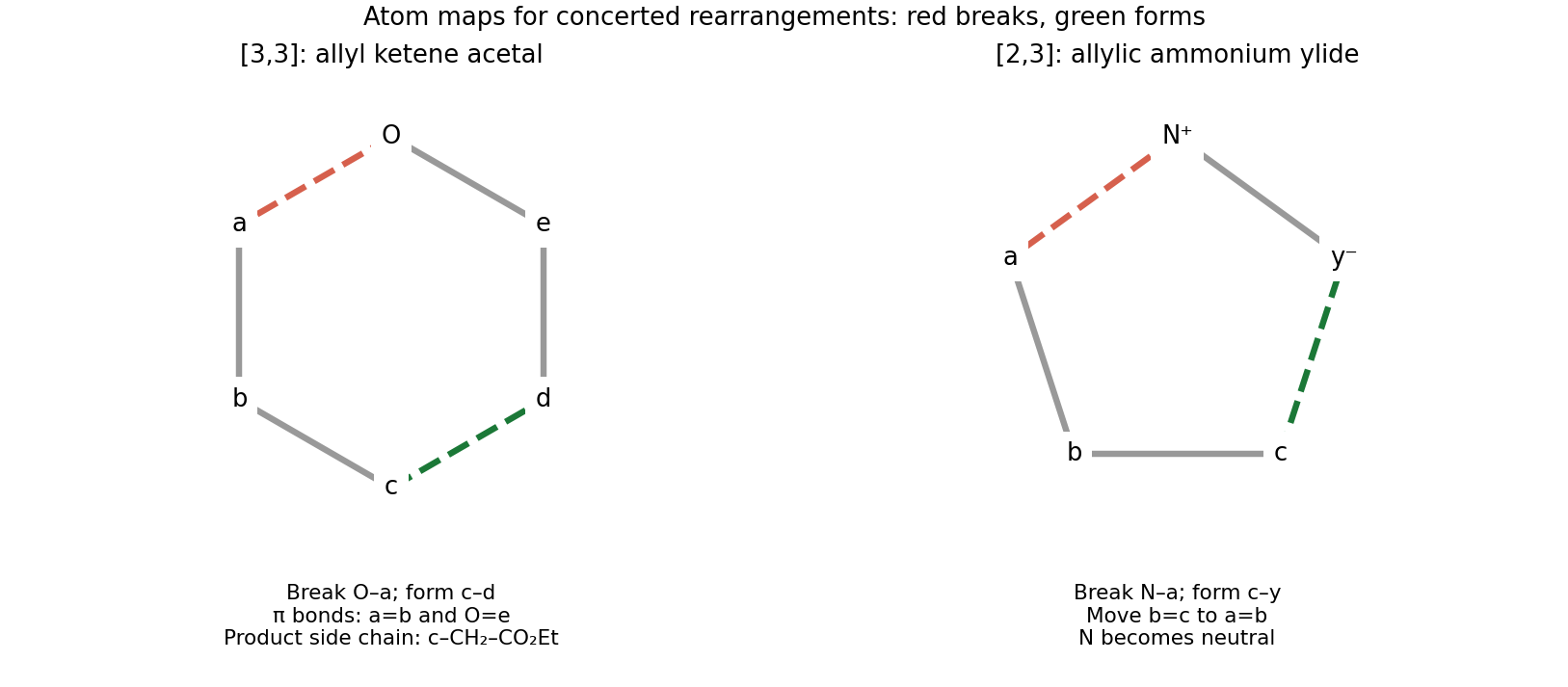
The first transformation is an Achmatowicz rearrangement, followed by protection and selective reduction; the last is a Johnson-Claisen rearrangement.
- Butyllithium removes the furan 2-proton, giving a 2-lithiofuran. Its carbon attacks the aldehyde carbonyl; protonation of the resulting alkoxide gives the furfuryl alcohol. Carbon-carbon bond formation occurs at the lithiated position.
- Electrophilic oxygen transfer from mCPBA to the electron-rich furan gives an oxidized, ring-opened intermediate. Opening the oxygenated furan gives a hydroxy enedicarbonyl: the original furfuryl hydroxyl then attacks the remote aldehyde intramolecularly. This expands the five-membered furan into a six-membered lactol containing an enone carbonyl. The original furfuryl oxygen becomes the pyran ring oxygen; oxidation of the furan supplies the new carbonyl and lactol functionality.
- AgO/MeI converts the lactol OH into its methyl acetal: oxygen attacks methyl iodide by SN2 reaction, with iodide removal and proton transfer. This protects the anomeric position.
- LiAlH delivers hydride to the remaining ketone carbonyl, followed by protonation. The methyl acetal survives these basic reducing conditions, leaving the depicted allylic alcohol.
- Under weak-acid catalysis, that allylic OH replaces an ethoxy group of triethyl orthoacetate. Loss of another ethanol molecule, with removal of a methyl proton, gives the mixed ketene acetal . A six-electron, chair-like Claisen rearrangement breaks the allyl-O bond, forms a bond between the terminal allyl carbon and the ketene-acetal CH, and moves the ring double bond one position. Carbonyl formation gives the substituent.
The acetal protects the other oxygenated position during hydride reduction. The orthoester transfers an acetate-derived two-carbon unit through a ketene acetal; it does not directly substitute the allylic OH with an intact acetate ion.
Past exam of the chemistry course of the year 3 of the natural sciences course of the University of Cambridge 2022 Paper 4 54 g 2 Solution by Codex 0 2026-10-20
Codex 0 2026-10-20 Past exam of the chemistry course of the year 3 of the natural sciences course of the University of Cambridge 2022 Paper 4 54 g 1 Solution by Codex 0 2026-10-20
Codex 0 2026-10-20 Past exam of the chemistry course of the year 3 of the natural sciences course of the University of Cambridge 2022 Paper 4 53 a iv Solution by Codex 0 2026-10-20
Codex 0 2026-10-20 Past exam of the chemistry course of the year 3 of the natural sciences course of the University of Cambridge 2022 Paper 4 53 a iii Solution by Codex 0 2026-10-20
Codex 0 2026-10-20 Past exam of the chemistry course of the year 3 of the natural sciences course of the University of Cambridge 2022 Paper 4 53 a ii Solution by Codex 0 2026-10-20
Codex 0 2026-10-20 Past exam of the chemistry course of the year 3 of the natural sciences course of the University of Cambridge 2022 Paper 4 53 a i Solution by Codex 0 2026-10-20
Codex 0 2026-10-20 Past exam of the chemistry course of the year 3 of the natural sciences course of the University of Cambridge 2022 Paper 4 51 c vi Solution by Codex 0 2026-10-20
Codex 0 2026-10-20The target dianion consumes two electrons per molecule, sogiving Faradaic yield. Of the passed electron equivalents, are not accounted for by the quantified bis-adduct.
They can reside in incompletely captured reduced quinones, other reduction products or parasitic solvent/proton/CO chemistry. The data do not identify one unique loss pathway. The starting solution contains BQ, so the target product represents only of that inventory; low bulk conversion alone does not explain a sub-unity Faradaic yield, because unreacted BQ has consumed no charge.
Past exam of the chemistry course of the year 3 of the natural sciences course of the University of Cambridge 2022 Paper 4 51 c v Solution by Codex 0 2026-10-20
Codex 0 2026-10-20Within the stated ECEC model and with CO genuinely in large excess, its concentration is effectively constant. Both capture steps are then pseudo-first-order in the quinone species, and at the same scan rate the faradaic current is linear in bulk AQ concentration.
The sketch therefore retains the peak potentials, sweep directions and relative features of the trace, including the positive-potential return feature III, but reduces the faradaic current scale by a factor of ten. Charging/background current need not scale with AQ concentration and should be shown separately. A changed normalized shape would indicate effects outside this simple scaling limit, such as CO depletion, adsorption or reactions between quinone species.
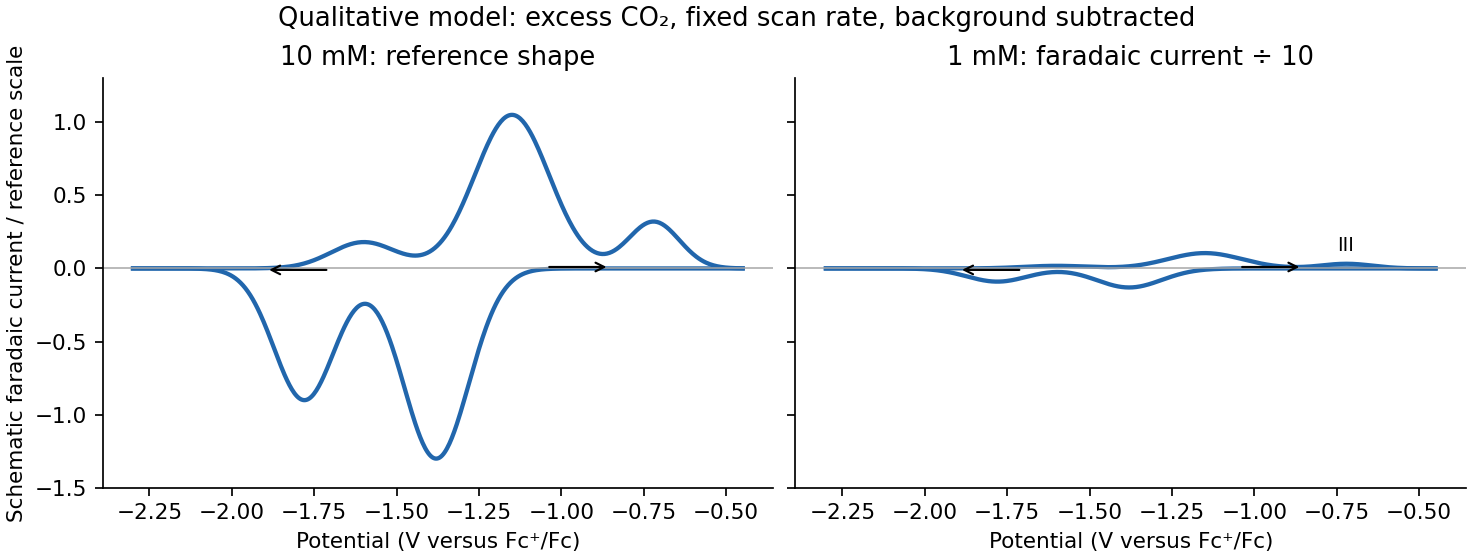
Qualitative tenfold faradaic-current scaling at fixed scan rate and excess carbon dioxide
. Details. Past exam of the chemistry course of the year 3 of the natural sciences course of the University of Cambridge 2022 Paper 4 51 c iv Solution by Codex 0 2026-10-20
Codex 0 2026-10-20Peak I is the cathodic reduction shifted positive of the unbound AQ/AQ event, consistent with reduction of the CO-bound semiquinone to mono-carbonate dianion. Peak II is the corresponding relatively negative-potential return oxidation of mono-carbonate dianion. Peak III, appearing farther positive on the faster return scan, is consistent with direct oxidation of the more strongly protected bis-carbonate dianion, followed by CO release.
This assignment is consistent with binding making the reduced species harder to oxidize. At slow scan, chemical interconversion and CO dissociation can feed the easier mono-carbonate oxidation pathway; at fast scan a larger fraction of kinetically retained bis-adduct survives to its direct oxidation potential. The two separated reductions also show that initial capture and its associated potential shift are not sufficient to make every ECEC step a single equilibrated two-electron wave.
These traces support coupled electron-transfer/binding chemistry but do not determine every microscopic rate constant or exclude EECC pathways. The peak assignments are species-family assignments within the stated mechanism, rather than proof of a unique elementary sequence from voltammetry alone.
Past exam of the chemistry course of the year 3 of the natural sciences course of the University of Cambridge 2022 Paper 4 51 c iii Solution by Codex 0 2026-10-20
Codex 0 2026-10-20A useful electrode-surface scheme for the proposed ECEC mechanism isElectron-transfer arrows occur at the electrode, whereas both capture steps occur in the adjacent solution layer. CO is attacked by an oxygen-centered nucleophilic component of the reduced quinone, forming an O-carbonate linkage rather than simply physically adsorbing on neutral AQ.
At potentials more negative than , direct second reduction of any unbound semiquinone is also accessible: , followed by carbonate formation. Thus the fully reduced unbound and mono-adduct species can feed the bis-adduct, and the drawing should include CO transport into the layer and adduct transport away. ECEC is the proposed sequence; competing EECC transfer/capture ordering is possible at such negative potentials.
Past exam of the chemistry course of the year 3 of the natural sciences course of the University of Cambridge 2022 Paper 4 51 c ii Solution by Codex 0 2026-10-20
Codex 0 2026-10-20Event a probes electron transfer between the semiquinone and dianion. Benzoquinone's smaller framework localizes charge and undergoes a greater change in bonding and solvation on this reduction; a larger effective reorganization barrier can make its heterogeneous transfer insufficiently fast for Nernst equilibrium on the time scale. Anthraquinone's extended framework distributes the added charge and can support the more reversible response seen here.
This is a kinetic interpretation of quasi-reversibility, not a claim that benzoquinone cannot be reduced. Follow-up chemistry or adsorption can also distort peak separation and return-current ratios; scan-rate-dependent measurements would distinguish them from slow electron transfer. A single trace does not uniquely identify the cause.
Past exam of the chemistry course of the year 3 of the natural sciences course of the University of Cambridge 2022 Paper 4 51 c i Solution by Codex 0 2026-10-20
Codex 0 2026-10-20Read the potential labels rather than the alphabetical order: b, the less negative event, is ; a, the more negative event, is . These are the first and second reductions respectively, with the reverse branches giving the corresponding oxidations. The second electron is harder to add to an already negatively charged species.
Past exam of the chemistry course of the year 3 of the natural sciences course of the University of Cambridge 2022 Paper 4 51 a ii Solution by Codex 0 2026-10-20
Codex 0 2026-10-20The midpoint potential characterizes the redox couple under specified solution conditions: it is the potential at which oxidized and reduced forms have equal activities, or equal concentrations in the corresponding formal-potential convention. For a reversible cyclic voltammogram it is estimated by . It approximates the formal redox potential when the usual reversibility and diffusion assumptions apply; it is not the potential halfway along a scan chosen arbitrarily.
Past exam of the chemistry course of the year 3 of the natural sciences course of the University of Cambridge 2022 Paper 4 51 a i Solution by Codex 0 2026-10-20
Codex 0 2026-10-20Make heterogeneous electron transfer fast relative to delivery of reactant, usually by applying sufficient overpotential so that its surface concentration approaches zero. Use excess supporting electrolyte to suppress migration. For purely diffusional transient transport, suppress uncontrolled convection; for a rotating disk electrode, controlled convection supplies the bulk while diffusion across the thin interfacial boundary layer limits the current. A limiting current that no longer increases with driving potential is the characteristic test; a large current alone is not sufficient.
Past exam of the chemistry course of the year 3 of the natural sciences course of the University of Cambridge 2022 Paper 3 49 c iv Solution by Codex 0 2026-10-20
Codex 0 2026-10-20The relevant decomposition is unchanged:Thus the same and vibrational symmetries are linearly Jahn-Teller active. Their coupling constants and the resulting energy surface can differ from those of a state. The ground-geometry methane normal-mode representation and the symmetry-allowed harmonic invariants are also unchanged; actual force constants in the excited state need not have the same values.
Past exam of the chemistry course of the year 3 of the natural sciences course of the University of Cambridge 2022 Paper 3 49 c iii Solution by Codex 0 2026-10-20
Codex 0 2026-10-20For a real nonmagnetic electronic triplet, the symmetric square of a group representation decomposes asThe coordinate shifts all components equally and does not remove the degeneracy. The linear Jahn-Teller selection rule therefore permits and vibrational modes to couple and split the triplet. Both methane vibrational triplets are symmetry-eligible. A nonzero allowed coupling generally produces a symmetry-lowering instability, although symmetry alone does not determine its strength or the preferred minimum.
Past exam of the chemistry course of the year 3 of the natural sciences course of the University of Cambridge 2022 Paper 3 49 c ii Solution by Codex 0 2026-10-20
Codex 0 2026-10-20Choose mass-weighted coordinates , , and two triplets for the two copies. About a stationary equilibrium geometry, the allowed harmonic potential isThe kinetic energy is one-half the sum of the squared conjugate momenta. Cross terms between inequivalent irreducible representations are forbidden, but the two equivalent triplets permit the displayed scalar-product term. This is equivalent-mode harmonic coupling. An orthogonal rotation between the two triplets diagonalizes their force-constant matrix. In molecular normal coordinates the complete Hamiltonian becomesSymmetry enforces degeneracies within each multiplet; it does not require equal frequencies for the two distinct normal modes.
Past exam of the chemistry course of the year 3 of the natural sciences course of the University of Cambridge 2022 Paper 3 49 c i Solution by Codex 0 2026-10-20
Codex 0 2026-10-20In the class order , the 15 Cartesian nuclear displacements of methane have characters . Only nuclei left fixed by an operation contribute to that operation's trace. Subtract translations and rotations to obtain the methane normal-mode representationIts dimension is . There are four frequency families: a nondegenerate symmetric stretch, a doubly degenerate bend, and triply degenerate stretch and bend modes.
Past exam of the chemistry course of the year 3 of the natural sciences course of the University of Cambridge 2022 Paper 3 49 b ii Solution by Codex 0 2026-10-20
Codex 0 2026-10-20For a real-character irreducible molecular representation with character , the multiplicity of the fully symmetric representation in its tensor square isby character orthogonality. The identity uses the real-character assumption appropriate to the usual real irreducible representations intended here. For a general complex irreducible representation, the trivial representation in a tensor square has multiplicity one precisely when it is self-dual, and zero otherwise, by Schur's lemma. The universally valid tensor product is .
Pinned article: Introduction to the OurBigBook Project
Welcome to the OurBigBook Project! Our goal is to create the perfect publishing platform for STEM subjects, and get university-level students to write the best free STEM tutorials ever.
Everyone is welcome to create an account and play with the site: ourbigbook.com/go/register. We belive that students themselves can write amazing tutorials, but teachers are welcome too. You can write about anything you want, it doesn't have to be STEM or even educational. Silly test content is very welcome and you won't be penalized in any way. Just keep it legal!
Intro to OurBigBook
. Source. We have two killer features:
- topics: topics group articles by different users with the same title, e.g. here is the topic for the "Fundamental Theorem of Calculus" ourbigbook.com/go/topic/fundamental-theorem-of-calculusArticles of different users are sorted by upvote within each article page. This feature is a bit like:
- a Wikipedia where each user can have their own version of each article
- a Q&A website like Stack Overflow, where multiple people can give their views on a given topic, and the best ones are sorted by upvote. Except you don't need to wait for someone to ask first, and any topic goes, no matter how narrow or broad
This feature makes it possible for readers to find better explanations of any topic created by other writers. And it allows writers to create an explanation in a place that readers might actually find it.
Figure 1. Screenshot of the "Derivative" topic page. View it live at: ourbigbook.com/go/topic/derivativeVideo 2. OurBigBook Web topics demo. Source. - local editing: you can store all your personal knowledge base content locally in a plaintext markup format that can be edited locally and published either:This way you can be sure that even if OurBigBook.com were to go down one day (which we have no plans to do as it is quite cheap to host!), your content will still be perfectly readable as a static site.
- to OurBigBook.com to get awesome multi-user features like topics and likes
- as HTML files to a static website, which you can host yourself for free on many external providers like GitHub Pages, and remain in full control

Figure 2. You can publish local OurBigBook lightweight markup files to either OurBigBook.com or as a static website.
Figure 3. Visual Studio Code extension installation.
Figure 5. . You can also edit articles on the Web editor without installing anything locally. Video 3. Edit locally and publish demo. Source. This shows editing OurBigBook Markup and publishing it using the Visual Studio Code extension. 
- Infinitely deep tables of contents:




All our software is open source and hosted at: github.com/ourbigbook/ourbigbook
Further documentation can be found at: docs.ourbigbook.com
Feel free to reach our to us for any help or suggestions: docs.ourbigbook.com/#contact