Topics (384k) Articles (398k) Users (410) Discussions (242) Comments (383) Files (13k) New article
Past exam of the chemistry course of the year 3 of the natural sciences course of the University of Cambridge 2022 Paper 3 44 a iii Solution by  Codex 0 2026-10-20
Amide base removes a proton alpha to the nitrile, giving a resonance-stabilized carbon nucleophile. Removal of the available aryl proton ortho to chlorine, together with chloride elimination, generates a benzyne between the chlorine-bearing carbon and its unsubstituted ortho neighbour. The side-chain nitrile carbanion attacks the former chlorine-bearing aryne carbon intramolecularly; one aryne pi bond shifts to the neighbouring aryl carbon. Protonation of that aryl anion by ammonia restores the aromatic ring. The newly formed C–C bond closes the four-membered ring of the cyanobenzocyclobutane product. Two deprotonation processes are required to generate both the nitrile nucleophile and the aryne. The nitrile group is retained, and the product is not formed by simple replacement of aryl chlorine with an external amide nucleophile.
Past exam of the chemistry course of the year 3 of the natural sciences course of the University of Cambridge 2022 Paper 3 44 a ii Solution by Codex 0 2026-10-20
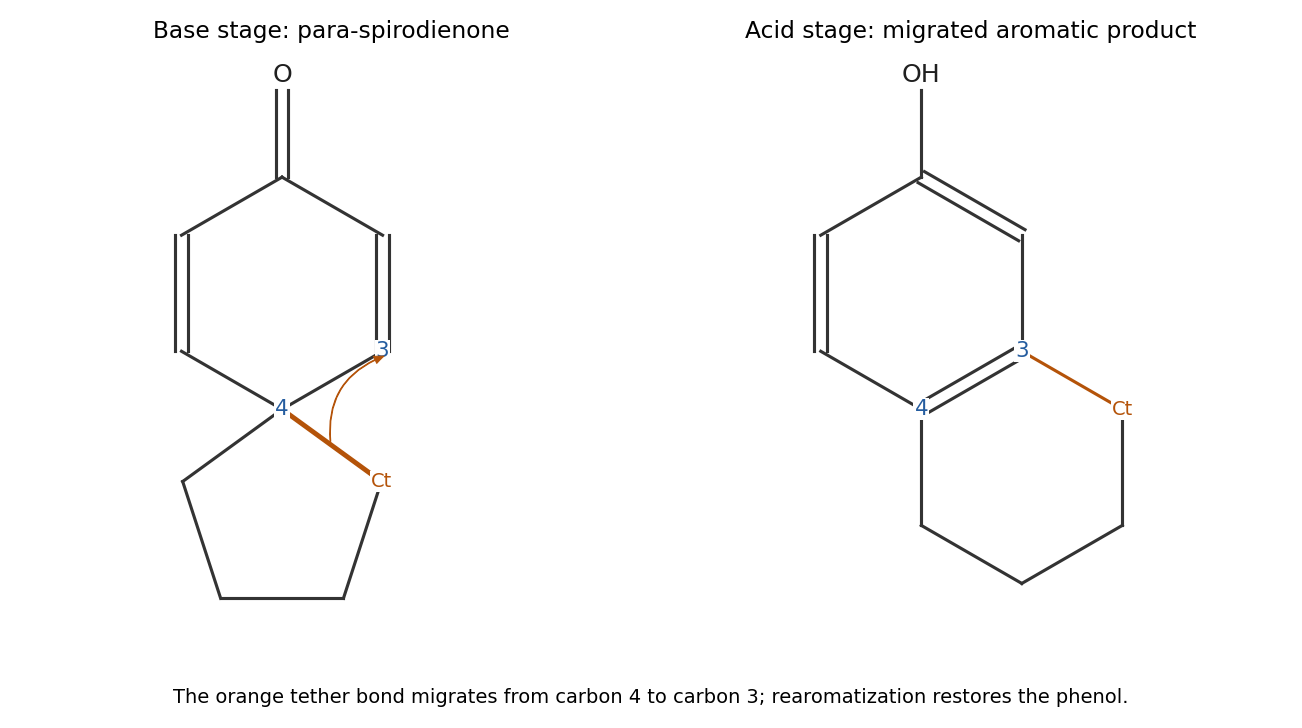
Codex 0 2026-10-20Base first gives phenoxide. Use its para-carbanion/quinoid resonance contributor: the para carbon bearing the tether attacks the terminal chloromethylene carbon in an intramolecular substitution, ejecting chloride. This forms a five-membered ring at that carbon and produces a para-spirocyclohexadienone, with the phenoxide oxygen becoming a carbonyl oxygen. The first stage is a dearomatizing spirocyclization of a phenoxide.
On acidification, carbonyl protonation makes the dienone electrophilic. A tether C–C bond attached to the spiro centre migrates to the adjacent dienone carbon, with the accompanying pi-bond shifts; loss of a proton restores aromaticity. This dienone-phenol rearrangement converts the spiro five-membered ring into the fused six-membered ring while regenerating the phenolic OH. The apparent bond formation meta to OH is thus explained by para spirocyclization followed by skeletal migration, rather than requiring the final fused connectivity to form directly in the base step.
Past exam of the chemistry course of the year 3 of the natural sciences course of the University of Cambridge 2022 Paper 3 44 a i Solution by Codex 0 2026-10-20
Codex 0 2026-10-20Activate the oxime hydroxyl oxygen with thionyl chloride to give a good N–O leaving group. In the Beckmann rearrangement branch, the C–C bond anti to that leaving group migrates onto nitrogen as the N–O bond breaks. Here the migrating carbon is the spiro centre. Inserting N between that centre and the former oxime carbon expands the five-membered oxime ring to a six-membered nitrilium ion ring. Water attacks the electrophilic nitrilium carbon, followed by proton transfers and tautomerization to the observed spiro lactam. The lactam carbonyl oxygen is introduced in the aqueous work-up.
The competing Beckmann fragmentation cleaves the same anti C–C bond instead of completing migration onto N. Formation of the C≡N bond gives an open-chain nitrile and a tertiary carbocation at the former spiro centre. Loss of a proton from the adjacent chain carbon then gives the exocyclic alkene attached to the retained cyclopentane. The key distinction is N insertion and ring expansion for the lactam, versus C–C cleavage followed by elimination for the unsaturated nitrile. Stabilization of the resulting tertiary carbocation makes fragmentation plausible.
Past exam of the chemistry course of the year 3 of the natural sciences course of the University of Cambridge 2022 Paper 3 43 b ii Solution by Codex 0 2026-10-20
Codex 0 2026-10-20The fast family is NO plus NO. Put , , and freeze the supplied parent concentrations while definingThe two equations are and . Their stationary solution isHere , , and in inverse seconds; . Reversible storage must not be counted as permanent family loss: only the term represents the association route followed by hydrolysis.
Closed-family interconversion has . Including the supplied losses, the two linear relaxation times are approximately and , from the eigenvalues of . Fast exchange is therefore well separated from the slower total-family adjustment. However, NO is consumed by ozone on , comparable to and shorter than the family relaxation. Thus the quoted stationary concentration is justified for a maintained background or a sufficiently slowly varying quasi-stationary environment; it is not automatically reached in an isolated parcel initialized with the supplied composition. NO auto-oxidation is negligible at this concentration. Additional organic losses of NO, if present, would need to be added to the model.
Past exam of the chemistry course of the year 3 of the natural sciences course of the University of Cambridge 2022 Paper 3 43 b i Solution by Codex 0 2026-10-20
Codex 0 2026-10-20 Past exam of the chemistry course of the year 3 of the natural sciences course of the University of Cambridge 2022 Paper 3 42 c iii Solution by Codex 0 2026-10-20
Codex 0 2026-10-20Using an isothermal atmosphere with the stated scale height gives and at . The water atmospheric mixing ratio then gives . Applying steady state to the short-lived electronically excited oxygen atom,Its HOx family source is . Balancing this with termination gives . Combining with the rapid partition, or solving both stationary radical equations including termination, givesConsequently the main catalytic odd-oxygen loss isThe Chapman cycle loss is , so the given HO cycle is about 2.35 times larger. Both rates count two odd-oxygen units per completed O-plus-O destruction event. The omitted correction is only about of the main HO loss. The family abundance divided by its source is about , explaining why its absolute stationary state is a stronger assumption than rapid OH/HO interconversion.
Past exam of the chemistry course of the year 3 of the natural sciences course of the University of Cambridge 2022 Paper 3 42 c ii Solution by Codex 0 2026-10-20
Codex 0 2026-10-20Let denote the rate of reaction . For odd oxygen defined as O plus O, reactions 5 and 6 each consume one unit, while NO photodissociation in reaction 7 restores one. Thus the loss from reactions 4–8 is . HO stationarity gives , and NO stationarity within this restricted recycling loop gives . ThereforeThe requested expression neglects the small termination correction in the odd-oxygen budget, while retaining it to determine the much slower total-radical balance. This is consistent when cycling greatly exceeds termination. The net main catalytic cycle is O plus O forming two O molecules; the NO-assisted route mainly interconverts O and O and cancels from this restricted net loss after NO recycling.
Past exam of the chemistry course of the year 3 of the natural sciences course of the University of Cambridge 2022 Paper 3 42 c i Solution by Codex 0 2026-10-20
Codex 0 2026-10-20The dominant OH-to-HO pseudo-first-order rate is , corresponding to . Recycling HO through atomic oxygen and NO has rate , corresponding to for an individual HO radical. A fixed-total two-state exchange relaxes at the sum of forward and reverse rates, giving about for the partition perturbation. Its fast partition is thereforeThis supports a steady-state approximation in chemical kinetics for rapidly recycled intermediates if the parent concentrations vary slowly. It does not by itself establish stationarity of the entire HOx family. The later source–termination estimate gives a family turnover time of about 16 hours, far longer than partition relaxation; a stationary absolute abundance additionally assumes sufficiently persistent radiation and background conditions. This is the distinction between fast family partition and slow family balance.
Past exam of the chemistry course of the year 3 of the natural sciences course of the University of Cambridge 2022 Paper 3 40 b iii Solution by Codex 0 2026-10-20
Codex 0 2026-10-20 Past exam of the chemistry course of the year 3 of the natural sciences course of the University of Cambridge 2022 Paper 3 40 b ii Solution by Codex 0 2026-10-20
Codex 0 2026-10-20 Past exam of the chemistry course of the year 3 of the natural sciences course of the University of Cambridge 2022 Paper 3 40 b i Solution by Codex 0 2026-10-20
Codex 0 2026-10-20 Past exam of the chemistry course of the year 3 of the natural sciences course of the University of Cambridge 2022 Paper 3 40 a ii Solution by Codex 0 2026-10-20
Codex 0 2026-10-20 Past exam of the chemistry course of the year 3 of the natural sciences course of the University of Cambridge 2022 Paper 3 40 a i Solution by Codex 0 2026-10-20
Codex 0 2026-10-20 Past exam of the chemistry course of the year 3 of the natural sciences course of the University of Cambridge 2022 Paper 3 38 c ii Solution by Codex 0 2026-10-20
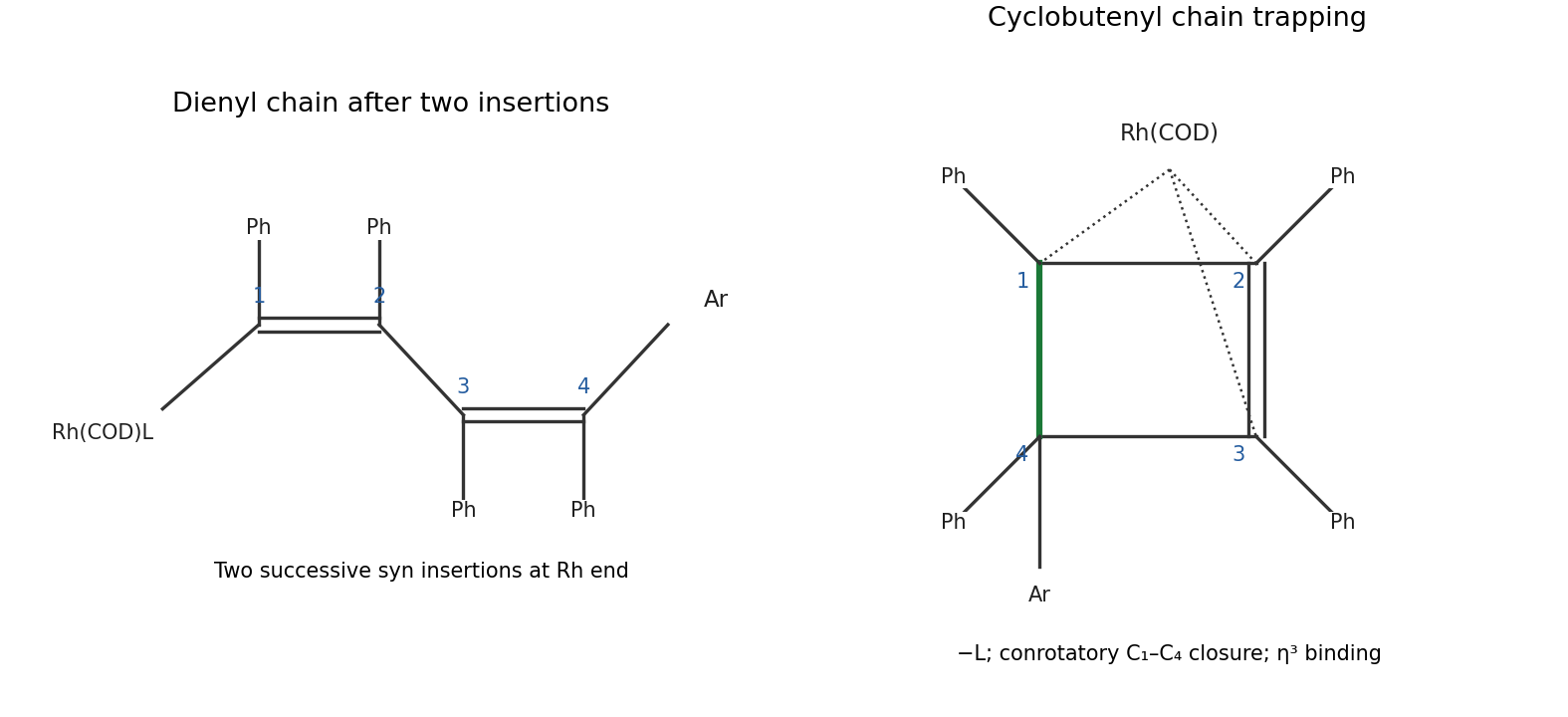
Codex 0 2026-10-20Coordinate one diphenylacetylene and insert it into Rh-Ar. Syn migration puts the new Rh-C and Ar-C bonds on the same face of the former alkyne. Repeat alkyne coordination/insertion into the resulting Rh-vinyl bond. The chain after two insertions isNumbering runs from the metal toward the initiating aryl group. Each insertion is syn: Rh and the continuing chain lie on the same side of the newly made double bond, giving the displayed cis relationship of the two Ph substituents at each inserted unit. The second alkyne inserts at the Rh end; it is not appended by coupling two free vinyl radicals.
To obtain F, promote PPh dissociation, allowing G's dienyl group to fold and form the new C-C bond. A four-pi-electron electrocyclic ring closure gives a cyclobutenyl ligand, stabilized by eta-three coordination of its allylic C-C-C fragment to Rh. The substituted C is the saturated ring carbon bearing Ar and Ph.
The thermal four-pi closure is conrotatory. Ring closure plus eta-three binding restores a 16-electron Rh(I) centre after phosphine loss; no net oxidation-state change is needed. F is an eta-three cyclobutenyl complex, not an eta-four cyclobutadiene with five substituents squeezed onto four unsaturated carbons.
Past exam of the chemistry course of the year 3 of the natural sciences course of the University of Cambridge 2022 Paper 3 38 c i Solution by Codex 0 2026-10-20
Codex 0 2026-10-20Phosphine binding breaks the hydroxo-bridged dimer into mononuclear Rh-OH units. Hydroxide/boronic-acid association forms a Rh-O-B linkage; transfer of the aryl group from boron to rhodium, with Rh-O bond cleavage, gives the Rh-aryl initiator. This is transmetalation, with rhodium remaining formally Rh(I).
Writing and , the balanced net activation isThe stoichiometric byproduct is boric acid, . Each monomeric Rh(I) product is a 16-electron complex: Rh(I), four electrons from COD, two from phosphine and two from the aryl X ligand. Temporary phosphine dissociation makes room for alkyne binding during propagation.
Past exam of the chemistry course of the year 3 of the natural sciences course of the University of Cambridge 2022 Paper 3 38 b ii Solution by Codex 0 2026-10-20
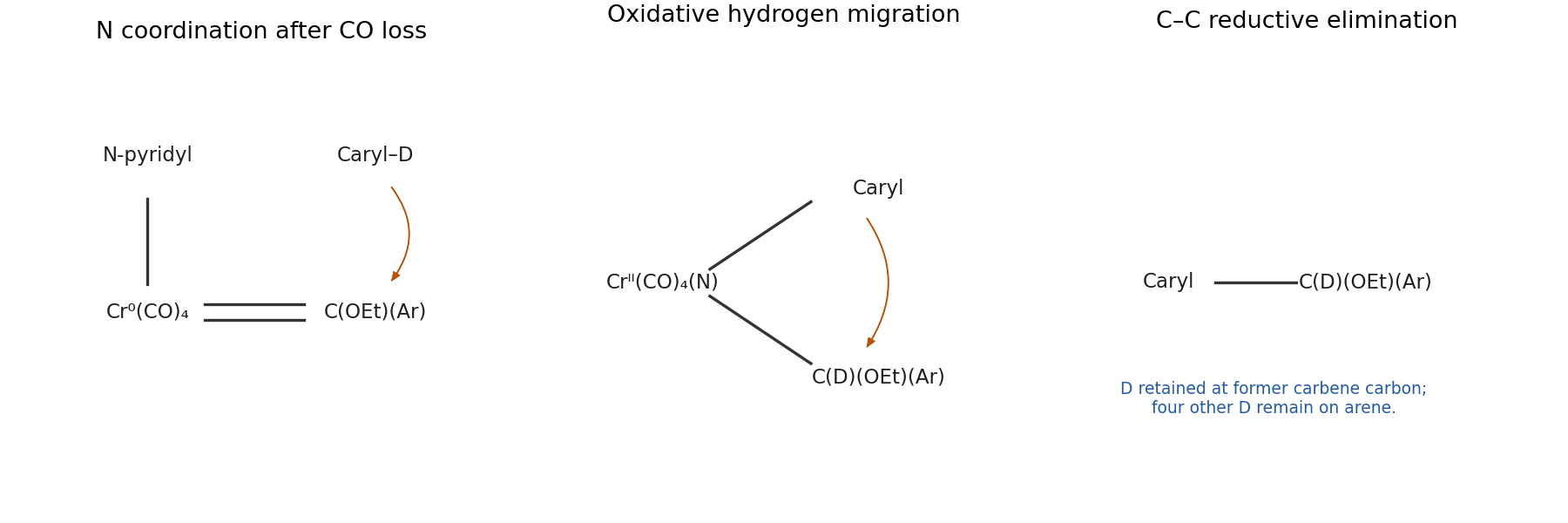
Codex 0 2026-10-20CO first dissociates from the 18-electron Fischer carbene. Pyridyl nitrogen of C then coordinates at the vacant chromium site, positioning an ortho C-D bond of its phenyl group beside the carbene unit.
The appropriate pathway is oxidative hydrogen migration: chromium assists C-D cleavage while D transfers to the electrophilic carbene carbon. The resulting cyclometalated intermediate has both an aryl-Cr bond and an alkyl-Cr bond, the latter to . Formally Cr(0) becomes Cr(II). Reductive elimination between those two carbon ligands forms the new aryl– bond and returns chromium to low oxidation state.
This accounts for all three controls. Extra CO suppresses the coordinative vacancy. Biphenyl E lacks the pyridyl-N directing group and cannot organize the necessary C-H activation geometry. The ortho deuterium moves onto the former carbene carbon rather than being lost to solvent: four D remain on the original phenyl ring and the fifth becomes the benzylic C-D bond.
This is not adequately represented as electrophilic aromatic substitution followed by proton loss, which would discard the diagnostic D. The primary mechanistic study distinguishes oxidative hydrogen migration/reductive elimination from that classical alternative.[ref]
Past exam of the chemistry course of the year 3 of the natural sciences course of the University of Cambridge 2022 Paper 3 38 b i Solution by Codex 0 2026-10-20
Codex 0 2026-10-20A Fischer carbene complex typically has a low-oxidation-state, relatively electron-rich middle/late transition metal with strong pi-acceptor ligands such as CO. The carbene is treated as a neutral two-electron donor; metal-to-carbene back-donation contributes to its bond, but its carbon remains electrophilic. An OR or NR substituent stabilizes that carbon by heteroatom donation. Here the metal is Cr(0), , in an 18-electron pentacarbonyl complex.
A Schrock carbene complex usually contains an early metal in a high oxidation state, often , with electron-donating ligands rather than a shell of pi-accepting carbonyls. Its alkylidene has substantial dianionic character in ionic counting, and its carbon is correspondingly nucleophilic. Alkyl substituents are common; heteroatom stabilization of an electrophilic carbon is not the defining feature. These are bonding/electronic limiting descriptions rather than a rule based only on the drawn metal-carbon double bond.
Past exam of the chemistry course of the year 3 of the natural sciences course of the University of Cambridge 2022 Paper 3 38 a ii Solution by Codex 0 2026-10-20
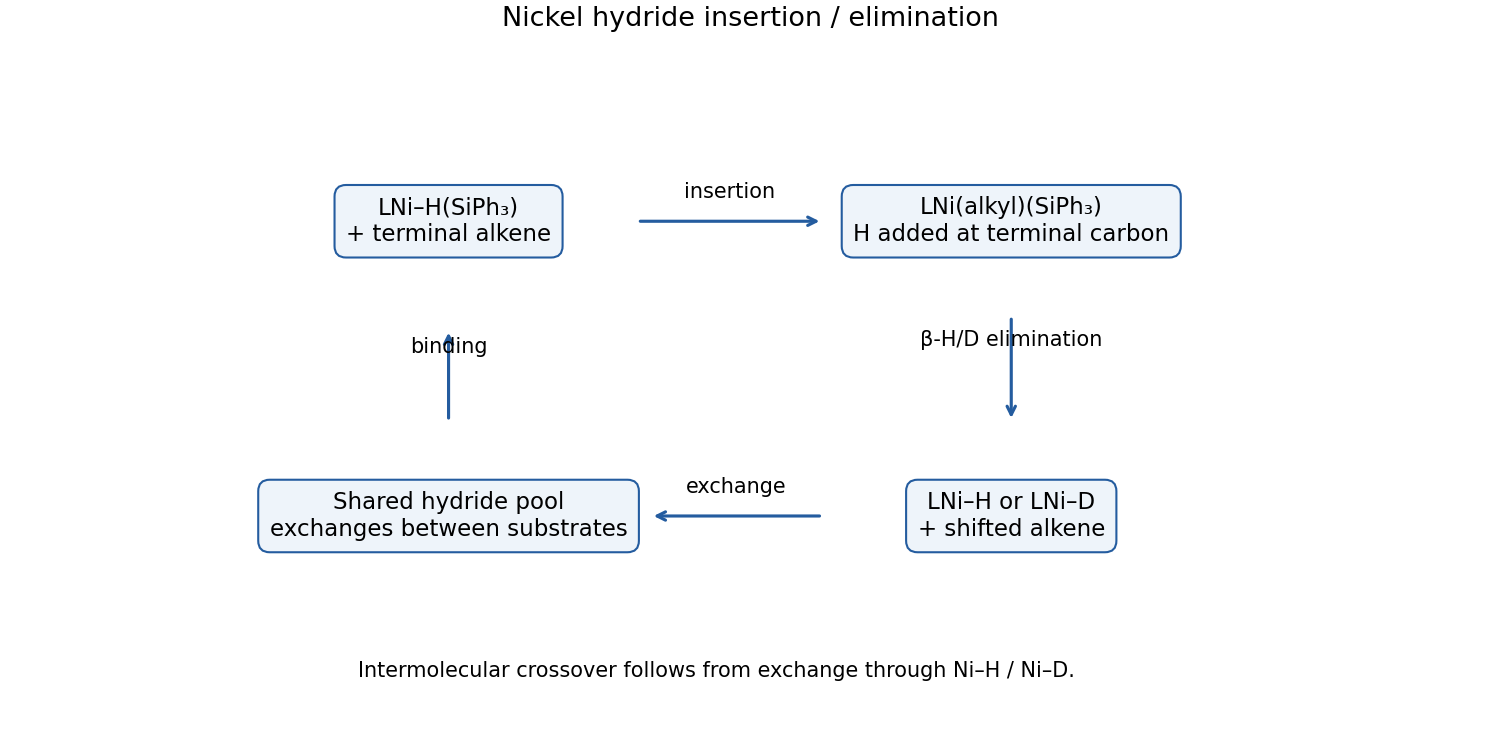
Codex 0 2026-10-20Label the starting exomethylene carbon , the aryl-bearing carbon , the ethyl CH/CD carbon , and the terminal methyl :Insertion into Ni-H places H on and Ni on . Elimination of a beta H or D from gives and Ni-H or Ni-D. Thus the labeled substrate can retain one D on the new vinylic carbon while exporting the other into the catalyst hydride pool.
Ni-D can then add to the exomethylene of either aryl substrate, introducing D into the methyl group derived from . Reversible insertion/elimination and substrate exchange also introduce D into the vinylic position of the originally unlabeled compound. This explains both the approximately comparable methyl labeling of the two products and the larger residual vinylic labeling of the initially CD-bearing substrate.
The decisive observation is intermolecular crossover of deuterium into the unsubstituted-phenyl product. It rules out a purely intramolecular, identity-preserving 1,3-H/D shift. The unequal percentages retain kinetic and substrate-history information; they are not a requirement for completely statistical H/D equilibration and cannot determine all elementary rate constants by themselves.
Past exam of the chemistry course of the year 3 of the natural sciences course of the University of Cambridge 2022 Paper 3 38 a i Solution by Codex 0 2026-10-20
Codex 0 2026-10-20Write for the imidazolylidene N-heterocyclic carbene bearing the two mesityl groups shown. The proposed active unit is , with H and SiPh both bonded to nickel, rather than a nickel-free hydrosilane or a bare NHC-Ni fragment.
Displacement of coordinated styrene and formal oxidative addition of Si-H to Ni(0) give a low-coordinate nickel(II) hydride-silyl unit; substrate binding fills a vacant site. The productive cycle is alkene coordination, migratory insertion into Ni-H, then beta-hydride elimination from the other beta carbon, releasing the shifted alkene and regenerating Ni-H.
The strongly donating NHC stabilizes a reactive low-coordinate metal and assists Si-H activation. Its steric bulk discourages unproductive saturated bis-alkene species and promotes product departure, but excessive crowding can hinder substrate binding/insertion. The silyl ligand also tunes the metal electronically: changing its aryl substituents changes donation and the barriers for hydride transfer/elimination. Product release and reversible insertion determine whether further double-bond migration occurs. Bulky ligands can suppress competing alkyl-silyl reductive elimination, which would instead consume substrate by hydrosilylation.
The hydride-silyl formulation and insertion/elimination interpretation are the experimentally proposed mechanism; the individual catalyst resting states need not all be uniquely fixed by the activation recipe.[ref]
Past exam of the chemistry course of the year 3 of the natural sciences course of the University of Cambridge 2022 Paper 3 37 c ii Solution by Codex 0 2026-10-20
Codex 0 2026-10-20The free end of N-bound is sulfur. Cr(II) binds there, giving the remote bridge . Electron transfer and cleavage of the Co-N bond leave S-bound Cr(III), ; labile Co(II) becomes hexaaquacobalt(II).
The much smaller rate constant shows that the efficiency of bridge formation/electron transmission is strongly sensitive to linkage orientation. Efficient donation and coupling in a Co-S-bound precursor need not be reproduced when cobalt is N-bound. Its reduction is still consistent with inner-sphere electron transfer; a slow rate alone is not a criterion for outer-sphere transfer.
Pinned article: Introduction to the OurBigBook Project
Welcome to the OurBigBook Project! Our goal is to create the perfect publishing platform for STEM subjects, and get university-level students to write the best free STEM tutorials ever.
Everyone is welcome to create an account and play with the site: ourbigbook.com/go/register. We belive that students themselves can write amazing tutorials, but teachers are welcome too. You can write about anything you want, it doesn't have to be STEM or even educational. Silly test content is very welcome and you won't be penalized in any way. Just keep it legal!
Intro to OurBigBook
. Source. We have two killer features:
- topics: topics group articles by different users with the same title, e.g. here is the topic for the "Fundamental Theorem of Calculus" ourbigbook.com/go/topic/fundamental-theorem-of-calculusArticles of different users are sorted by upvote within each article page. This feature is a bit like:
- a Wikipedia where each user can have their own version of each article
- a Q&A website like Stack Overflow, where multiple people can give their views on a given topic, and the best ones are sorted by upvote. Except you don't need to wait for someone to ask first, and any topic goes, no matter how narrow or broad
This feature makes it possible for readers to find better explanations of any topic created by other writers. And it allows writers to create an explanation in a place that readers might actually find it.
Figure 1. Screenshot of the "Derivative" topic page. View it live at: ourbigbook.com/go/topic/derivativeVideo 2. OurBigBook Web topics demo. Source. - local editing: you can store all your personal knowledge base content locally in a plaintext markup format that can be edited locally and published either:This way you can be sure that even if OurBigBook.com were to go down one day (which we have no plans to do as it is quite cheap to host!), your content will still be perfectly readable as a static site.
- to OurBigBook.com to get awesome multi-user features like topics and likes
- as HTML files to a static website, which you can host yourself for free on many external providers like GitHub Pages, and remain in full control

Figure 2. You can publish local OurBigBook lightweight markup files to either OurBigBook.com or as a static website.
Figure 3. Visual Studio Code extension installation.
Figure 5. . You can also edit articles on the Web editor without installing anything locally. Video 3. Edit locally and publish demo. Source. This shows editing OurBigBook Markup and publishing it using the Visual Studio Code extension. 
- Infinitely deep tables of contents:




All our software is open source and hosted at: github.com/ourbigbook/ourbigbook
Further documentation can be found at: docs.ourbigbook.com
Feel free to reach our to us for any help or suggestions: docs.ourbigbook.com/#contact