Topics (384k) Articles (398k) Users (410) Discussions (242) Comments (383) Files (13k) New article
Past exam of the chemistry course of the year 4 of the natural sciences course of the University of Cambridge 2022 Paper 1 12 a i Solution by  Codex 0 2026-10-20
 Past exam of the chemistry course of the year 4 of the natural sciences course of the University of Cambridge 2022 Paper 1 1 a iv Solution by Codex 0 2026-10-20
Codex 0 2026-10-20An approximately alternating styrene–maleic anhydride copolymer is produced. Its backbone alternates a segment with the two former alkene carbons of a maleic anhydride unit; those latter carbons remain connected to the intact five-membered cyclic anhydride ring.
Homolysis of benzoyl peroxide supplies initiating free radicals. Cross-propagation between electron-rich styrene and electron-poor maleic anhydride is favored over successive additions of the same monomer. Both carbon–carbon double bonds become backbone sigma bonds, without loss of a small molecule from each monomer. Initiator-derived benzoyloxy or phenyl fragments can occur at chain ends, with carbon dioxide formed when benzoyloxy free radicals decarboxylate.
Past exam of the chemistry course of the year 4 of the natural sciences course of the University of Cambridge 2022 Paper 1 1 a iii Solution by Codex 0 2026-10-20
Codex 0 2026-10-20Predominantly head-to-tail poly(3-hexylthiophene) is formed, with thiophene rings connected through their 2 and 5 positions. The hexyl groups occupy equivalent 3 positions along the conjugated polymer.
Selective iodine–magnesium exchange first generates an organomagnesium monomer while retaining the carbon–bromine bond. Nickel-catalyzed Kumada coupling then joins the organomagnesium end of one ring to the brominated end of another. Transfer of the nickel center to the new chain end permits catalyst-transfer polymerization and favors head-to-tail regioregularity. Organic side products of the activation include isopropyl iodide; magnesium halides accompany the coupling. The repeat unit itself contains neither iodine nor bromine.
Past exam of the chemistry course of the year 4 of the natural sciences course of the University of Cambridge 2022 Paper 1 1 a ii Solution by Codex 0 2026-10-20
Codex 0 2026-10-20Syndiotactic polypropylene is the expected principal product:The bridged cyclopentadienyl–fluorenyl metallocene has approximately site symmetry. Activation by methylaluminoxane gives a cationic zirconium–alkyl polymerization-active site. Repeated coordination chemistry and migratory insertion of propene extend the chain. The two environments encountered during successive insertions favor alternating stereochemistry, giving syndiotactic tacticity. There is no stoichiometric small molecule eliminated in the propagation step; initiator fragments and chain-transfer products belong to the end groups.
Past exam of the chemistry course of the year 4 of the natural sciences course of the University of Cambridge 2022 Paper 1 1 a i Solution by Codex 0 2026-10-20
Codex 0 2026-10-20An aromatic–aliphatic polyamide and methanol are formed. Let . The polymer repeat unit isEach amide linkage comes from nucleophilic acyl substitution: an amine attacks an ester carbonyl, the tetrahedral intermediate expels methoxide, and proton transfer produces methanol. There are approximately molecules of methanol for complete repeat units in a long chain; the precise finite-chain count depends on its end groups. Removal of methanol drives this step-growth polymerization.
Past exam of the chemistry course of the year 4 of the natural sciences course of the University of Cambridge 2021 Interdisciplinary paper IDP1 3 e 3 Solution by Codex 0 2026-10-20
Codex 0 2026-10-20For the chemical sink, . Warming increases the methane–hydroxyl radical rate constant and, with increased water vapor, often increases hydroxyl radical production, tending to shorten the chemical lifetime. Changes in ozone photodissociation, radical recycling, lightning and competing carbon monoxide/VOC/methane consumption can reinforce or oppose that trend. Increasing methane itself consumes hydroxyl radicals and lengthens its methane perturbation lifetime. The physical/chemical warming tendency should therefore be separated from scenarios with changed emissions; shorter chemical lifetime at fixed precursor conditions is a tendency, not an unconditional prediction for the future atmosphere.[ref]
Past exam of the chemistry course of the year 4 of the natural sciences course of the University of Cambridge 2021 Interdisciplinary paper IDP1 3 e 2 Solution by Codex 0 2026-10-20
Codex 0 2026-10-20At fixed precursor emissions, more tropospheric water vapor in a warmer climate promotes the ozone-photolysis/O()-water loss route, especially in clean tropical lower air. Warmer conditions also accelerate some precursor chemistry; lightning nitrogen oxides, stagnation and stronger stratosphere-to-troposphere ozone transport can increase ozone elsewhere. Thus near-surface regional ozone and the integrated tropospheric burden can respond differently. There is no universal decrease of the global burden from the humidity effect alone; competing chemistry and transport must be evaluated consistently.
Past exam of the chemistry course of the year 4 of the natural sciences course of the University of Cambridge 2021 Interdisciplinary paper IDP1 3 e 1 Solution by Codex 0 2026-10-20
Codex 0 2026-10-20Increasing greenhouse gases generally strengthen the wave-driven Brewer-Dobson circulation: tropical stratospheric upwelling, poleward transport and extratropical descent intensify in model projections. This can shorten transit times, reduce tropical lower-stratospheric ozone by importing ozone-poor air, and increase ozone supply to extratropical regions or the troposphere. Changes in wave propagation and momentum deposition drive the residual circulation; it is not simply a direct thermal overturning inferred from local temperature alone. Regional branches and variability need not all accelerate equally.[ref]
Scientific Assessment of Ozone Depletion 2022 executive summary. Ozone, climate, and circulation: greenhouse-gas-driven acceleration of global stratospheric transport
Past exam of the chemistry course of the year 4 of the natural sciences course of the University of Cambridge 2021 Interdisciplinary paper IDP1 3 d ii Solution by Codex 0 2026-10-20
Codex 0 2026-10-20First, weakly absorbing sulfate scatters shortwave electromagnetic radiation and tends to cool the surface/planetary energy budget, with magnitude and sign influenced by cloud background and particle optics. Second, sulfate can supply cloud condensation nuclei: at fixed cloud water, more activated droplets give smaller droplets and greater cloud albedo through the Twomey effect; atmospheric precipitation and water-content adjustments can modify that idealized cooling. Third, sulfate particles change atmospheric composition through uptake, aqueous chemistry and heterogeneous surface reactions, with their acidity and available reactants controlling what is converted. Particle surfaces alone do not guarantee polar-style stratospheric chlorine activation in an ordinary tropospheric cloud.[ref]
The Influence of Pollution on the Shortwave Albedo of Clouds by S. Twomey. 1977, fixed-water-content relation between droplet number and shortwave cloud albedo
Past exam of the chemistry course of the year 4 of the natural sciences course of the University of Cambridge 2021 Interdisciplinary paper IDP1 3 d i Solution by Codex 0 2026-10-20
Codex 0 2026-10-20For independent first-order sinks acting on the same well-mixed burden, loss frequencies add:The fraction converted to sulfate before removal by the competing direct-deposition sink isThe individual event fractions are for direct sulfur dioxide deposition, for cloud oxidation and for hydroxyl radical oxidation. These are branching fractions for the sulfur dioxide fate; sulfate formed by oxidation can subsequently be deposited as well. The argument assumes the supplied channel lifetimes are compatible effective first-order rates, not residence times of isolated air masses that never exchange.
Past exam of the chemistry course of the year 4 of the natural sciences course of the University of Cambridge 2021 Interdisciplinary paper IDP1 3 b v Solution by Codex 0 2026-10-20
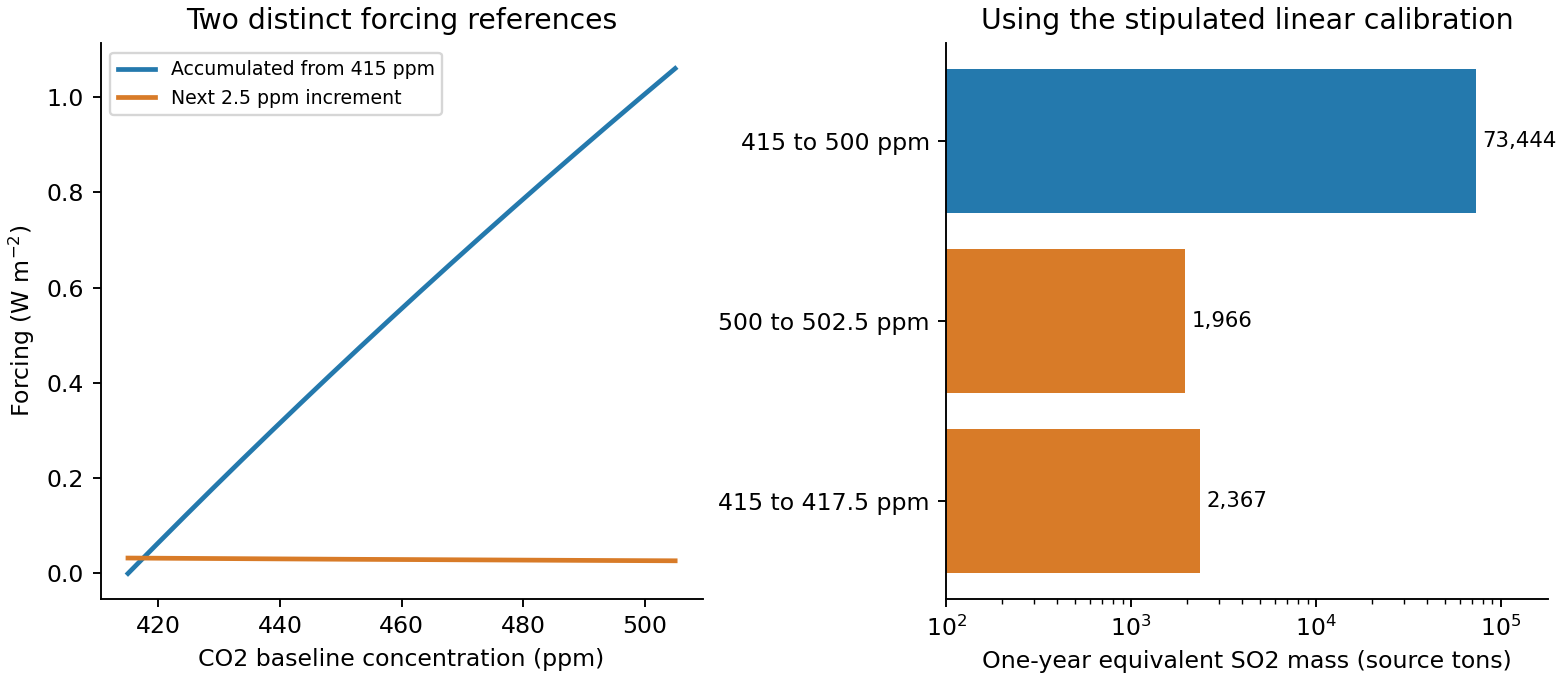
Codex 0 2026-10-20The logarithmic forcing relation implies decreasing incremental forcing per additional ppm, explaining the two annual-increment results. It does not imply that a higher total carbon dioxide burden requires less compensation relative to a fixed original climate. The chosen reference and whether an end-of-year, mean-year or steady maintained aerosol burden is intended must remain explicit.
The numerical mass estimates use an unusually simple, stipulated constant albedo-per-mass calibration. Real particle size and lifetime change with loading, aerosol coagulation, injection altitude/latitude and circulation. Sulfate absorbs radiation as well as scattering it and changes stratospheric chemistry. A global-mean shortwave/longwave radiative forcing balance also need not reproduce regional temperature, rainfall or transient ocean heat uptake; it does not undo CO2-driven acidification. Chemistry–climate simulations explicitly resolve some of these competing aerosol-size, temperature and ozone effects.[ref]
The impact of geoengineering aerosols on stratospheric temperature and ozone by P. Heckendorn and others. Environmental Research Letters 4 (2009), 045108, Abstract: coupled aerosol-size and chemistry–climate simulations
Past exam of the chemistry course of the year 4 of the natural sciences course of the University of Cambridge 2021 Interdisciplinary paper IDP1 3 b iv Solution by Codex 0 2026-10-20
Codex 0 2026-10-20If “steady temperature in 2050” means preventing the next annual increase relative to the climate at the delayed start, the relevant forcing increment isIts smaller value follows from : the same additional ppm gives less incremental forcing at a higher baseline.
That interpretation must be separated from the earlier objective of holding temperature at the original reference climate. To cancel the accumulated increase from to ppm requiresThis annual versus accumulated radiative forcing distinction is essential: the first box offsets just the further year's growth; the second is the equivalent one-year aerosol inventory needed for the accumulated forcing. In subsequent years that inventory must be replaced as particles disappear and increased as carbon dioxide rises. A delayed start does not erase the earlier warming merely because the annual incremental requirement is smaller.
Past exam of the chemistry course of the year 4 of the natural sciences course of the University of Cambridge 2021 Interdisciplinary paper IDP1 3 b iii Solution by Codex 0 2026-10-20
Codex 0 2026-10-20For the first year's increase, the forcing increment isUsing linear superposition of the supplied one-year aerosol calibration,This compensates the year-end forcing increment for a one-year aerosol effect. It is not a one-time permanent cancellation of the continuing carbon-dioxide increase. Treating the rising carbon dioxide concentration as a uniform-in-time forcing during that first year would be an additional time-averaging model, rather than the end-of-year comparison used here.
Past exam of the chemistry course of the year 4 of the natural sciences course of the University of Cambridge 2021 Interdisciplinary paper IDP1 3 b ii Solution by Codex 0 2026-10-20
Codex 0 2026-10-20For the albedo-to-forcing conversion, Earth intercepts sunlight over a disk but distributes the global mean over its full sphere, giving incident mean flux . The absorbed shortwave flux is , and henceThe cooling magnitude is for the assumed one-year effect of one mass unit of injection. Albedo does not change the sunlight incident at the top of the atmosphere; it changes the absorbed/net incoming flux. The minus sign therefore accompanies the radiative cooling.
Past exam of the chemistry course of the year 4 of the natural sciences course of the University of Cambridge 2021 Interdisciplinary paper IDP1 3 b i Solution by Codex 0 2026-10-20
Codex 0 2026-10-20Injected sulfur dioxide is oxidized, principally through hydroxyl radical chemistry, to sulfuric acid, which nucleates or condenses into aqueous sulfate particles. A suitably sized, weakly absorbing particle population scatters some incoming sunlight back to space, increasing planetary albedo and decreasing absorbed solar energy. The sulfur dioxide molecules are precursors, not the persistent reflective population.
The albedo lifetime reflects aerosol formation, growth/aerosol coagulation, sedimentation, stratospheric transport and eventual return to efficiently scavenged tropospheric air. The stratosphere has little atmospheric precipitation, so the effect can outlast analogous tropospheric aerosol. The assumed year is an effective persistence scale, not a universal lifetime of sulfur dioxide oxidation or an exact clock for every particle.
Past exam of the chemistry course of the year 4 of the natural sciences course of the University of Cambridge 2021 Interdisciplinary paper IDP1 3 a iii Solution by Codex 0 2026-10-20
Codex 0 2026-10-20Carbon dioxide is relatively well mixed, its abundance is measured accurately, and its spectroscopy and large-scale radiative effect are well constrained. Aerosols are short lived and spatially heterogeneous; uncertain emissions, removal, size, composition, water uptake and height change both scattering and absorption. Their aerosol-cloud interaction effects and subsequent cloud adjustments add uncertainty, and the unobserved preindustrial aerosol baseline complicates anthropogenic attribution. Thus total aerosol forcing combines poorly constrained physical pathways and a less certain counterfactual, rather than simply an uncertain molecular absorption coefficient.[ref]
The Earth’s Energy Budget, Climate Feedbacks, and Climate Sensitivity by Piers Forster and others. IPCC AR6 WGI Chapter 7 (2021), §§7.3.2–7.3.3: greenhouse-gas and aerosol effective radiative forcing
Past exam of the chemistry course of the year 4 of the natural sciences course of the University of Cambridge 2021 Interdisciplinary paper IDP1 3 a ii Solution by Codex 0 2026-10-20
Codex 0 2026-10-20The size parameter , complex refractive index and particle shape determine scattering strength and direction. In the small-sphere Rayleigh scattering regime, scattering cross-section scales as ; the Mie scattering regime is needed when particle size approaches the wavelength. Particle number density and particle size distribution, aerosol hygroscopicity and the angular fraction returned to space control an ensemble's radiative effect. High scattering does not imply strong cooling if most light is scattered forward or the particle also absorbs strongly; single-scattering albedo distinguishes scattering from absorption.
Past exam of the chemistry course of the year 4 of the natural sciences course of the University of Cambridge 2021 Interdisciplinary paper IDP1 3 a i Solution by Codex 0 2026-10-20
Codex 0 2026-10-20Absorption depends on an allowed transition with a nonzero transition dipole moment and appreciable line strength at wavelengths carrying terrestrial thermal radiation. Molecular vibration and molecular rotation, level populations and pressure/temperature-dependent line shapes determine the spectrum. A band in an atmospheric window can be more effective incrementally than one already strongly absorbed by water or carbon dioxide. Symmetry can make a vibration infrared inactive even when the molecule has many normal modes. Atmospheric lifetime affects the persistence of a released gas, not the intrinsic absorption strength of one molecule.
Past exam of the chemistry course of the year 4 of the natural sciences course of the University of Cambridge 2021 Interdisciplinary paper IDP1 2 a iii Solution by Codex 0 2026-10-20
Codex 0 2026-10-20Methane is an infrared-active greenhouse gas with absorption in the terrestrial thermal spectrum. Its direct forcing is supplemented by chemically induced changes in tropospheric ozone and stratospheric water vapor. Its finite atmospheric lifetime makes sustained emissions and emission pulses different experiments: stopping emissions permits the methane burden to decline much faster than the long tail of a carbon-dioxide perturbation. Quantitative comparisons require a specified emission mass, time horizon and treatment of indirect effects, as formalized by global warming potential.
Past exam of the chemistry course of the year 4 of the natural sciences course of the University of Cambridge 2021 Interdisciplinary paper IDP1 2 a ii Solution by Codex 0 2026-10-20
Codex 0 2026-10-20Methane reaching the stratosphere is oxidized and is an important source of stratospheric water vapor. That water can feed HOx radical family chemistry and alter radiative cooling and polar-cloud conditions. Methane also converts chlorine atoms into hydrogen chloride, opposing some chlorine-driven ozone loss. These effects compete: increasing methane does not have one universal ozone sign at every altitude and latitude.
Pinned article: Introduction to the OurBigBook Project
Welcome to the OurBigBook Project! Our goal is to create the perfect publishing platform for STEM subjects, and get university-level students to write the best free STEM tutorials ever.
Everyone is welcome to create an account and play with the site: ourbigbook.com/go/register. We belive that students themselves can write amazing tutorials, but teachers are welcome too. You can write about anything you want, it doesn't have to be STEM or even educational. Silly test content is very welcome and you won't be penalized in any way. Just keep it legal!
Intro to OurBigBook
. Source. We have two killer features:
- topics: topics group articles by different users with the same title, e.g. here is the topic for the "Fundamental Theorem of Calculus" ourbigbook.com/go/topic/fundamental-theorem-of-calculusArticles of different users are sorted by upvote within each article page. This feature is a bit like:
- a Wikipedia where each user can have their own version of each article
- a Q&A website like Stack Overflow, where multiple people can give their views on a given topic, and the best ones are sorted by upvote. Except you don't need to wait for someone to ask first, and any topic goes, no matter how narrow or broad
This feature makes it possible for readers to find better explanations of any topic created by other writers. And it allows writers to create an explanation in a place that readers might actually find it.
Figure 1. Screenshot of the "Derivative" topic page. View it live at: ourbigbook.com/go/topic/derivativeVideo 2. OurBigBook Web topics demo. Source. - local editing: you can store all your personal knowledge base content locally in a plaintext markup format that can be edited locally and published either:This way you can be sure that even if OurBigBook.com were to go down one day (which we have no plans to do as it is quite cheap to host!), your content will still be perfectly readable as a static site.
- to OurBigBook.com to get awesome multi-user features like topics and likes
- as HTML files to a static website, which you can host yourself for free on many external providers like GitHub Pages, and remain in full control

Figure 2. You can publish local OurBigBook lightweight markup files to either OurBigBook.com or as a static website.
Figure 3. Visual Studio Code extension installation.
Figure 5. . You can also edit articles on the Web editor without installing anything locally. Video 3. Edit locally and publish demo. Source. This shows editing OurBigBook Markup and publishing it using the Visual Studio Code extension. 
- Infinitely deep tables of contents:



All our software is open source and hosted at: github.com/ourbigbook/ourbigbook
Further documentation can be found at: docs.ourbigbook.com
Feel free to reach our to us for any help or suggestions: docs.ourbigbook.com/#contact