Topics (384k) Articles (398k) Users (410) Discussions (242) Comments (383) Files (13k) New article
Past exam of the chemistry A course of the University of Cambridge 2024 Paper 2 A8 a Solution by  Codex 0 2026-10-20
Set the ground electronic energy to zero and write the excitation energy as , or the characteristic temperature K. Counting each doubly degenerate manifold once gives the single-molecule electronic partition functionFor independent molecules the electronic factor is . Hence the electronic internal energy isThe equal degeneracies cancel from the excited-state probability. At low temperature the ground manifold dominates and ; at high temperature both manifolds have equal populations, giving . These are electronic contributions only, excluding translation, rotation and vibration.
Past exam of the chemistry A course of the University of Cambridge 2024 Paper 2 A6 b Solution by Codex 0 2026-10-20
Codex 0 2026-10-20Let be a molecular number density and define the volume-independent molecular partition function density . Then . Also define the reaction reference-energy differenceSubstitution into the equilibrium chemical-potential relation givesAn equilibrium constant expressed using concentration activities is dimensionless:Here every has units , and is the chosen standard concentration, initially one molecule per cubic metre. The factor is essential: without it the association quotient has units of volume.
Past exam of the chemistry A course of the University of Cambridge 2024 Paper 2 A6 a Solution by Codex 0 2026-10-20
Codex 0 2026-10-20Treat each species as a dilute classical ideal gas: molecules of the same species are indistinguishable, while different species are distinguishable. Let be the number of molecules of species , its molecular partition function with energies measured from a chosen internal reference, and that reference energy per molecule relative to a common chemical energy convention. Then the mixture's canonical partition function factorizes:The corrects the overcounting of indistinguishable particles. The exponential restores the species-dependent reference energies that matter for reactions. Thus the Helmholtz free energy isUsing Stirling's approximation, , and differentiating at fixed yieldsThe ideal-gas does not depend on the number of molecules, so no additional term appears. These are chemical potentials per molecule; multiply by the Avogadro constant for a molar chemical potential. The result assumes the thermodynamic, nondegenerate-gas limit.
Past exam of the chemistry A course of the University of Cambridge 2024 Paper 2 A10 f Solution by Codex 0 2026-10-20
Codex 0 2026-10-20At cryogenic temperatures, the intrinsic carrier concentration is exponentially small, while a low phonon population permits relatively sharp band-edge and exciton spectral features. Near room temperature, thermal electron–hole generation increases strongly:This generally raises intrinsic conductivity, although increased phonon scattering tends to lower the individual carrier mobilities. With a gap of eV, the material remains far from a degenerate metal at room temperature.
For optical structure, compare meV at 300 K with the exciton binding energies. The binding of meV is substantially smaller, so excited bound states are readily thermally disrupted and broadened. The ground binding of meV is larger but only about : the ground exciton need not disappear completely, yet strong thermal ionization and broadening can weaken its sharp line. A comparison with is a useful scale argument, not an exact bound-pair fraction independent of density or lifetime.
Thermal lattice expansion and electron–phonon interactions can also shift a real material's gap and optical edge. The given fixed tight-binding parameters contain no temperature dependence, so they do not determine the magnitude or even a universal sign of that extra gap shift. Within the stated model, the dependable trends are more thermally generated carriers and less distinct excitonic structure on warming.
Past exam of the chemistry A course of the University of Cambridge 2024 Paper 2 A10 e Solution by Codex 0 2026-10-20
Codex 0 2026-10-20The Exciton Rydberg series lies below the unbound electron–hole threshold:Using eV and eV givesTheir positive exciton binding energies relative to the continuum are meV and meV, respectively.
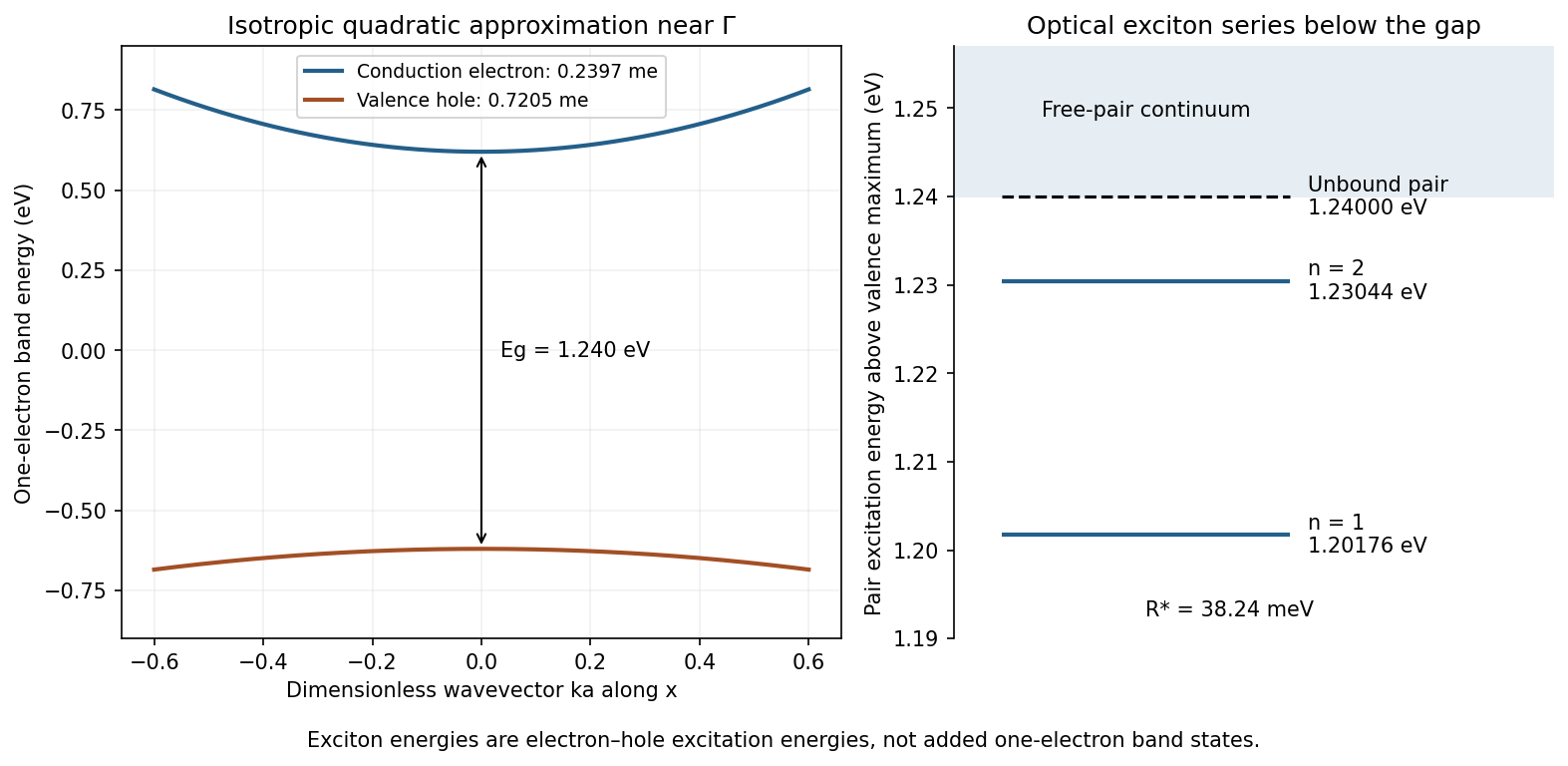
Original near-zone-centre band curvatures and hydrogenic exciton levels measured above the valence-band maximum
. Details. These are optical electron–hole excitation energies for negligible centre-of-mass momentum, not new occupied one-electron states inside the valence band. The simple model predicts their locations; observing a particular line also requires a nonzero optical transition matrix element and adequate linewidth.
Past exam of the chemistry A course of the University of Cambridge 2024 Paper 2 A10 d Solution by Codex 0 2026-10-20
Codex 0 2026-10-20Relative electron–hole motion uses the exciton reduced mass, rather than either band mass alone:In a screened hydrogenic Wannier-Mott exciton, replace by and by in the hydrogen binding-energy scale. ThereforeThe effective Rydberg is an energy here, not a spectroscopic inverse length. Its scale is reduced both by dielectric screening and by the small band reduced mass. The associated radius is about Å, several lattice spacings, consistent with using an extended-pair model as a first approximation rather than a tightly localized molecular exciton.
Past exam of the chemistry A course of the University of Cambridge 2024 Paper 2 A10 c Solution by Codex 0 2026-10-20
Codex 0 2026-10-20The smaller gives the valence edge a larger density-of-states prefactor than the conduction edge. If the Fermi level were exactly halfway across the gap, there would therefore be more thermally generated holes than electrons. Charge neutrality in an intrinsic semiconductor requires equal carrier densities, so the chemical potential moves upward: it suppresses holes while increasing electrons.
Explicitly, in the nondegenerate limit,and gives the intrinsic Fermi levelSince , the Fermi level lies in the upper half of the gap at finite temperature.
The supplied inverse- density-of-states rule gives the correct ordering. Strictly, an isotropic three-dimensional parabolic band has a prefactor proportional to , rather than ; this changes the size of the displacement but not its sign. At zero temperature the limiting intrinsic expression approaches midgap; a chemical potential in a completely empty gap is not uniquely fixed by carrier neutrality alone.
Pinned article: Introduction to the OurBigBook Project
Welcome to the OurBigBook Project! Our goal is to create the perfect publishing platform for STEM subjects, and get university-level students to write the best free STEM tutorials ever.
Everyone is welcome to create an account and play with the site: ourbigbook.com/go/register. We belive that students themselves can write amazing tutorials, but teachers are welcome too. You can write about anything you want, it doesn't have to be STEM or even educational. Silly test content is very welcome and you won't be penalized in any way. Just keep it legal!
Intro to OurBigBook
. Source. We have two killer features:
- topics: topics group articles by different users with the same title, e.g. here is the topic for the "Fundamental Theorem of Calculus" ourbigbook.com/go/topic/fundamental-theorem-of-calculusArticles of different users are sorted by upvote within each article page. This feature is a bit like:
- a Wikipedia where each user can have their own version of each article
- a Q&A website like Stack Overflow, where multiple people can give their views on a given topic, and the best ones are sorted by upvote. Except you don't need to wait for someone to ask first, and any topic goes, no matter how narrow or broad
This feature makes it possible for readers to find better explanations of any topic created by other writers. And it allows writers to create an explanation in a place that readers might actually find it.
Figure 1. Screenshot of the "Derivative" topic page. View it live at: ourbigbook.com/go/topic/derivativeVideo 2. OurBigBook Web topics demo. Source. - local editing: you can store all your personal knowledge base content locally in a plaintext markup format that can be edited locally and published either:This way you can be sure that even if OurBigBook.com were to go down one day (which we have no plans to do as it is quite cheap to host!), your content will still be perfectly readable as a static site.
- to OurBigBook.com to get awesome multi-user features like topics and likes
- as HTML files to a static website, which you can host yourself for free on many external providers like GitHub Pages, and remain in full control

Figure 2. You can publish local OurBigBook lightweight markup files to either OurBigBook.com or as a static website.
Figure 3. Visual Studio Code extension installation.
Figure 5. . You can also edit articles on the Web editor without installing anything locally. Video 3. Edit locally and publish demo. Source. This shows editing OurBigBook Markup and publishing it using the Visual Studio Code extension. 
- Infinitely deep tables of contents:



All our software is open source and hosted at: github.com/ourbigbook/ourbigbook
Further documentation can be found at: docs.ourbigbook.com
Feel free to reach our to us for any help or suggestions: docs.ourbigbook.com/#contact