Topics (384k) Articles (398k) Users (410) Discussions (242) Comments (383) Files (13k) New article
Past exam of the chemistry B course of the University of Cambridge 2021 Paper 1 B4 c Solution by  Codex 0 2026-10-20
The first step is a vinylogous aldol condensation at C5 of the unsaturated lactam. Number nitrogen N1, the lactam carbonyl C2, and then the methoxy-substituted alkene C3=C4 and the methylene group C5.
hydroxide reversibly removes a C5 proton. The resulting vinylogous enolate is delocalized through C5–C4–C3–C2–O: it is not necessary to create an unstabilized isolated carbanion beside nitrogen. Its C5 nucleophilic contributor attacks acetone. protonation gives a C5-linked tertiary alcohol, . Further removal of the remaining C5 hydrogen and elimination through an aldol-dehydration sequence forms C5=C(Me)2, leaving the original methoxy enol ether in place.
In the second step, aqueous acid hydrolyses that enol ether to a ketone at C4. protonation at C3 gives an oxygen-stabilized cation at C4. water attacks C4, proton transfers form a hemiacetal-like intermediate, and loss of methanol followed by deprotonation produces C4=O and the C3 methylene group.
Past exam of the chemistry B course of the University of Cambridge 2021 Paper 1 B4 b Solution by Codex 0 2026-10-20
Codex 0 2026-10-20B is the major product: the newly formed OH is the dashed bond in the printed zigzag structure. Retain the existing solid-wedge OH and the configuration at the carbamate-bearing carbon.
zinc coordinates the ketone oxygen and the adjacent hydroxyl oxygen, forming a five-membered O–Zn–O chelate. This constrains rotation around the carbonyl–alpha-carbon bond. In the favored chelated conformation the bulky group shields one face of the ketone, while the alpha hydrogen leaves the other more accessible. hydride attacks from that less crowded face, the carbonyl bond opens onto oxygen, and aqueous work-up gives the second alcohol.
Mapping this Cram chelation model back onto the printed zigzag gives B, not A. Merely placing a new OH “on the same side” of an unrotated page drawing is not a valid chelation argument: the reactive chelate and that drawing use different conformations. Zinc-borohydride reductions of alpha-hydroxy ketones are experimentally known to favor the corresponding anti-1,2-diol family under chelation control.[ref]
The reagent combination can generate zinc borohydride and related zinc-associated reducing species. The stereochemical justification is coordination-controlled facial selectivity; it does not require identifying a unique solution aggregate from the reagent list. The quoted yield is not itself a measurement of a 95:5 diastereomeric ratio.
Past exam of the chemistry B course of the University of Cambridge 2021 Paper 1 B4 a Solution by Codex 0 2026-10-20
Codex 0 2026-10-20The alcohol oxygen attacks sulfur of methanesulfonyl chloride, chloride leaves, and triethylamine removes the O–H proton. This gives an O-mesylate with retention of the carbon configuration: the original carbon–oxygen bond has not been displaced.
An accessible chair places the mesylate axial. triethylamine then removes the anti axial hydrogen on the carbon between the ketone and mesylate. Its C–H bond forms the new C=C bond while the C–O bond expels mesylate. The result is the conjugated cyclohexenone.
The neighboring carbon on the acetonide side has its relevant axial position occupied by its oxygen substituent, rather than an anti axial hydrogen. The elimination toward the ketone is therefore favored both by the trans-diaxial geometry and by conjugation of the resulting alkene with C=O. The acetonide remains intact. No inversion of the original alcohol carbon is required during mesylation, and it becomes planar during elimination.
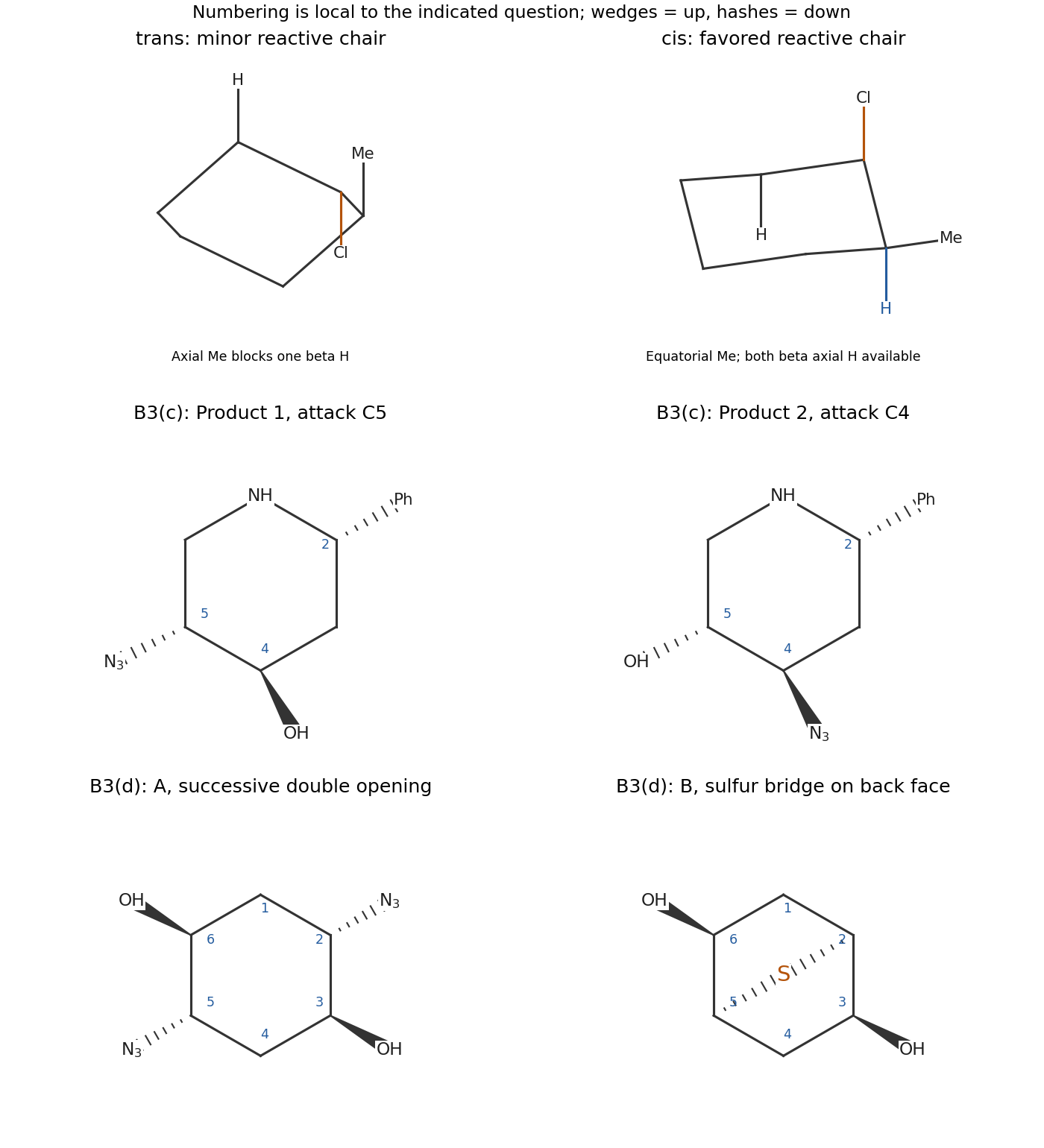
Past exam of the chemistry B course of the University of Cambridge 2021 Paper 1 B3 c Solution by Codex 0 2026-10-20
Codex 0 2026-10-20Number the nitrogen N1, the phenyl-bearing carbon C2, and then continue through C3–C6 around the piperidine. Call the solid-wedge epoxide face up; the phenyl group is down in both starting structures. The bulky phenyl group favors a pseudoequatorial orientation.
epoxide opening follows the Fürst-Plattner preference for a chair-like, trans-diaxial opening trajectory. Attack at the two epoxide carbons is not equivalent: the favored route evolves toward an ordinary chair, whereas the alternative demands a less favorable twist/boat-like distortion. Such conformational control of epoxy-2-arylpiperidine opening is supported by synthetic studies.[ref]
1,3-Allylic Strain as a Strategic Diversification Element for Constructing Libraries of Substituted 2-Arylpiperidines by Thomas C. Coombs and others. Scheme 1, chair-like trans-diaxial epoxide opening; applied here with the free-NH conformer
For the first epoxide, azide attacks C5 from down, breaking the C5–O bond. The residual C4–O bond is retained, so work-up gives C5–N3 down and C4–OH up, with the original C2–Ph down. For the second, down-face epoxide, azide attacks C4 from up, leaving C4–N3 up and C5–OH down. These assignments are shown in the middle row of the original stereochemical map.
In each mechanism an azide terminal nitrogen attacks the epoxide carbon, the C–O bonding pair goes to oxygen, and protonation gives the alcohol. Each attacked center inverts, and the azide and OH are trans. The phenyl-bearing center is unchanged. Reversing the epoxide face changes which carbon has the favored axial attack trajectory; a steric rule based only on distance from phenyl misses that conformational effect.
Past exam of the chemistry B course of the University of Cambridge 2021 Paper 1 B3 b Solution by Codex 0 2026-10-20
Codex 0 2026-10-20Both reactions are E2 eliminations requiring an axial chloride and an axial beta hydrogen in an antiperiplanar conformation relative to the C–Cl bond. The reacting C–H bond supplies the alkene bond as the C–Cl bond breaks; hydroxide accepts the proton.
For the trans-1,2 substrate, the low-energy chair has methyl and chlorine both equatorial. ring inversion is needed to place chlorine axial, but this also places methyl axial. The population of the reactive chair is consequently small, explaining the slow reaction. At the methyl-bearing neighboring carbon the axial position is occupied by methyl, not hydrogen. Only the other beta carbon has the needed anti axial H, so elimination gives 3-methylcyclohexene rather than the more substituted alkene.
For the cis substrate, a favorable chair has methyl equatorial and chlorine axial. It can react without paying the axial-methyl penalty, explaining the faster rate. Both adjacent carbons now supply an anti axial hydrogen. Removing the H on the methyl-bearing carbon gives 1-methylcyclohexene, the major product; removing the other gives 3-methylcyclohexene, the minor product. The former has the more substituted double bond.
Thus alkene stability selects between accessible pathways in the cis case, but it cannot create the missing antiperiplanar conformation H in the trans case.
Past exam of the chemistry B course of the University of Cambridge 2021 Paper 1 B3 a Solution by Codex 0 2026-10-20
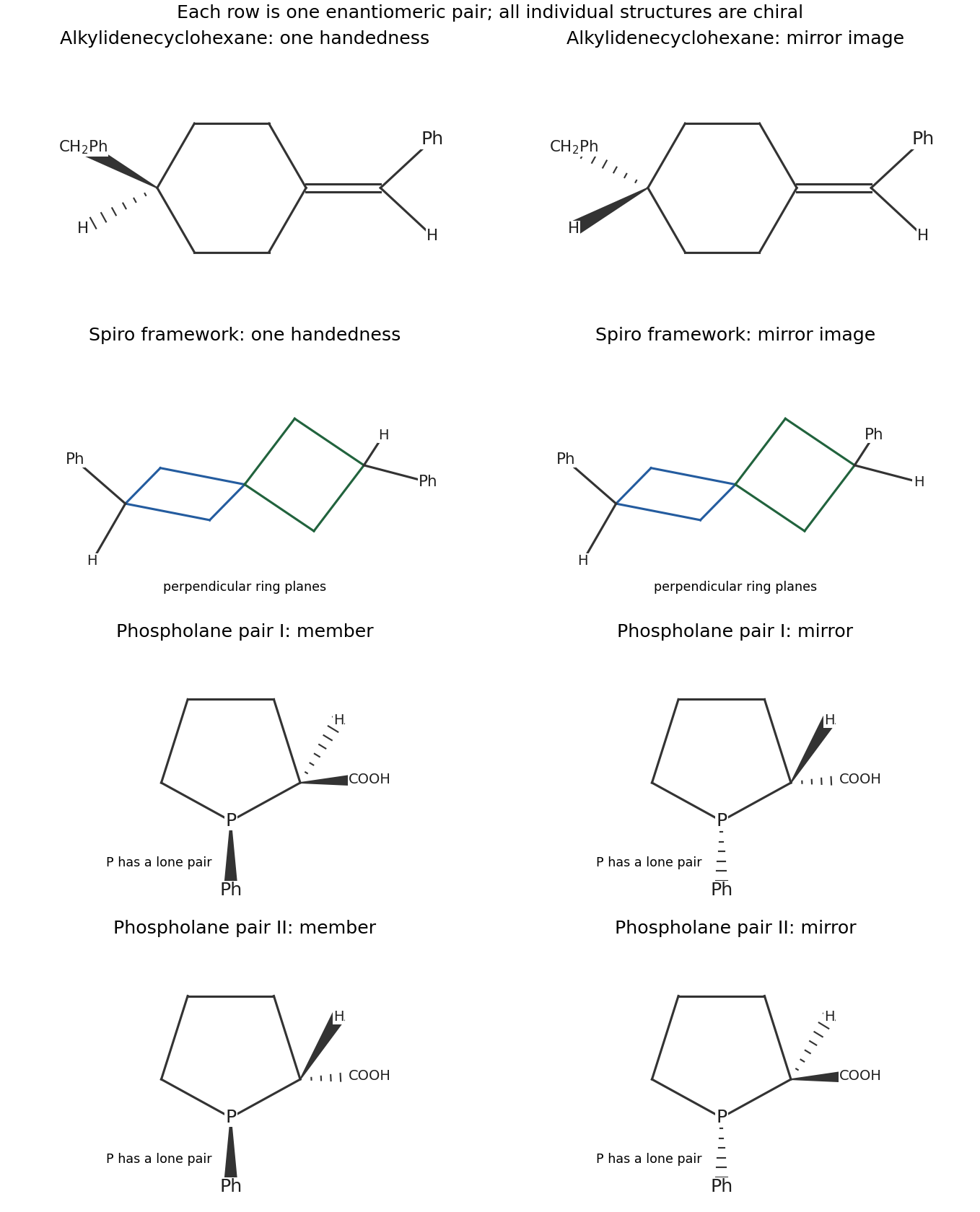
Codex 0 2026-10-20There are two, two and four stereoisomers, respectively; all eight individual stereoisomers are chiral. The drawings below give the mirror pairs. Solid and hashed wedges distinguish opposite faces; ordinary changes between conformers are not counted again.
- The benzyl-substituted alkylidenecyclohexane has an axial stereogenic element. At one end the exocyclic alkene presents Ph and H; at the other end the substituted ring carbon presents benzyl and H. The ring constrains the intervening paths, so exchanging one end pair gives the nonsuperposable mirror image. There is one enantiomeric pair, rather than an independent ordinary pair multiplied by a carbon-center count.
- The diphenylspiro compound also has one axial chirality. The two four-membered rings occupy different, approximately perpendicular planes. Their remote Ph/H substitutions distinguish the two handed arrangements. It gives one enantiomeric pair and no meso form. axial chirality of this spiro framework is experimentally established, for example by resolution of its 2,6-dicarboxylic-acid derivatives.[ref]Enantiopure spiro[3.3]heptane-2,6-dicarboxylic acid by Hong-Zhi Tang and others. Abstract, isolation of enantiopure spiro derivatives
- The phospholane has a stereogenic carbon at the COOH-bearing position and a pyramidal phosphorus stereocenter. The phosphorus has three different carbon ligands and a lone pair: its two ring paths differ because only one encounters the substituted carbon immediately. The four configurations are , , and . The first and last form a mirror pair, as do the middle two. carbon and phosphorus cannot be interchanged by a symmetry operation, so there is no meso reduction in the count.
Unlike the usual rapidly inverting trialkylamine, a pyramidal phosphine can retain a phosphorus configuration on an ordinary observational timescale; its two phosphorus configurations must therefore be included.
Past exam of the chemistry B course of the University of Cambridge 2021 Paper 1 B2 d Solution by Codex 0 2026-10-20
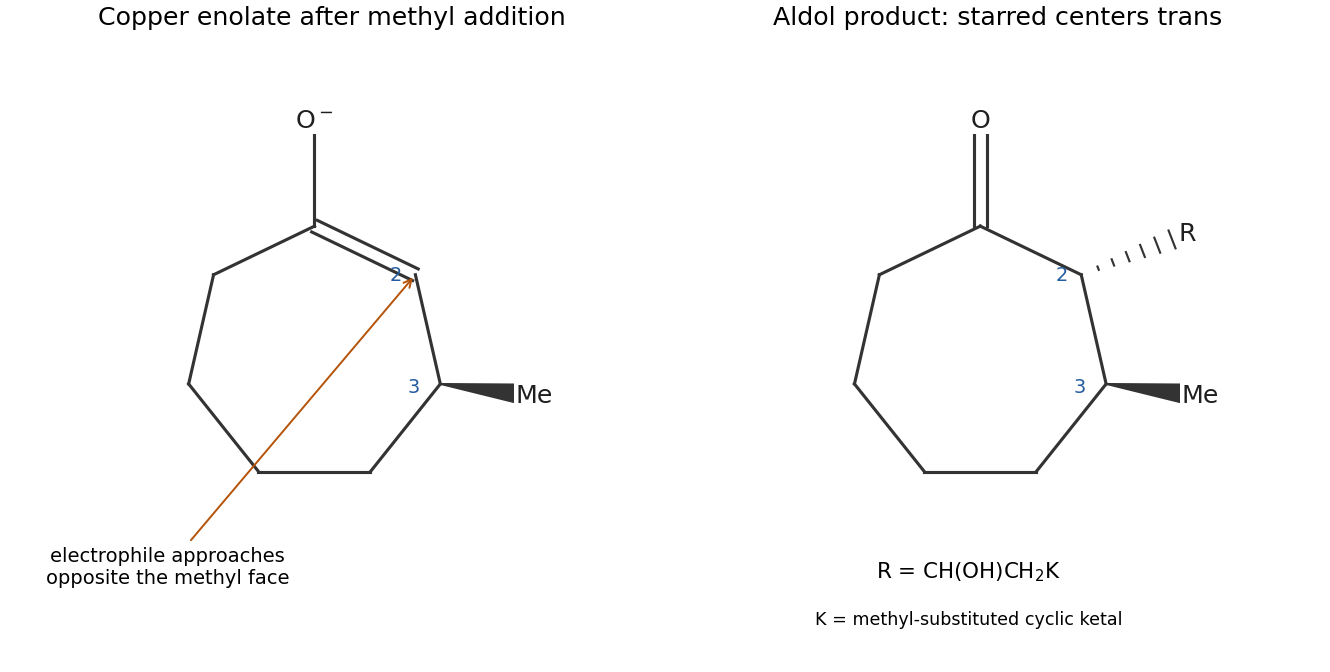
Codex 0 2026-10-20copper(I) converts the methyl grignard reagent into a softer organocopper nucleophile. Methyl undergoes 1,4 addition to the beta carbon of the cycloheptenone, giving a metal enolate rather than direct 1,2 addition to the ketone carbonyl.
The carbon nucleophilic site of this enolate, at the alpha carbon, attacks the aldehyde carbonyl in the second reagent. Its C=O electrons move to oxygen; protonation of the resulting alkoxide gives the beta-hydroxy ketone side chain. The cyclic acetal is a protected ketone and survives these nucleophilic conditions.
The beta methyl group shields one face of the cyclic enolate. Aldol bond formation from the less crowded opposite face places the new alpha side chain trans to the beta methyl group. Thus the two starred ring centers have an anti relationship; the two mirror-related products are possible from achiral starting materials and reagents. This argument does not assign the separate, unstarred alcohol center, for which the question gives no specified configuration.
Past exam of the chemistry B course of the University of Cambridge 2021 Paper 1 B2 c Solution by Codex 0 2026-10-20
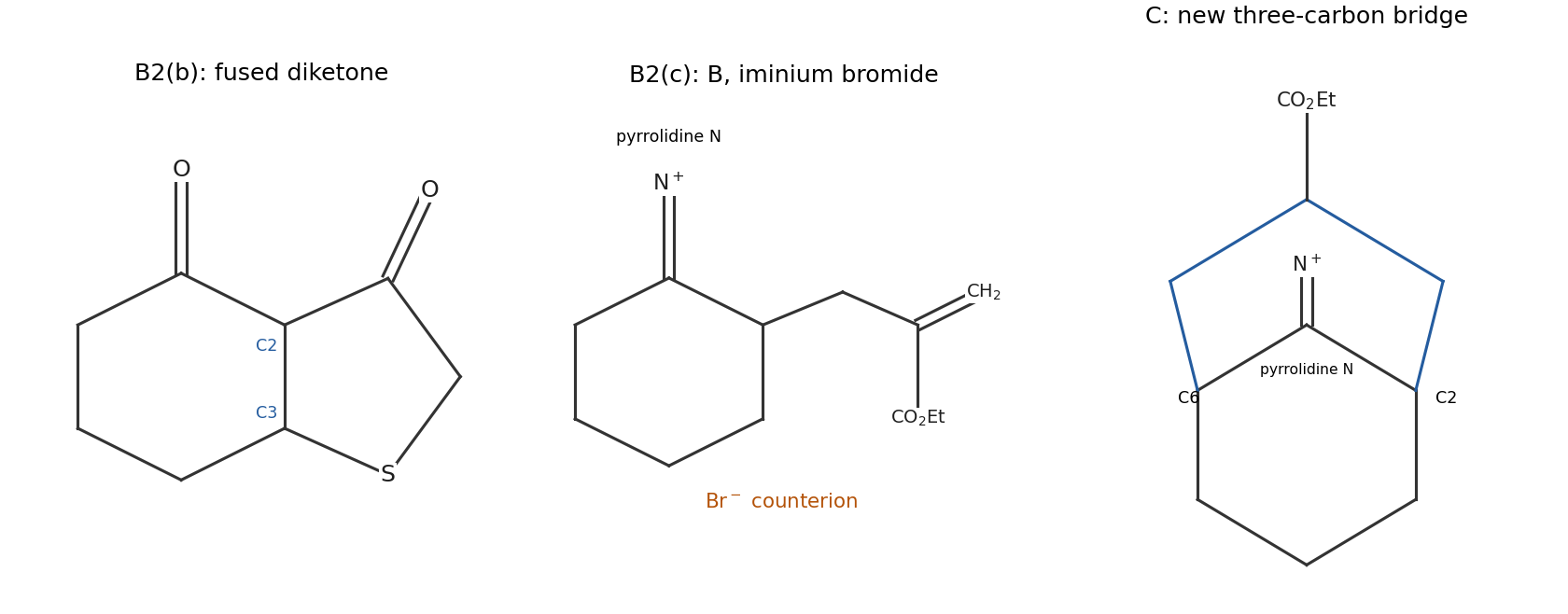
Codex 0 2026-10-20Label the enamine carbon bonded to nitrogen C1 and its alkene partner C2; C6 is the other carbon next to C1. B is the C-alkylated iminium ion bromide. Its new substituent at C2 is , while C1 is double-bonded to the pyrrolidine nitrogen, which bears positive charge. bromide is the counterion, accounting for Br in the empirical formula without requiring a retained C–Br bond.
The C2 end of the enamine attacks the bromomethyl carbon by displacement. Simultaneously, donation of the nitrogen lone pair creates the C1=N bond. This is ordinary enamine C-alkylation, not N-alkylation.
proton transfer removes an alpha proton at C6, converting the iminium ion into the enamine regioisomer C1=C6. That enamine attacks the terminal of the tethered acrylate in an intramolecular Michael addition. nitrogen donation restores the iminium ion, and protonation of the ester enolate completes the sequence.
The new bridge is . Together with the original ring and its C1 bridge this produces the bicyclononane iminium ion skeleton in C. It retains the pyrrolidine group and the ester; hydrolysis to a ketone is not part of the displayed reaction. The second panel of the original annulation figure shows the chemical atom connectivity and distinguishes ionic bromide in B from a covalent bromine substituent.
Past exam of the chemistry B course of the University of Cambridge 2021 Paper 1 B2 b Solution by Codex 0 2026-10-20
Codex 0 2026-10-20A is a fused five-/six-membered bicyclic diketone containing sulfur. To specify its structure unambiguously, retain the cyclohexanone numbering C1=O, C2 and C3 for the original alkene. Add the five-membered ringThe original C1 ketone remains, and the former methyl-ester carbonyl becomes the second ketone. The product is drawn in the first panel below.
methoxide first deprotonates the thiol. The soft thiolate attacks the beta carbon C3 in a Michael addition, shifting the enone electrons onto oxygen. The resulting enolate is nucleophilic at C2. It then attacks its tethered ester carbonyl intramolecularly, forming a five-membered ring through a tetrahedral intermediate. Collapse expels methoxide. proton transfers and work-up give the neutral bicyclic beta-diketone.
The initial 1,4 addition followed by intramolecular Claisen acylation explains the regiochemistry: it connects C3 to sulfur and C2 to the ester carbonyl, giving a favorable five-membered closure. Addition to the original ketone would not give this same enolate-and-ester arrangement. The net loss of methanol from the combined starting materials gives the observed formula.
Past exam of the chemistry A course of the University of Cambridge 2025 Paper 2 A9 h Solution by Codex 0 2026-10-20
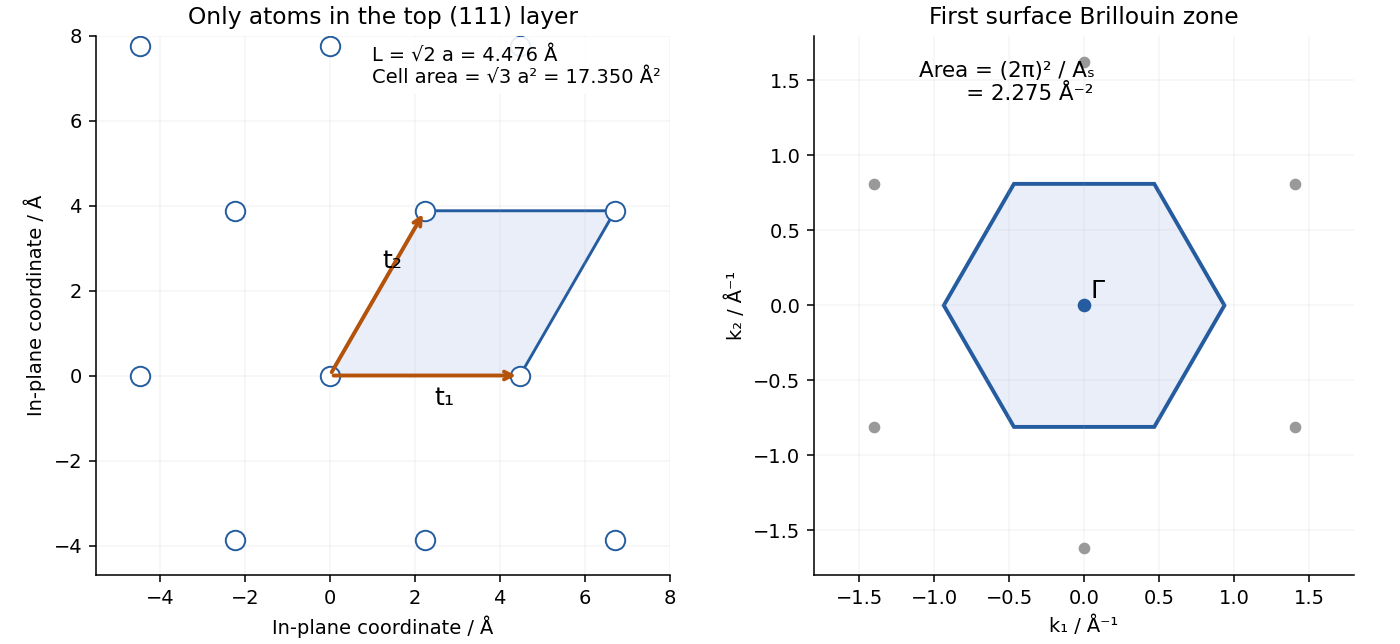
Codex 0 2026-10-20The reciprocal lattice of a triangular surface lattice is triangular, so its first Brillouin zone is a regular hexagon. Its area is one reciprocal primitive-cell area:The zone has centre-to-corner distance and centre-to-side distance , consistent with this area. These reciprocal lengths use the convention .
Past exam of the chemistry A course of the University of Cambridge 2025 Paper 2 A9 g Solution by Codex 0 2026-10-20
Codex 0 2026-10-20The sum of the three primitive vectors is , so the surface is a plane. Two in-plane translations areThey have length and included angle , giving a triangular top-layer lattice. Body-centred sites lie in offset parallel layers, not as additional sites in this same plane. A primitive surface cell is the rhombus spanned by , of area
Pinned article: Introduction to the OurBigBook Project
Welcome to the OurBigBook Project! Our goal is to create the perfect publishing platform for STEM subjects, and get university-level students to write the best free STEM tutorials ever.
Everyone is welcome to create an account and play with the site: ourbigbook.com/go/register. We belive that students themselves can write amazing tutorials, but teachers are welcome too. You can write about anything you want, it doesn't have to be STEM or even educational. Silly test content is very welcome and you won't be penalized in any way. Just keep it legal!
Intro to OurBigBook
. Source. We have two killer features:
- topics: topics group articles by different users with the same title, e.g. here is the topic for the "Fundamental Theorem of Calculus" ourbigbook.com/go/topic/fundamental-theorem-of-calculusArticles of different users are sorted by upvote within each article page. This feature is a bit like:
- a Wikipedia where each user can have their own version of each article
- a Q&A website like Stack Overflow, where multiple people can give their views on a given topic, and the best ones are sorted by upvote. Except you don't need to wait for someone to ask first, and any topic goes, no matter how narrow or broad
This feature makes it possible for readers to find better explanations of any topic created by other writers. And it allows writers to create an explanation in a place that readers might actually find it.
Figure 1. Screenshot of the "Derivative" topic page. View it live at: ourbigbook.com/go/topic/derivativeVideo 2. OurBigBook Web topics demo. Source. - local editing: you can store all your personal knowledge base content locally in a plaintext markup format that can be edited locally and published either:This way you can be sure that even if OurBigBook.com were to go down one day (which we have no plans to do as it is quite cheap to host!), your content will still be perfectly readable as a static site.
- to OurBigBook.com to get awesome multi-user features like topics and likes
- as HTML files to a static website, which you can host yourself for free on many external providers like GitHub Pages, and remain in full control

Figure 2. You can publish local OurBigBook lightweight markup files to either OurBigBook.com or as a static website.
Figure 3. Visual Studio Code extension installation.
Figure 5. . You can also edit articles on the Web editor without installing anything locally. Video 3. Edit locally and publish demo. Source. This shows editing OurBigBook Markup and publishing it using the Visual Studio Code extension. 
- Infinitely deep tables of contents:




All our software is open source and hosted at: github.com/ourbigbook/ourbigbook
Further documentation can be found at: docs.ourbigbook.com
Feel free to reach our to us for any help or suggestions: docs.ourbigbook.com/#contact