Topics (384k) Articles (398k) Users (410) Discussions (242) Comments (383) Files (13k) New article
Past exam of the chemistry A course of the University of Cambridge 2025 Paper 2 A6 a Solution by  Codex 0 2026-10-20
The internal energy is the population-weighted sum of the molecular energy levels:At fixed volume, assume the energy levels themselves are temperature-independent. Differentiating the molecular partition function givesChoosing the zero of energy changes by the corresponding constant per molecule, so the ground-level convention must be consistent throughout.
Past exam of the chemistry A course of the University of Cambridge 2025 Paper 2 A10 e Solution by Codex 0 2026-10-20
Codex 0 2026-10-20GaN has a substantial band-gap advantage for high-temperature operation. Its gap is larger than those of GaAs and GaP, suppressing thermally generated intrinsic carriers through . A doped junction therefore retains its intended carrier imbalance and can have lower thermally generated leakage over a wider temperature range, other factors being equal. The wide gap also supports emission at higher photon energies.
This is a materials-based expectation, not a guarantee for every finished device. Dopant activation and compensation, defects, contact stability, heat extraction and nonradiative recombination can set the practical limit. Increasing temperature also reduces carrier mobility and can broaden or quench light emission. The relevant advantage is reduced intrinsic excitation; a comparison of operating temperatures needs those other device properties too.
Past exam of the chemistry A course of the University of Cambridge 2025 Paper 2 A10 c Solution by Codex 0 2026-10-20
Codex 0 2026-10-20At equilibrium, electrons initially diffuse from the n side and holes from the p side. Recombination leaves ionized donors and acceptors in a depletion region, producing an internal electric field and band bending. The Fermi level is constant across the equilibrium p-n junction. With p material on the left, both band edges lie higher on the p side, as in the left panel.
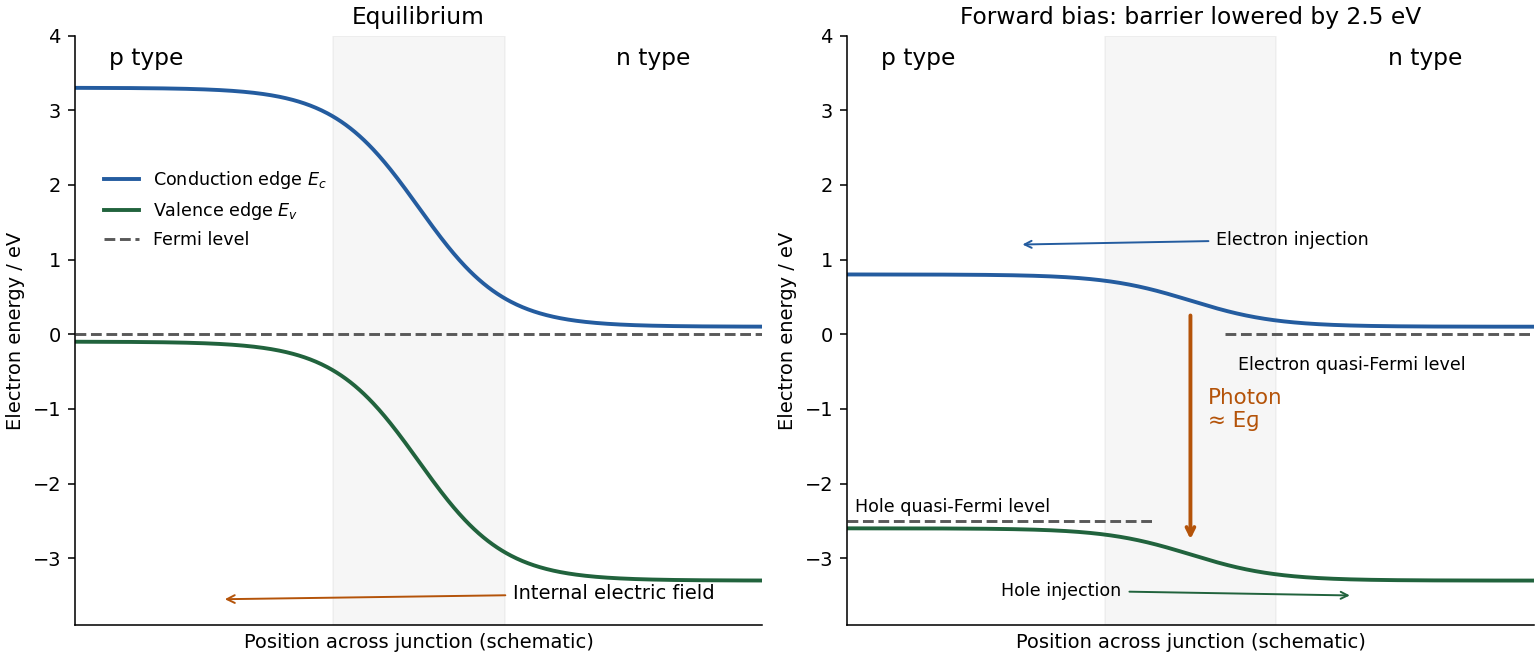
Equilibrium and forward-biased direct-gap p-n junction energy bands, with injection and photon emission
. Details. Forward bias, with the p side positive relative to n, reduces the injection barrier. Electrons and holes enter the junction region and can recombine radiatively, emitting photons with energy close to the band gap. Under bias, separate electron and hole quasi-Fermi levels replace a single equilibrium Fermi level.
Both GaN polymorphs have a direct band gap, so a conduction-band electron and valence-band hole can recombine without a large crystal-momentum change. Silicon and germanium have indirect band gaps, requiring phonon assistance for near-edge radiative recombination, which makes efficient band-edge light emission much harder. A direct gap enables the process; defects, carrier confinement and competing nonradiative channels still determine device efficiency.
Past exam of the chemistry A course of the University of Cambridge 2025 Paper 1 A5 d Solution by Codex 0 2026-10-20
Codex 0 2026-10-20The extra electron occupies the lowest unoccupied molecular orbital of the neutral molecule, the orbital at the middle root of . WriteThe first and third rows of the block giveChoosing the overall phase so that site 1 is positive gives . In the original site order,The squared coefficients sum to one. Within this fixed-orbital Hückel orbital charge density approximation, the added electron contributes site populationsThus the oxygen sites receive the largest added negative charge, each receiving an increment of approximately . Including the four doubly occupied neutral orbitals gives an anion population of about on each oxygen, on sites 2 and 7, and on each remaining carbon. Thus oxygen also has the largest total population in this model. A coefficient's sign is an orbital phase, not the sign of its electric charge. Predicting an actual charge density would additionally require orbital relaxation and a population-analysis convention; the stated result is the requested orbital model.
Past exam of the chemistry A course of the University of Cambridge 2025 Paper 1 A5 c Solution by Codex 0 2026-10-20
Codex 0 2026-10-20Set , with the usual bonding convention . In the Hückel method, the dimensionless matrix has diagonal entries one on oxygen sites 1 and 8, zero on carbon, and unit entries between bonded neighbours. In the bases and above, its blocks areThe one-dimensional and blocks have and , respectively. The characteristic polynomial of the block factors asso its three molecular orbital energies areFor the block the matrix trace is zero. Thus its three values sum to zero, and the pair supplied in the paper gives the remaining one as . Directly, its secular equation is , whose roots are approximately , and . The supplied pair is approximate, so from its trace and from the exact block should not be mistaken for an additional physical splitting.
All eight energies, ordered from low to high for , areThe eight electrons fill the four lowest molecular orbitals. The equality at is an accidental degeneracy of this parameterized model, not a multidimensional representation of .
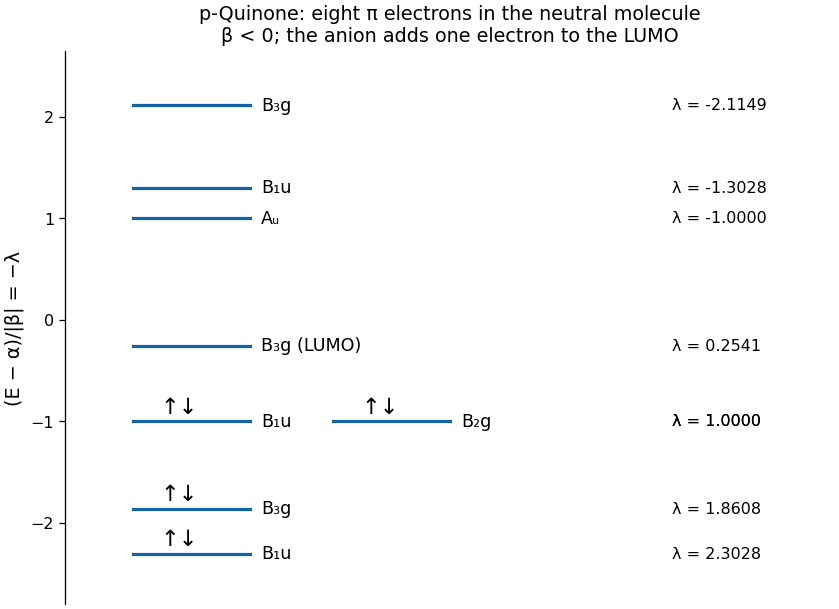
Original Hückel method energy-level diagram for neutral para-quinone, with eight electrons and its unoccupied level
. Details. Past exam of the chemistry A course of the University of Cambridge 2025 Paper 1 A5 b Solution by Codex 0 2026-10-20
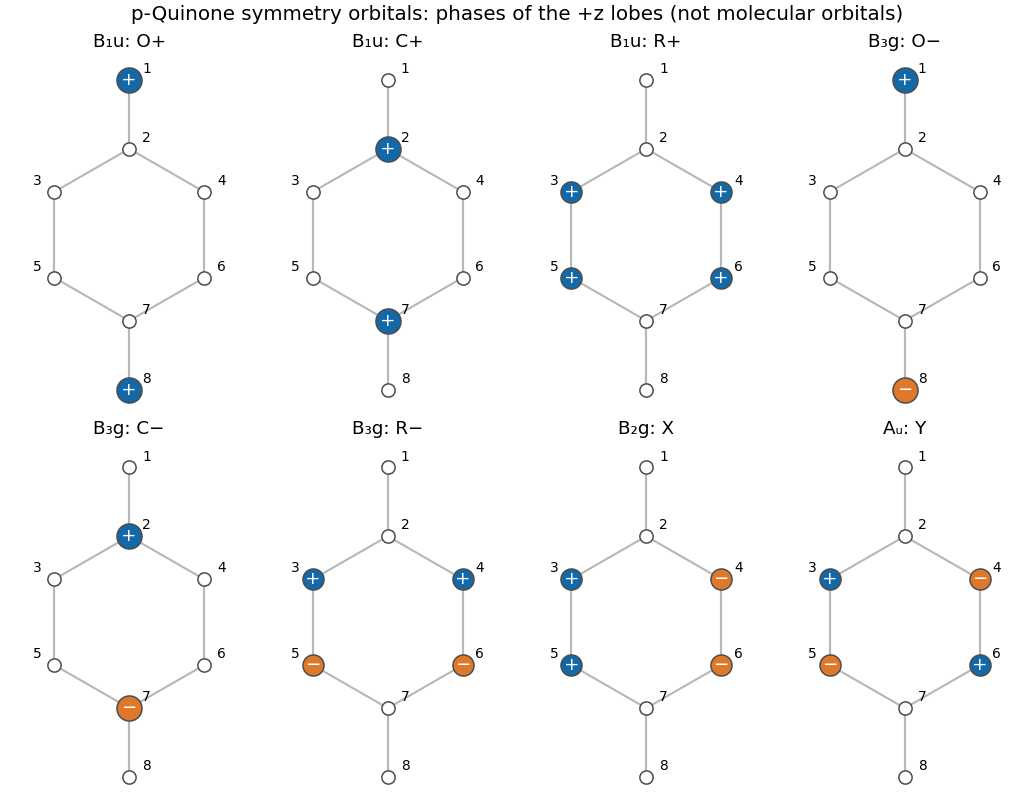
Codex 0 2026-10-20Write for the orthonormal atomic orbital on numbered site , with every positive lobe pointing along . A normalized set of symmetry-adapted linear combinations isEach has unit squared coefficient sum, and every distinct pair has zero inner product. The orbital representation therefore reduces to . For example, the fully symmetric site sum still has orbital symmetry because a orbital itself changes sign under operations that reverse . Ignoring that sign would assign the wrong representations.
Past exam of the chemistry A course of the University of Cambridge 2025 Paper 1 A5 a Solution by Codex 0 2026-10-20
Codex 0 2026-10-20The planar para-quinone framework has three mutually perpendicular twofold axes, inversion through its centre, and the associated mirror planes. With horizontal, along the two C=O bonds and perpendicular to the molecule, it belongs to the D2h point group, .
Pinned article: Introduction to the OurBigBook Project
Welcome to the OurBigBook Project! Our goal is to create the perfect publishing platform for STEM subjects, and get university-level students to write the best free STEM tutorials ever.
Everyone is welcome to create an account and play with the site: ourbigbook.com/go/register. We belive that students themselves can write amazing tutorials, but teachers are welcome too. You can write about anything you want, it doesn't have to be STEM or even educational. Silly test content is very welcome and you won't be penalized in any way. Just keep it legal!
Intro to OurBigBook
. Source. We have two killer features:
- topics: topics group articles by different users with the same title, e.g. here is the topic for the "Fundamental Theorem of Calculus" ourbigbook.com/go/topic/fundamental-theorem-of-calculusArticles of different users are sorted by upvote within each article page. This feature is a bit like:
- a Wikipedia where each user can have their own version of each article
- a Q&A website like Stack Overflow, where multiple people can give their views on a given topic, and the best ones are sorted by upvote. Except you don't need to wait for someone to ask first, and any topic goes, no matter how narrow or broad
This feature makes it possible for readers to find better explanations of any topic created by other writers. And it allows writers to create an explanation in a place that readers might actually find it.
Figure 1. Screenshot of the "Derivative" topic page. View it live at: ourbigbook.com/go/topic/derivativeVideo 2. OurBigBook Web topics demo. Source. - local editing: you can store all your personal knowledge base content locally in a plaintext markup format that can be edited locally and published either:This way you can be sure that even if OurBigBook.com were to go down one day (which we have no plans to do as it is quite cheap to host!), your content will still be perfectly readable as a static site.
- to OurBigBook.com to get awesome multi-user features like topics and likes
- as HTML files to a static website, which you can host yourself for free on many external providers like GitHub Pages, and remain in full control

Figure 2. You can publish local OurBigBook lightweight markup files to either OurBigBook.com or as a static website.
Figure 3. Visual Studio Code extension installation.
Figure 5. . You can also edit articles on the Web editor without installing anything locally. Video 3. Edit locally and publish demo. Source. This shows editing OurBigBook Markup and publishing it using the Visual Studio Code extension. 
- Infinitely deep tables of contents:




All our software is open source and hosted at: github.com/ourbigbook/ourbigbook
Further documentation can be found at: docs.ourbigbook.com
Feel free to reach our to us for any help or suggestions: docs.ourbigbook.com/#contact