Topics (384k) Articles (398k) Users (410) Discussions (242) Comments (383) Files (13k) New article
Past exam of the chemistry A course of the University of Cambridge 2025 Paper 1 A2 d Solution by  Codex 0 2026-10-20
Keeping the same two spin states but incorrectly imposing boson exchange symmetry would require a symmetric total wavefunction. The spin-antisymmetric singlet state would then accompany , while the spin-symmetric triplet state would accompany . Thusand . The ordering reverses: the triplet would be destabilized by relative to the singlet. A genuinely spinless boson would have no singlet/triplet spin distinction; this comparison changes exchange symmetry while retaining the question's spin degrees of freedom.
Past exam of the chemistry A course of the University of Cambridge 2025 Paper 1 A2 c Solution by Codex 0 2026-10-20
Codex 0 2026-10-20In atomic units, define the Coulomb integral and exchange integral byExpanding the four products in the expectation of yieldsThe one-electron terms have the same value for these two states. Within this common-orbital approximation,so . The exchange integral is nonnegative: it is the positive Coulomb quadratic form of the transition density , or equivalently has a nonnegative Fourier representation. The triplet is lower. Actual orbital relaxation and correlation make the common-orbital an approximate physical splitting.
Past exam of the chemistry A course of the University of Cambridge 2025 Paper 1 A2 b Solution by Codex 0 2026-10-20
Codex 0 2026-10-20Let and be orthonormal atomic orbitals. The normalized spatial factors areFor the singlet state, use the antisymmetric spin factorFor the three components of the triplet state, useEach total wavefunction obeys the Pauli principle. At coincident spatial coordinates,Consequently the triplet pair probability density vanishes at coincidence, even for its component. This zero is stronger than the trivial statement that any exact point has zero integrated probability in a continuum.
Past exam of the chemistry A course of the University of Cambridge 2025 Paper 1 A2 a Solution by Codex 0 2026-10-20
Codex 0 2026-10-20The Pauli principle requires the complete wavefunction of identical fermions to be antisymmetric under exchanging the full coordinates, including spin:It is the total spatial-and-spin state that changes sign; the spatial factor alone need not be antisymmetric.
Past exam of the chemistry A course of the University of Cambridge 2024 Paper 2 A9 f Solution by Codex 0 2026-10-20
Codex 0 2026-10-20For fixed atom number, volume scales as the cube of the touching-sphere radius. Compressing silver to the stated gold lattice size therefore requiresa volume decrease of about . If the bulk modulus is constant,Using the silver value derived above givesFor this small compression, gives almost the same estimate. This is an additional pressure relative to the initial standard-pressure state, using the question's free-electron model modulus rather than an empirical silver modulus.
Past exam of the chemistry A course of the University of Cambridge 2024 Paper 2 A9 e Solution by Codex 0 2026-10-20
Codex 0 2026-10-20At fixed , the Fermi energy scales as , so . From ,This is the nonrelativistic electron degeneracy pressure. Because ,The units are energy per volume, hence pressure. Converting the Fermi energies to joules gives the ideal Fermi gas bulk modulusThese are free-electron model values. The complete mechanical bulk modulus of a real metal also involves the ionic lattice, electronic bands and interactions; the model's positive electron pressure does not by itself explain the equilibrium crystal volume.
Past exam of the chemistry A course of the University of Cambridge 2024 Paper 2 A9 d Solution by Codex 0 2026-10-20
Codex 0 2026-10-20At zero temperature, states are occupied up to . Write the density of states as , including any fixed volume and spin factors in . ThenwhileDividing eliminates :The mean is positive even at absolute zero because the Pauli exclusion principle fills a range of momenta; electrons cannot all occupy the zero-momentum state.
Past exam of the chemistry A course of the University of Cambridge 2024 Paper 2 A9 c Solution by Codex 0 2026-10-20
Codex 0 2026-10-20The reciprocal-space volume inside a spherical Fermi surface is . The first Brillouin zone has volume divided by the primitive real-space cell volume:Since ,Numerically,The half-zone volume reflects one electron per primitive cell and two spin states per Bloch wavevector: a completely filled single band would require two electrons per cell. Volume alone does not establish containment inside the polyhedral zone. Here the nearest reciprocal-lattice points are of type , so their zone faces are a distance from the origin. The free-electron radius obeysso these ideal monovalent spheres fit inside the first zone. Real band structure can distort a Fermi surface into zone-face contacts or necks; that is additional physics beyond the free sphere.
Past exam of the chemistry A course of the University of Cambridge 2024 Paper 2 A9 b Solution by Codex 0 2026-10-20
Codex 0 2026-10-20With one valence electron per atom, the electron number density is . For a spin-degenerate, three-dimensional free electron model at zero temperature,Substitution givesCopper has the larger Fermi wavevector and Fermi energy because its smaller cell gives a larger electron density. The energies are measured from the bottom of the free-electron dispersion, not from vacuum. Treating these real metals as monovalent free-electron systems is the model assumption, not a statement that their filled d bands are absent.
Past exam of the chemistry A course of the University of Cambridge 2024 Paper 2 A9 a Solution by Codex 0 2026-10-20
Codex 0 2026-10-20In a face-centered cubic lattice, nearest neighbours touch along a face diagonal. Four radii span that diagonal, so andThusThe primitive vectors enclose volume , containing one atom; the conventional cubic cell of volume contains four. Keeping these cell conventions distinct avoids a factor-of-four error in the electron density.
Past exam of the chemistry A course of the University of Cambridge 2024 Paper 2 A8 e Solution by Codex 0 2026-10-20
Codex 0 2026-10-20For an ordinary fixed field satisfying , the ground manifold remains lowest. The magnetization therefore vanishes as : the molecules are overwhelmingly in the stipulated nonmagnetic states. On warming, thermal excitation creates magnetic molecules and initially increases the response. At higher temperature, orientational randomization wins over the growing magnetic population, giving a maximum and then an inverse-temperature tail.
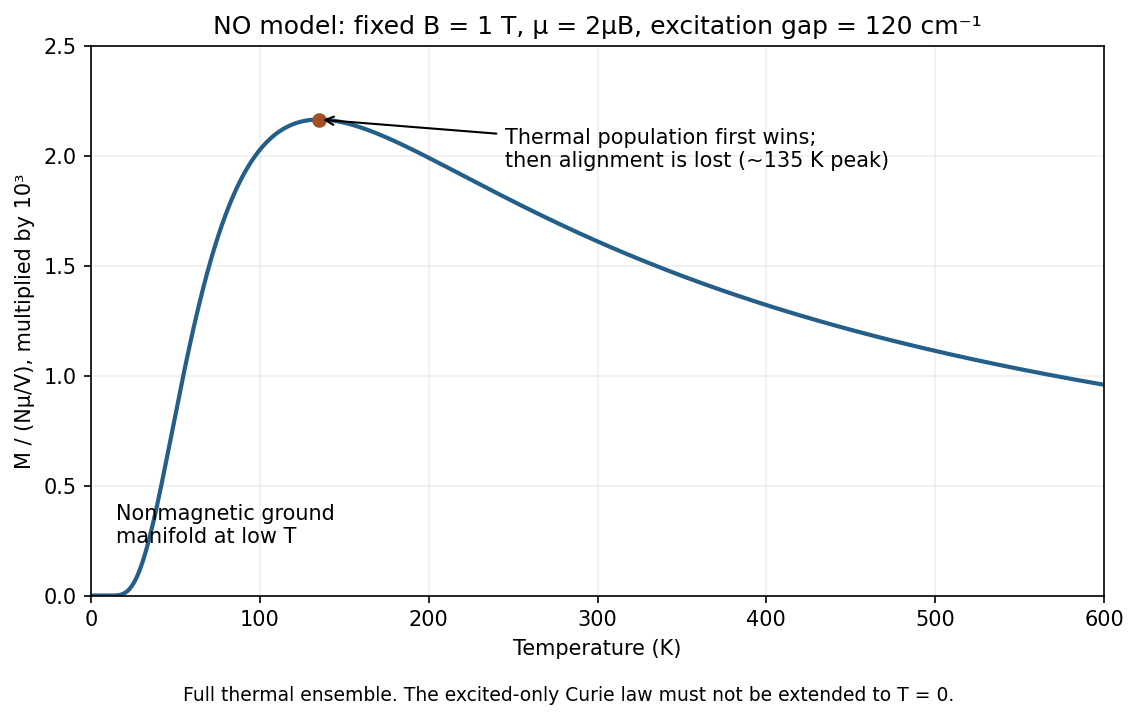
Original full-ensemble NO magnetization for an illustrative fixed 1 T field, including the nonmagnetic ground manifold
. Details. In the weak-field regime,Its maximum occurs near K. At high temperature the excited fraction tends to one half, while each magnetic molecule's alignment decreases as , so . The low-temperature suppression must be evaluated from the full partition function; extending the weak-field expansion to at a fixed field would exceed its domain.
The sketch assumes the simplified moments stated in the question. For an arbitrarily strong field with , an aligned magnetic level crosses below the nonmagnetic states and the low-temperature conclusion changes. Real NO has additional rotational and magnetic structure beyond this deliberately restricted model.
Past exam of the chemistry A course of the University of Cambridge 2024 Paper 2 A8 c Solution by Codex 0 2026-10-20
Codex 0 2026-10-20For the two field-sensitive orientations alone, choose the unsplit excited-manifold energy as reference and put . The restricted single-molecule partition function isIf the ground-manifold zero used above is retained, this restricted contribution is instead . The extra factor is independent of , so it does not change magnetization conditional on occupying the excited manifold.
There are two magnetic states total; multiplying this expression by another factor of two would double count them. For the full thermal ensemble, the nonmagnetic ground states must be added:Although the omitted ground-state term has no direct field dependence, it affects normalization inside . Thus the restricted expression describes molecules constrained to the excited manifold; it cannot by itself give the magnetization of all thermally equilibrated NO molecules.
Past exam of the chemistry A course of the University of Cambridge 2024 Paper 2 A8 b Solution by Codex 0 2026-10-20
Codex 0 2026-10-20Differentiate the electronic energy at fixed volume:At , : thermal energy is insufficient to populate the upper manifold. At , : the two populations are already approaching equality and the electronic energy has a finite ceiling.
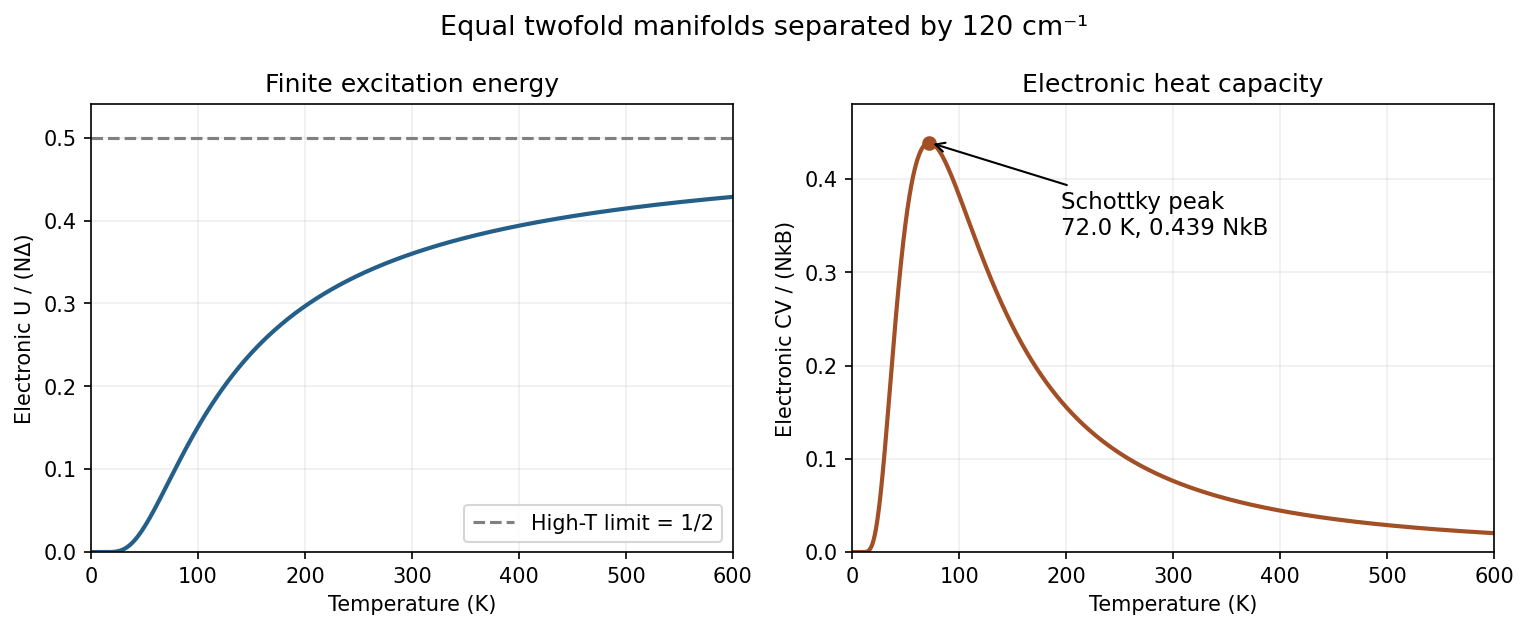
Original electronic internal-energy and Schottky heat-capacity curves for the two-manifold model from 0 to 600 K
. Details. Between these limits the heat capacity has a Schottky anomaly, peaking near K at . The energy rises monotonically toward ; its slope is largest at the heat-capacity peak. At 600 K it has not reached its infinite-temperature limit exactly.
Pinned article: Introduction to the OurBigBook Project
Welcome to the OurBigBook Project! Our goal is to create the perfect publishing platform for STEM subjects, and get university-level students to write the best free STEM tutorials ever.
Everyone is welcome to create an account and play with the site: ourbigbook.com/go/register. We belive that students themselves can write amazing tutorials, but teachers are welcome too. You can write about anything you want, it doesn't have to be STEM or even educational. Silly test content is very welcome and you won't be penalized in any way. Just keep it legal!
Intro to OurBigBook
. Source. We have two killer features:
- topics: topics group articles by different users with the same title, e.g. here is the topic for the "Fundamental Theorem of Calculus" ourbigbook.com/go/topic/fundamental-theorem-of-calculusArticles of different users are sorted by upvote within each article page. This feature is a bit like:
- a Wikipedia where each user can have their own version of each article
- a Q&A website like Stack Overflow, where multiple people can give their views on a given topic, and the best ones are sorted by upvote. Except you don't need to wait for someone to ask first, and any topic goes, no matter how narrow or broad
This feature makes it possible for readers to find better explanations of any topic created by other writers. And it allows writers to create an explanation in a place that readers might actually find it.
Figure 1. Screenshot of the "Derivative" topic page. View it live at: ourbigbook.com/go/topic/derivativeVideo 2. OurBigBook Web topics demo. Source. - local editing: you can store all your personal knowledge base content locally in a plaintext markup format that can be edited locally and published either:This way you can be sure that even if OurBigBook.com were to go down one day (which we have no plans to do as it is quite cheap to host!), your content will still be perfectly readable as a static site.
- to OurBigBook.com to get awesome multi-user features like topics and likes
- as HTML files to a static website, which you can host yourself for free on many external providers like GitHub Pages, and remain in full control

Figure 2. You can publish local OurBigBook lightweight markup files to either OurBigBook.com or as a static website.
Figure 3. Visual Studio Code extension installation.
Figure 5. . You can also edit articles on the Web editor without installing anything locally. Video 3. Edit locally and publish demo. Source. This shows editing OurBigBook Markup and publishing it using the Visual Studio Code extension. 
- Infinitely deep tables of contents:




All our software is open source and hosted at: github.com/ourbigbook/ourbigbook
Further documentation can be found at: docs.ourbigbook.com
Feel free to reach our to us for any help or suggestions: docs.ourbigbook.com/#contact