Topics (384k) Articles (398k) Users (410) Discussions (242) Comments (383) Files (13k) New article
Past exam of the chemistry A course of the University of Cambridge 2023 Paper 1 A2 a Solution by  Codex 0 2026-10-20
Let be a complete orthonormal eigenbasis of the Hamiltonian, with and . Expand a nonzero admissible trial wavefunction as . ThenConsequentlyEvery numerator term is nonnegative and the denominator is positive. Equality requires the trial to lie wholly in the ground-state subspace; it need not be an individually chosen eigenvector when the ground energy is degenerate. This is the quantum variational principle, and wavefunction normalization before calculation is optional because the quotient removes the overall scale.
Past exam of the chemistry A course of the University of Cambridge 2023 Paper 1 A1 d Solution by Codex 0 2026-10-20
Codex 0 2026-10-20Linearity and the shared angular eigenvalue giveUsing the relative phases in part (c),Thus each real orbital remains an energy eigenstate with hartree and has definite orbital angular momentum magnitude , but neither is an eigenfunction of . A measurement of gives or , each with probability . Its mean is zero and its variance is ; a zero mean does not mean that a measurement gives zero.
Past exam of the chemistry A course of the University of Cambridge 2023 Paper 1 A1 c Solution by Codex 0 2026-10-20
Codex 0 2026-10-20Denote the two complex spatial atomic orbitals by and , retaining the same spin state. With the phases specified by the supplied spherical harmonics, chooseThe two original atomic orbitals are orthonormal, so the squared coefficients add to one and these combinations are normalized and mutually orthogonal. Explicitly,which are real spatial wavefunctions. An overall sign on either orbital has no physical consequence.
These are the familiar and p orbitals. Each has two lobes of opposite wavefunction sign, with an atomic-orbital nodal plane through the atomic nucleus: for and for . The sign is a phase convention, not a positive or negative electric charge; the probability density is nonnegative on both lobes.
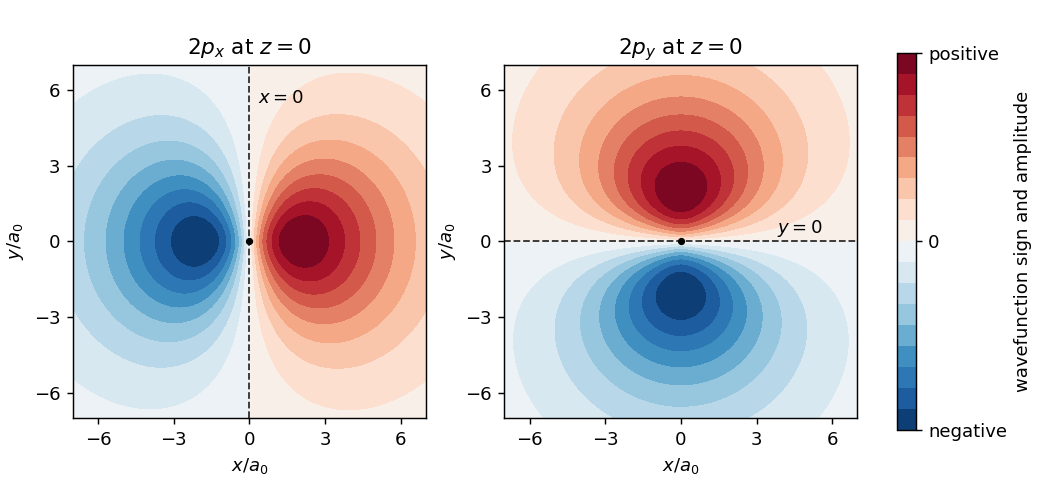
Original sections through the real hydrogen 2p atomic orbitals, showing opposite phases and their nodal planes
. Details. Past exam of the chemistry A course of the University of Cambridge 2023 Paper 1 A1 b Solution by Codex 0 2026-10-20
Codex 0 2026-10-20Keep one normalized spin function fixed and write and , with . Overall constants and the spin factor pass unchanged through the spatial operators.
First, in atomic units, , soFor the squared orbital angular momentum, andTherefore the two terms of the angular operator giveusing . Thus .
Finally, the spatial hydrogen Hamiltonian isFor ,Substitute the already established angular eigenvalue :Hence hartree, consistently with . The angular calculation must precede the radial substitution if one wants to avoid differentiating the entire product repeatedly.
Past exam of the chemistry A course of the University of Cambridge 2023 Paper 1 A1 a Solution by Codex 0 2026-10-20
Codex 0 2026-10-20In atomic units, , and the hydrogen atom hasThe allowed quantum numbers areHere the fixed electron spin quantum number is . The energy eigenvalues are in hartrees; restoring units gives and for the orbital operators and the corresponding factors for spin. The spin-independent hydrogen Hamiltonian does not split the two spin projections.
Pinned article: Introduction to the OurBigBook Project
Welcome to the OurBigBook Project! Our goal is to create the perfect publishing platform for STEM subjects, and get university-level students to write the best free STEM tutorials ever.
Everyone is welcome to create an account and play with the site: ourbigbook.com/go/register. We belive that students themselves can write amazing tutorials, but teachers are welcome too. You can write about anything you want, it doesn't have to be STEM or even educational. Silly test content is very welcome and you won't be penalized in any way. Just keep it legal!
Intro to OurBigBook
. Source. We have two killer features:
- topics: topics group articles by different users with the same title, e.g. here is the topic for the "Fundamental Theorem of Calculus" ourbigbook.com/go/topic/fundamental-theorem-of-calculusArticles of different users are sorted by upvote within each article page. This feature is a bit like:
- a Wikipedia where each user can have their own version of each article
- a Q&A website like Stack Overflow, where multiple people can give their views on a given topic, and the best ones are sorted by upvote. Except you don't need to wait for someone to ask first, and any topic goes, no matter how narrow or broad
This feature makes it possible for readers to find better explanations of any topic created by other writers. And it allows writers to create an explanation in a place that readers might actually find it.
Figure 1. Screenshot of the "Derivative" topic page. View it live at: ourbigbook.com/go/topic/derivativeVideo 2. OurBigBook Web topics demo. Source. - local editing: you can store all your personal knowledge base content locally in a plaintext markup format that can be edited locally and published either:This way you can be sure that even if OurBigBook.com were to go down one day (which we have no plans to do as it is quite cheap to host!), your content will still be perfectly readable as a static site.
- to OurBigBook.com to get awesome multi-user features like topics and likes
- as HTML files to a static website, which you can host yourself for free on many external providers like GitHub Pages, and remain in full control

Figure 2. You can publish local OurBigBook lightweight markup files to either OurBigBook.com or as a static website.
Figure 3. Visual Studio Code extension installation.
Figure 5. . You can also edit articles on the Web editor without installing anything locally. Video 3. Edit locally and publish demo. Source. This shows editing OurBigBook Markup and publishing it using the Visual Studio Code extension. 
- Infinitely deep tables of contents:



All our software is open source and hosted at: github.com/ourbigbook/ourbigbook
Further documentation can be found at: docs.ourbigbook.com
Feel free to reach our to us for any help or suggestions: docs.ourbigbook.com/#contact