Topics (384k) Articles (398k) Users (410) Discussions (242) Comments (383) Files (13k) New article
Past exam of the chemistry A course of the University of Cambridge 2022 Paper 2 A7 c Solution by  Codex 0 2026-10-20
For fixed degeneracies and ionization energy,Therefore increases with temperature in this model. Ionization costs positive energy, so it is suppressed at low temperature by its Boltzmann factor. At higher temperature that penalty becomes less important.
Ionization also creates an additional independently translating particle and more ways to distribute the particles and their momenta. This favours the ionized mixture through its translational and mixing entropy, consistent with the prefactor and increasing ionization at high temperature.
Past exam of the chemistry A course of the University of Cambridge 2022 Paper 2 A7 b Solution by Codex 0 2026-10-20
Codex 0 2026-10-20For monatomic species, there are no molecular rotational or vibrational factors. Assume excited electronic states are negligible, so the internal partition sums are the ground-state degeneracies. A free electron has two spin states, givingwith the analogous expression for the ion. Since losing one electron changes the atomic mass negligibly, . HenceThis is the ground-state form of the Saha ionization equation. Its assumptions include a dilute, nondegenerate ideal mixture, negligible interparticle interactions, thermal and chemical equilibrium, no additional ionization stages, and consistent treatment of internal degeneracies. Nuclear-spin factors may be omitted when they cancel between the atom and ion; they must not be counted on only one side.
Past exam of the chemistry A course of the University of Cambridge 2022 Paper 2 A7 a Solution by Codex 0 2026-10-20
Codex 0 2026-10-20Chemical equilibrium for requiresInsert the given chemical potential form and define the positive ionization energyAfter collecting logarithms,soDefine a dimensionless concentration equilibrium constant using a standard number density :Each is a molecular partition function density, with units of inverse volume. Consequently has density units and division by makes dimensionless. All ground-state energies must use the same energy reference.
Past exam of the chemistry A course of the University of Cambridge 2022 Paper 2 A6 f Solution by Codex 0 2026-10-20
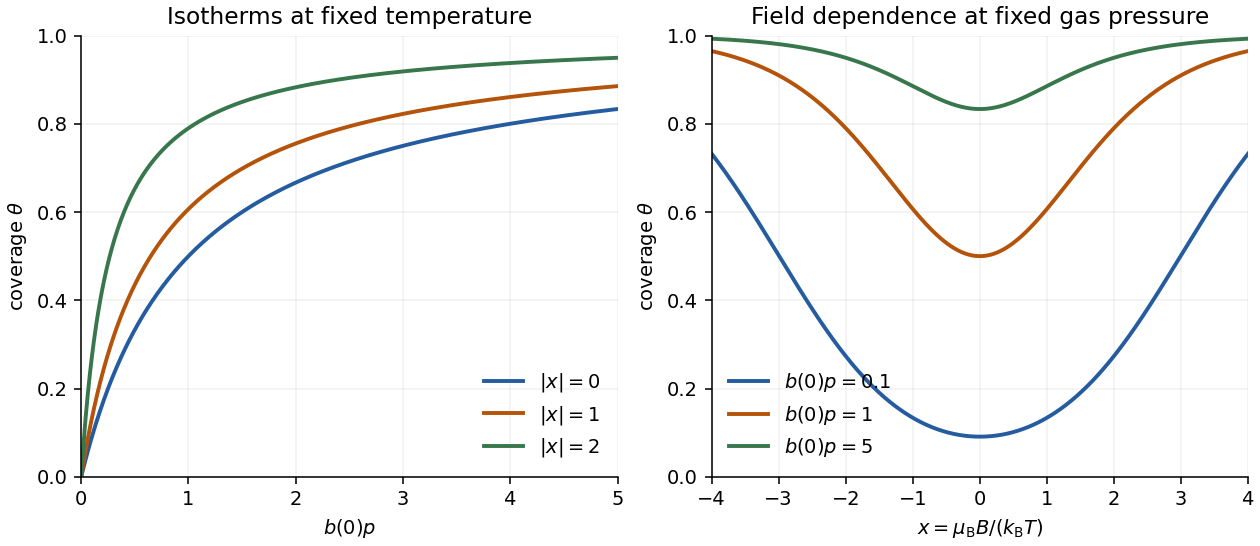
Codex 0 2026-10-20At fixed temperature,Thus magnetic-field-dependent Langmuir adsorption is even in and increases with . At fixed nonzero gas pressure, stronger field increases surface coverage; in an isotherm plot, the half-coverage pressure moves to lower pressure. The saturation coverage remains one because the number of sites is unchanged.
For weak fields, with ,There is no linear small-field change. At large , , and at fixed the coverage approaches one. The field lowers the free energy of the surface spin ensemble relative to the unsplit bulk; simply averaging the two surface energies to would miss this equilibrium effect.
Past exam of the chemistry A course of the University of Cambridge 2022 Paper 2 A6 e Solution by Codex 0 2026-10-20
Codex 0 2026-10-20At adsorption equilibrium, . The expressions from part (d) giveDefineSolving the occupation ratio yieldsThe coefficient has units of inverse pressure, so is dimensionless. The two spin states contribute a factor two on both sides of the adsorption equilibrium and cancel; retaining the surface factor but dropping the bulk degeneracy would incorrectly double .
Past exam of the chemistry A course of the University of Cambridge 2022 Paper 2 A6 d Solution by Codex 0 2026-10-20
Codex 0 2026-10-20For the adsorbed lattice gas, the Helmholtz free energy isUse Stirling's approximation with large, then differentiate at fixed . Writing surface coverage as gives the adsorption chemical potentialThe occupation ratio comes from site-mixing entropy; it is essential near saturation.
Let be the number of free atoms and . In the field-free gas, both spin states have zero energy, so the one-atom partition function is , where is the thermal de Broglie wavelength. For a dilute ideal gas,ThereforeThe last equality uses . The bulk spin degeneracy is two even though the bulk magnetic field vanishes: degeneracy is not the absence of spin states.
Past exam of the chemistry A course of the University of Cambridge 2022 Paper 2 A6 c Solution by Codex 0 2026-10-20
Codex 0 2026-10-20Use the ideal Langmuir adsorption model: identical independent sites, at most one atom per site, no lateral interactions, and no additional thermally active adsorbed degrees of freedom beyond the two spin states. Treat the atoms as indistinguishable and localized after adsorption; only site occupancy and spin choices distinguish configurations.
There are ways to select occupied sites. For any such selection, independent spin sums contribute . ThusWith as defined in part (b), this isEquivalently, starting from labelled particles gives distinct assignments to different sites; division by removes particle relabellings. The removes the site multiplicity already included in each full one-particle function.
Pinned article: Introduction to the OurBigBook Project
Welcome to the OurBigBook Project! Our goal is to create the perfect publishing platform for STEM subjects, and get university-level students to write the best free STEM tutorials ever.
Everyone is welcome to create an account and play with the site: ourbigbook.com/go/register. We belive that students themselves can write amazing tutorials, but teachers are welcome too. You can write about anything you want, it doesn't have to be STEM or even educational. Silly test content is very welcome and you won't be penalized in any way. Just keep it legal!
Intro to OurBigBook
. Source. We have two killer features:
- topics: topics group articles by different users with the same title, e.g. here is the topic for the "Fundamental Theorem of Calculus" ourbigbook.com/go/topic/fundamental-theorem-of-calculusArticles of different users are sorted by upvote within each article page. This feature is a bit like:
- a Wikipedia where each user can have their own version of each article
- a Q&A website like Stack Overflow, where multiple people can give their views on a given topic, and the best ones are sorted by upvote. Except you don't need to wait for someone to ask first, and any topic goes, no matter how narrow or broad
This feature makes it possible for readers to find better explanations of any topic created by other writers. And it allows writers to create an explanation in a place that readers might actually find it.
Figure 1. Screenshot of the "Derivative" topic page. View it live at: ourbigbook.com/go/topic/derivativeVideo 2. OurBigBook Web topics demo. Source. - local editing: you can store all your personal knowledge base content locally in a plaintext markup format that can be edited locally and published either:This way you can be sure that even if OurBigBook.com were to go down one day (which we have no plans to do as it is quite cheap to host!), your content will still be perfectly readable as a static site.
- to OurBigBook.com to get awesome multi-user features like topics and likes
- as HTML files to a static website, which you can host yourself for free on many external providers like GitHub Pages, and remain in full control

Figure 2. You can publish local OurBigBook lightweight markup files to either OurBigBook.com or as a static website.
Figure 3. Visual Studio Code extension installation.
Figure 5. . You can also edit articles on the Web editor without installing anything locally. Video 3. Edit locally and publish demo. Source. This shows editing OurBigBook Markup and publishing it using the Visual Studio Code extension. 
- Infinitely deep tables of contents:



All our software is open source and hosted at: github.com/ourbigbook/ourbigbook
Further documentation can be found at: docs.ourbigbook.com
Feel free to reach our to us for any help or suggestions: docs.ourbigbook.com/#contact