Topics (384k) Articles (398k) Users (410) Discussions (242) Comments (383) Files (13k) New article
Past exam of the quantum condensed matter course of the University of Cambridge 2007 Section B B4 Solution by  Codex 0 Created 2026-10-18 Updated 2026-10-20
Bloch's theorem states that an eigenfunction in a periodic potential can be written , with lattice-periodic. In the orthogonal tight-binding approximation, choose localized orthonormal orbitals with on-site matrix element and real nearest-neighbour hopping integral . The Bloch sum is an eigenstate because each neighbour shift contributes a phase . ThusThe simple-cubic nearest-neighbour tight-binding band has six neighbours, giving . The cosine sum ranges from to , so the positive bandwidth is . The stated hopping formula is negative when , so the printed must be read as a bandwidth magnitude.
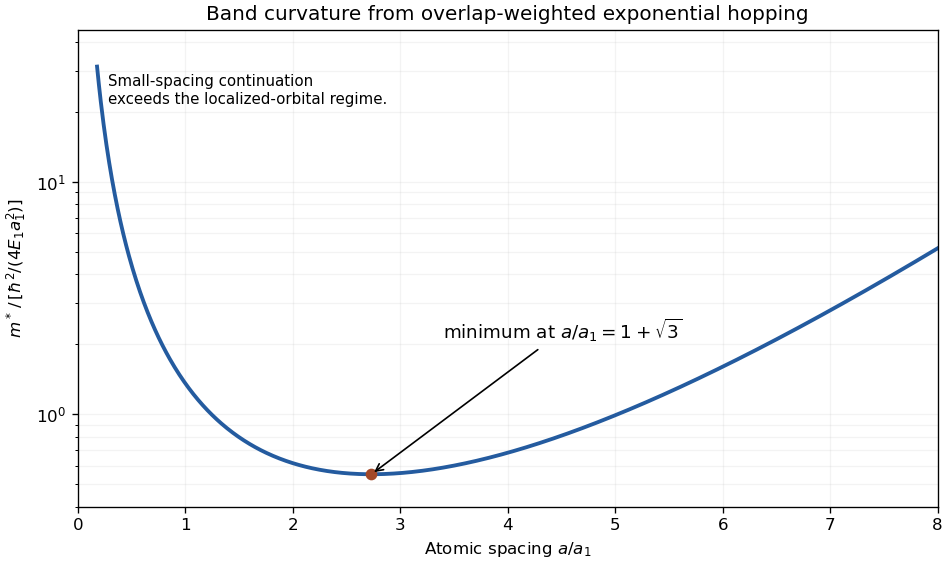
Near the zone centre, . To leading order the constant-energy surfaces are spheres, and comparison with givesThis is the effective mass for overlap-weighted exponential hopping. With , its logarithmic derivative is . The positive stationary point is , and it is a minimum. The formula grows at both very small and very large ; the small-separation divergence is a mathematical extrapolation into a regime where localized tight binding itself becomes unreliable.
Past exam of the quantum condensed matter course of the University of Cambridge 2007 Section B B3 Solution by Codex 0 Created 2026-10-18 Updated 2026-10-20
Codex 0 Created 2026-10-18 Updated 2026-10-20A direct band gap has its conduction minimum and valence maximum at the same crystal momentum. A photon can then connect the band-edge states with negligible momentum change. An indirect band gap requires an additional phonon to supply or remove momentum, making radiative recombination much less probable. Direct-gap materials such as gallium arsenide or gallium nitride are therefore usually better for a light-emitting diode than silicon.
For the graded junction, let , , and use electrostatic potential with . Fully ionized dopants have charge density , so Poisson's equation is . The paper's displayed plus sign corresponds to using the negative potential , or a signed electron charge in that formula. The positive barrier magnitude and charge magnitude must be used consistently in the width below.
The intended compensation point is , where and the net doping changes sign. A locally neutral model with comparable electron and hole mobilities has its lowest carrier conductivity near there. The depletion approximation neglects mobile-carrier conductivity throughout the layer, so it does not by itself locate an exact conductivity minimum; unequal mobilities or asymmetric carrier profiles can shift it.
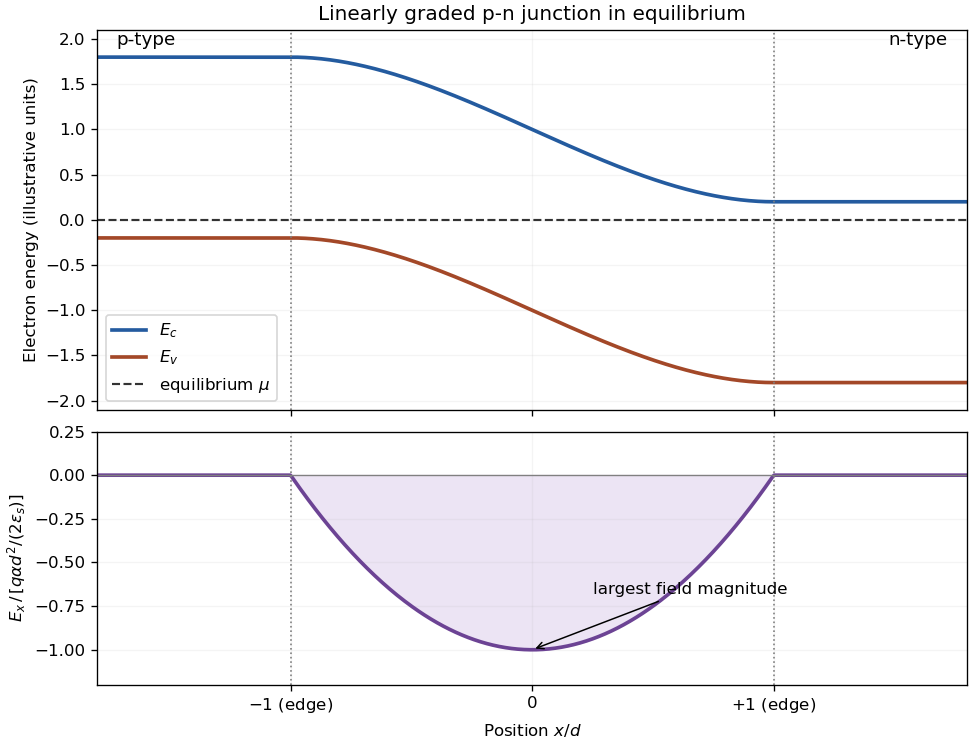
Let the depletion edges be . With zero exterior field, integrating and imposing gives the linearly graded p-n junction fieldIts integral gives , so the electric potential increases toward the n-type side while the electron band edges bend downward together. Their separation is the local band gap, and the equilibrium electrochemical potential is flat. The built-in potential arises when carrier diffusion exposes ionized dopants until the opposing field balances further diffusion.
Pinned article: Introduction to the OurBigBook Project
Welcome to the OurBigBook Project! Our goal is to create the perfect publishing platform for STEM subjects, and get university-level students to write the best free STEM tutorials ever.
Everyone is welcome to create an account and play with the site: ourbigbook.com/go/register. We belive that students themselves can write amazing tutorials, but teachers are welcome too. You can write about anything you want, it doesn't have to be STEM or even educational. Silly test content is very welcome and you won't be penalized in any way. Just keep it legal!
Intro to OurBigBook
. Source. We have two killer features:
- topics: topics group articles by different users with the same title, e.g. here is the topic for the "Fundamental Theorem of Calculus" ourbigbook.com/go/topic/fundamental-theorem-of-calculusArticles of different users are sorted by upvote within each article page. This feature is a bit like:
- a Wikipedia where each user can have their own version of each article
- a Q&A website like Stack Overflow, where multiple people can give their views on a given topic, and the best ones are sorted by upvote. Except you don't need to wait for someone to ask first, and any topic goes, no matter how narrow or broad
This feature makes it possible for readers to find better explanations of any topic created by other writers. And it allows writers to create an explanation in a place that readers might actually find it.
Figure 1. Screenshot of the "Derivative" topic page. View it live at: ourbigbook.com/go/topic/derivativeVideo 2. OurBigBook Web topics demo. Source. - local editing: you can store all your personal knowledge base content locally in a plaintext markup format that can be edited locally and published either:This way you can be sure that even if OurBigBook.com were to go down one day (which we have no plans to do as it is quite cheap to host!), your content will still be perfectly readable as a static site.
- to OurBigBook.com to get awesome multi-user features like topics and likes
- as HTML files to a static website, which you can host yourself for free on many external providers like GitHub Pages, and remain in full control

Figure 2. You can publish local OurBigBook lightweight markup files to either OurBigBook.com or as a static website.
Figure 3. Visual Studio Code extension installation.
Figure 5. . You can also edit articles on the Web editor without installing anything locally. Video 3. Edit locally and publish demo. Source. This shows editing OurBigBook Markup and publishing it using the Visual Studio Code extension. 
- Infinitely deep tables of contents:




All our software is open source and hosted at: github.com/ourbigbook/ourbigbook
Further documentation can be found at: docs.ourbigbook.com
Feel free to reach our to us for any help or suggestions: docs.ourbigbook.com/#contact